

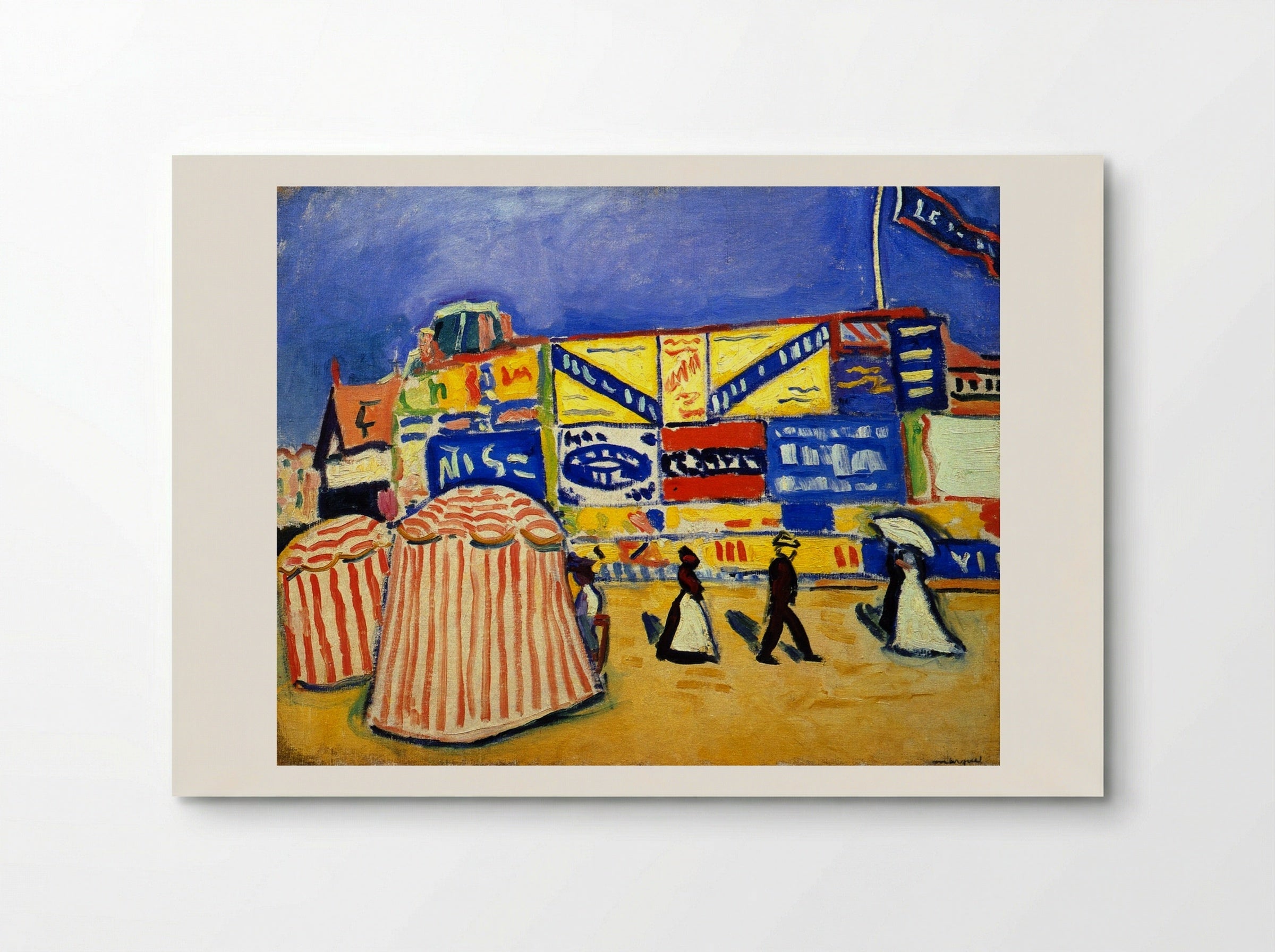
Posters at Trouville - Albert Marquet
Archival giclée
Frames arrive ready to hang
Secure checkout
Made to order
Description
A 1906 Fauvist oil painting by Albert Marquet, capturing the bright colours and graphic signage of the beach at Trouville.
Albert Marquet painted Posters at Trouville in 1906, a period when his association with the Fauvist movement encouraged a departure from traditional colour palettes. The work depicts a seaside scene in the Normandy town of Trouville, focusing on the graphic quality of advertising hoardings that dominated the beach front. Marquet employs a simplified visual language, using bold blocks of primary colours to define the space. The sky is rendered in a flat, uniform blue, while the beach is a warm, sandy tone that contrasts with the stark white of the striped bathing tents in the foreground. Figures are reduced to silhouettes, moving across the frame with a sense of casual observation. Marquet avoids excessive detail, preferring to capture the atmosphere of a summer day through the arrangement of shapes and the interplay of light and shadow. The shadows cast by the pedestrians are sharp and dark, suggesting the bright, direct sun of the coast. The composition is structured by the horizontal bands of the posters, which create a rhythmic pattern across the upper half of the canvas. This work demonstrates Marquet's ability to synthesise complex urban environments into clear, readable forms. Unlike some of his contemporaries who pushed Fauvism toward abstraction, Marquet maintained a connection to the observable world. His approach here is one of detached observation, documenting the leisure activities of the early twentieth century with a focus on the visual impact of modern signage against the natural setting of the beach. The painting remains a clear example of his interest in the relationship between human activity and the built environment, captured with a direct and economical application of paint.
Return policy
Because every print is made to order, we don't offer change-of-mind returns, refunds or exchanges. If your order arrives faulty, damaged or incorrect, we'll replace it free of charge — just contact us within 48 hours of delivery. See our refunds page for full details.
Shipping
We ship worldwide, printing at the production hub nearest to your delivery address. Delivery times and costs vary by destination — you'll see the options available to you at checkout.
Manufacturing
Each print is produced to order using 12-colour giclée printing on FSC-certified archival paper. Designed in Britain and printed at your nearest production hub to reduce waste and speed up delivery.
Posters at Trouville - Albert Marquet

Artist Biography
Albert Marquet
Marquet was born in Bordeaux on 27 March 1875, the son of a railway clerk. His mother moved the family to Paris to support his artistic education, and he enrolled at the Ecole des Arts Décoratifs in 1890, where he met Henri Matisse; the friendship lasted the rest of his life. The two painters shared studios and worked side by side for years, but their mature styles could scarcely be more different. Where Matisse reached for triumphant colour, Marquet worked with grey haze, snow light, and the tonal restraint of an elevated viewpoint over water.
His approach is visible in "The Beach at Fécamp" (1906, 51 x 61 cm, Musée National d'Art Moderne, Paris): the beach runs diagonally, figures and boats reduced to laconic dark brushstrokes, with only two sailors' blue collars and a red flag providing any colour accent. Similar economy governs the Paris quai paintings in the State Hermitage: "Rainy Day. Notre Dame de Paris" (1910, 81 x 66 cm) and "Louvre Embankment and the New Bridge" (1906, 60 x 73 cm), where cold grey mist substitutes for the chromatic intensity his contemporaries were deploying elsewhere.
He continued working until days before his death. Returning from an operation on 31 January 1947, he immediately picked up his brush to capture falling snow from his apartment window at 1 Rue Dauphine, Paris. He died there on 14 June 1947.
Our Features
Designed for Lasting Impact
Specific Features
Every Solis piece is made to order with archival, gallery-quality materials built to last.
- Museum-grade giclée printing for rich, fade-resistant colour
- Archival matte fine-art paper, FSC-certified
- Multiple sizes and framing options available
- Frames in black, natural wood, dark wood or white
- Framed prints arrive ready to hang
Care & Cleaning
To keep your artwork looking its best:
- Dust gently with a soft, dry cloth
- Avoid prolonged direct sunlight
- Never use liquid cleaners on the print or canvas surface
- Keep in a dry, room-temperature space
- Handle prints with clean, dry hands
Materials & Sizing
Museum-grade giclée on FSC-certified archival matte paper, with framed and canvas options.
- Paper sizes: A4, A3, A2, A1, A0 and B2 (50×70 cm)
- Canvas: XS (20×30 cm) to Large (60×90 cm)
- Frames: black, natural wood, dark wood or white
Why Choose Us ?
Damage-free delivery guarantee
Fast Shipping
Museum-Quality Materials
Artist Biography
Albert Marquet
Marquet was born in Bordeaux on 27 March 1875, the son of a railway clerk. His mother moved the family to Paris to support his artistic education, and he enrolled at the Ecole des Arts Décoratifs in 1890, where he met Henri Matisse; the friendship lasted the rest of his life. The two painters shared studios and worked side by side for years, but their mature styles could scarcely be more different. Where Matisse reached for triumphant colour, Marquet worked with grey haze, snow light, and the tonal restraint of an elevated viewpoint over water.
His approach is visible in "The Beach at Fécamp" (1906, 51 x 61 cm, Musée National d'Art Moderne, Paris): the beach runs diagonally, figures and boats reduced to laconic dark brushstrokes, with only two sailors' blue collars and a red flag providing any colour accent. Similar economy governs the Paris quai paintings in the State Hermitage: "Rainy Day. Notre Dame de Paris" (1910, 81 x 66 cm) and "Louvre Embankment and the New Bridge" (1906, 60 x 73 cm), where cold grey mist substitutes for the chromatic intensity his contemporaries were deploying elsewhere.
He continued working until days before his death. Returning from an operation on 31 January 1947, he immediately picked up his brush to capture falling snow from his apartment window at 1 Rue Dauphine, Paris. He died there on 14 June 1947.
You May Also Like