

Rhinocerotic Gooseflesh - Salvador Dalí
Archival giclée
Frames arrive ready to hang
Secure checkout
Made to order
Description
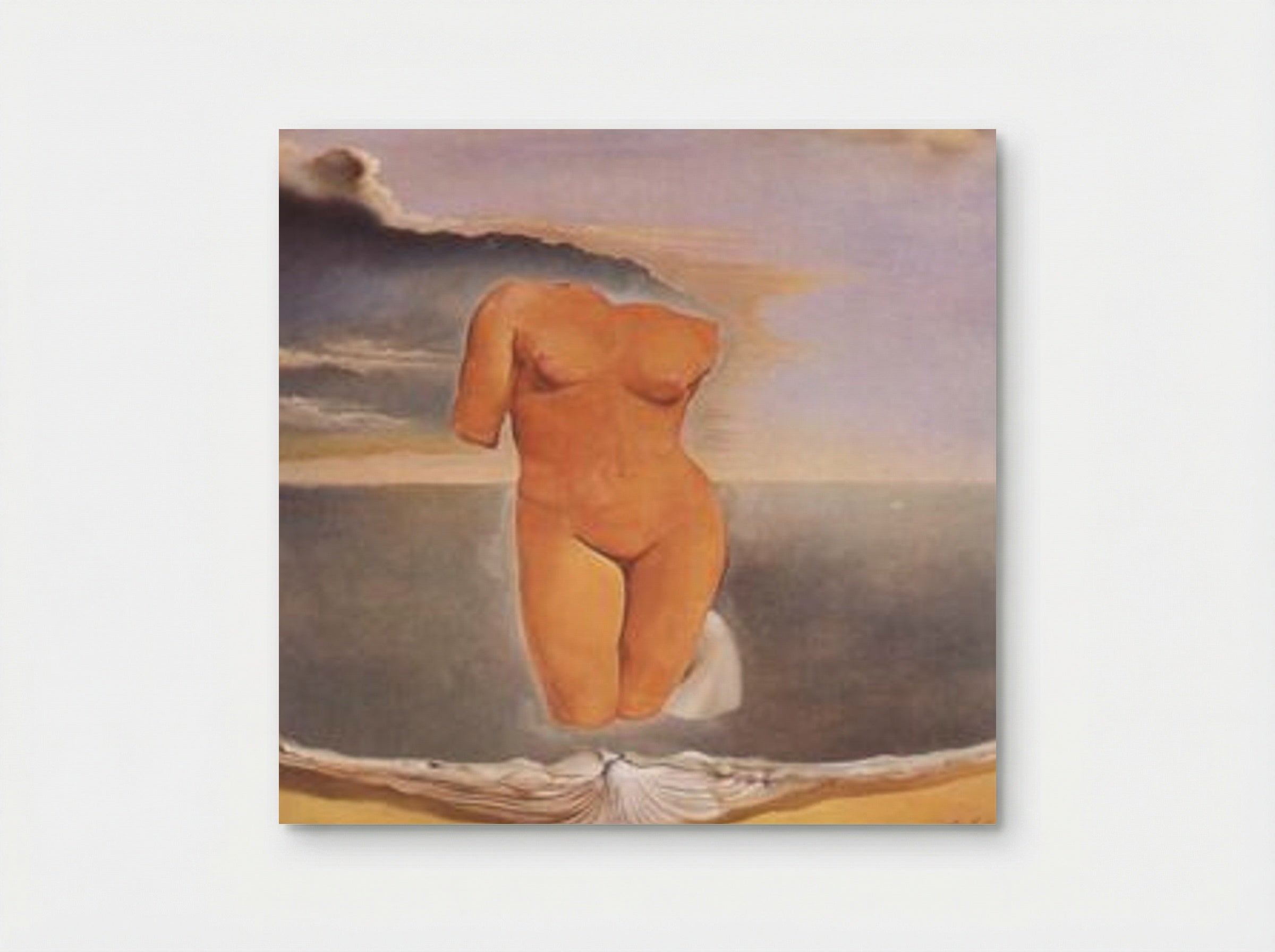
A surrealist composition by Salvador Dalí featuring a truncated female torso set against a vast, atmospheric horizon.
Salvador Dalí painted Rhinocerotic Gooseflesh in 1956, a period during which he became increasingly preoccupied with the geometry of the rhinoceros horn. This work presents a truncated female torso, rendered with a smooth, academic finish that contrasts with the dreamlike, atmospheric environment surrounding it. The figure appears to emerge from a shell-like structure at the base, set against a horizon line that separates a muted, hazy sky from a calm expanse of water. Dalí often utilised the rhinoceros horn as a symbol of logarithmic perfection, a concept he explored through his interest in mathematics and natural forms. In this composition, the juxtaposition of the human form with the rigid, organic curves of the shell and the vast, empty horizon creates a sense of displacement. The title itself, Rhinocerotic Gooseflesh, suggests a tactile, visceral reaction to the subject matter, typical of the artist's attempt to externalise internal psychological states. The lighting is soft and diffused, lending the torso a sculptural quality that mimics classical marble statuary, yet the placement of the figure within this desolate, non-specific space denies any traditional narrative context. By isolating the torso, Dalí focuses the viewer's attention on the physical form as an object of contemplation. The lack of limbs or head removes the possibility of human interaction, leaving only the presence of the body itself. The muted colour palette, dominated by ochre, soft pinks, and greyish blues, reinforces the quiet, almost melancholic atmosphere of the scene. This piece demonstrates the artist's technical precision and his ability to construct images that feel both familiar and entirely alien, inviting the viewer to engage with the visual paradoxes he constructed throughout his career.
Return policy
Because every print is made to order, we don't offer change-of-mind returns, refunds or exchanges. If your order arrives faulty, damaged or incorrect, we'll replace it free of charge — just contact us within 48 hours of delivery. See our refunds page for full details.
Shipping
We ship worldwide, printing at the production hub nearest to your delivery address. Delivery times and costs vary by destination — you'll see the options available to you at checkout.
Manufacturing
Each print is produced to order using 12-colour giclée printing on FSC-certified archival paper. Designed in Britain and printed at your nearest production hub to reduce waste and speed up delivery.
Care and materials
Specific Features
Every Solis piece is made to order with archival, gallery-quality materials built to last.
- Museum-grade giclée printing for rich, fade-resistant colour
- Archival matte fine-art paper, FSC-certified
- Multiple sizes and framing options available
- Frames in black, natural wood, dark wood or white
- Framed prints arrive ready to hang
Care & Cleaning
To keep your artwork looking its best:
- Dust gently with a soft, dry cloth
- Avoid prolonged direct sunlight
- Never use liquid cleaners on the print or canvas surface
- Keep in a dry, room-temperature space
- Handle prints with clean, dry hands
Materials & Sizing
Museum-grade giclée on FSC-certified archival matte paper, with framed and canvas options.
- Paper sizes: A4, A3, A2, A1, A0 and B2 (50×70 cm)
- Canvas: XS (20×30 cm) to Large (60×90 cm)
- Frames: black, natural wood, dark wood or white
Rhinocerotic Gooseflesh - Salvador Dalí

Artist Biography
Salvador Dali
He entered the Royal Academy of Fine Arts in Madrid at seventeen and was expelled twice. The first time for inciting a student riot. The second time, in 1926, for announcing that none of the faculty were competent to examine him. While in Madrid he read Freud's The Interpretation of Dreams and later called it one of the most important discoveries of his life. He began inducing hallucinatory states through a method he called 'paranoiac-critical': staring at objects until they transformed into something else, then painting what he saw.
The Persistence of Memory, the one with the melting clocks, was painted in 1931. He was twenty-seven. The clocks were not, as commonly assumed, a reference to Einstein. Dali said they were inspired by Camembert cheese melting in the sun. He joined the Surrealists in Paris but was eventually expelled by Andre Breton (Dali attracted expulsions) for political ambiguity and, more practically, for being impossible to control.
Gala Eluard became his wife, manager, muse, and business partner. She had previously been married to the poet Paul Eluard, and her departure for Dali divided the Surrealist circle. Together they built a career that crossed painting, film (Un Chien Andalou with Bunuel), fashion (the lobster telephone, Mae West's lips sofa), advertising, and later the Chupa Chups lollipop logo. He designed the Dali Theatre-Museum in Figueres on the ruins of the town theatre that had been destroyed in the Civil War. He is buried there, beneath the stage.
Why Choose Us ?
Damage-free delivery guarantee
Fast Shipping
Museum-Quality Materials
You May Also Like