

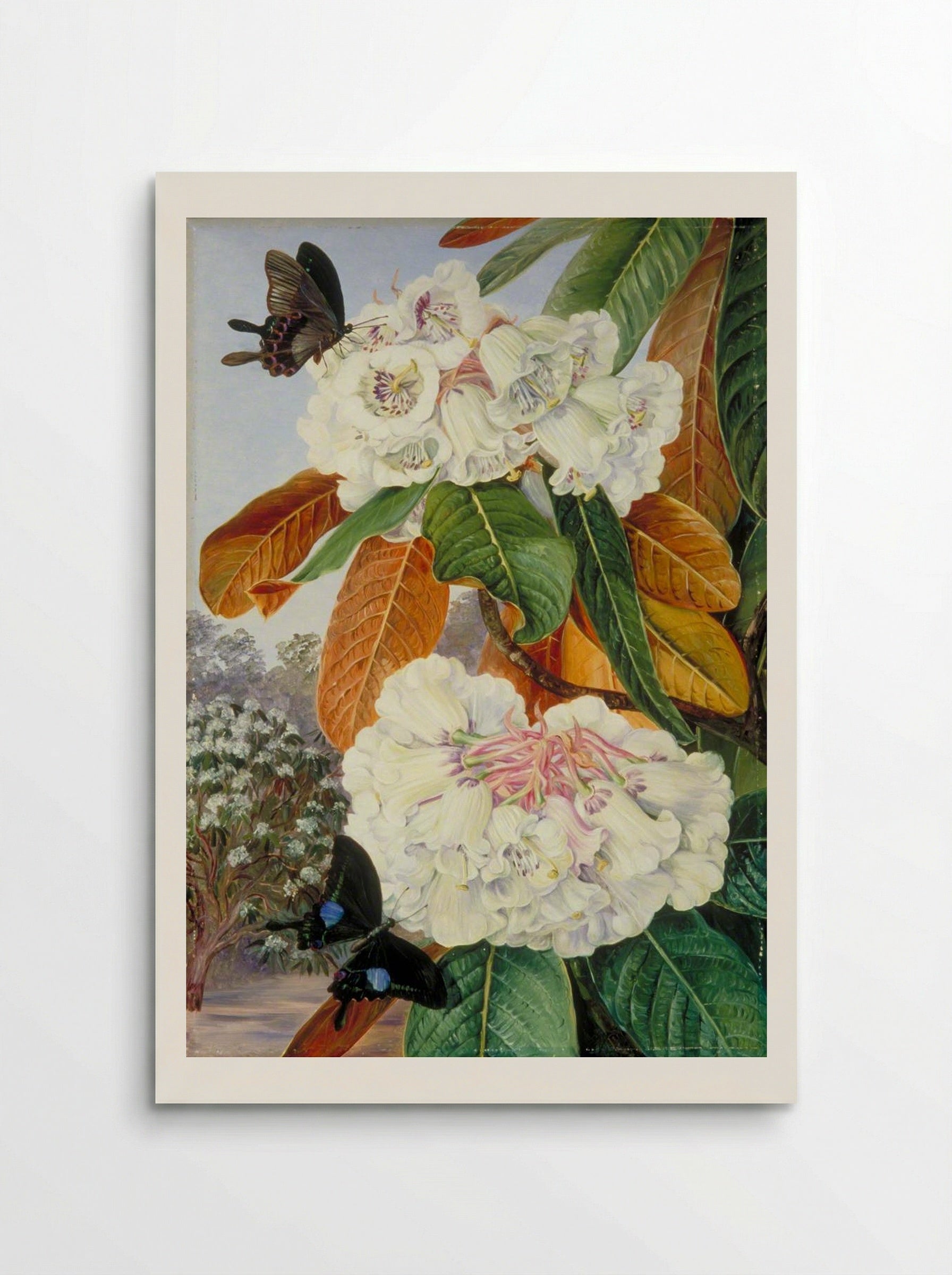
Rhododendron Falconeri from the Mountains of North India - Marianne North
Archival giclée
Frames arrive ready to hang
Secure checkout
Made to order
Description
A detailed botanical study of the Himalayan Rhododendron falconeri by Victorian explorer and artist Marianne North, featuring realistic white blooms and dark butterflies.
Marianne North was a prolific Victorian traveller and painter who dedicated her life to documenting the flora of the world. This work depicts the Rhododendron falconeri, a species native to the Himalayas, captured with the scientific precision that defined her practice. North travelled extensively across India between 1877 and 1879, producing a vast collection of oil paintings that now reside in the Marianne North Gallery at the Royal Botanic Gardens, Kew. The composition focuses on the heavy, bell-shaped white blossoms of the rhododendron, which are rendered with careful attention to their delicate structure and subtle purple markings. North contrasts these pale flowers with the deep, rusty-brown undersides of the leaves, a characteristic feature of this specific species. The inclusion of two dark butterflies adds a sense of scale and natural activity to the scene, grounding the botanical subject within its environment. Unlike many of her contemporaries who worked in watercolour, North preferred oil paints, which allowed her to achieve a greater degree of colour saturation and durability during her arduous travels in humid climates. Her approach to painting was direct and observational. She often painted on-site, working quickly to capture the appearance of plants before they wilted. This method resulted in a body of work that functions as both an artistic achievement and a historical record of plant life in the nineteenth century. The painting avoids the stylised conventions of earlier botanical illustration, opting instead for a realistic portrayal of the plant in its natural habitat. The background, showing a glimpse of the mountainous terrain, provides context for the specimen, reflecting North's interest in the relationship between plants and their native geography.
Return policy
Because every print is made to order, we don't offer change-of-mind returns, refunds or exchanges. If your order arrives faulty, damaged or incorrect, we'll replace it free of charge — just contact us within 48 hours of delivery. See our refunds page for full details.
Shipping
We ship worldwide, printing at the production hub nearest to your delivery address. Delivery times and costs vary by destination — you'll see the options available to you at checkout.
Manufacturing
Each print is produced to order using 12-colour giclée printing on FSC-certified archival paper. Designed in Britain and printed at your nearest production hub to reduce waste and speed up delivery.
Rhododendron Falconeri from the Mountains of North India - Marianne North

Artist Biography
Marianne North
She was born in 1830 into a wealthy Norfolk family. Her father was an MP. She trained as a singer, but her voice failed and she turned to painting. She was devoted to her father and travelled with him until his death in 1869, which freed her to go further.
She painted plants in oils, not watercolours, and she painted them in situ within their habitats, including animals, people, and temples. In Borneo she painted a pitcher plant unknown to science, which was named Nepenthes northiana in her honour. Charles Darwin personally suggested she visit Australia. She completed 848 paintings in thirteen years, donated 832 to Kew Gardens, and paid for the gallery to house them herself. The Marianne North Gallery at Kew remains the only permanent solo exhibition in a major UK institution. She died in 1890.
Our Features
Designed for Lasting Impact
Specific Features
Every Solis piece is made to order with archival, gallery-quality materials built to last.
- Museum-grade giclée printing for rich, fade-resistant colour
- Archival matte fine-art paper, FSC-certified
- Multiple sizes and framing options available
- Frames in black, natural wood, dark wood or white
- Framed prints arrive ready to hang
Care & Cleaning
To keep your artwork looking its best:
- Dust gently with a soft, dry cloth
- Avoid prolonged direct sunlight
- Never use liquid cleaners on the print or canvas surface
- Keep in a dry, room-temperature space
- Handle prints with clean, dry hands
Materials & Sizing
Museum-grade giclée on FSC-certified archival matte paper, with framed and canvas options.
- Paper sizes: A4, A3, A2, A1, A0 and B2 (50×70 cm)
- Canvas: XS (20×30 cm) to Large (60×90 cm)
- Frames: black, natural wood, dark wood or white
Why Choose Us ?
Damage-free delivery guarantee
Fast Shipping
Museum-Quality Materials
Artist Biography
Marianne North
She was born in 1830 into a wealthy Norfolk family. Her father was an MP. She trained as a singer, but her voice failed and she turned to painting. She was devoted to her father and travelled with him until his death in 1869, which freed her to go further.
She painted plants in oils, not watercolours, and she painted them in situ within their habitats, including animals, people, and temples. In Borneo she painted a pitcher plant unknown to science, which was named Nepenthes northiana in her honour. Charles Darwin personally suggested she visit Australia. She completed 848 paintings in thirteen years, donated 832 to Kew Gardens, and paid for the gallery to house them herself. The Marianne North Gallery at Kew remains the only permanent solo exhibition in a major UK institution. She died in 1890.
You May Also Like