

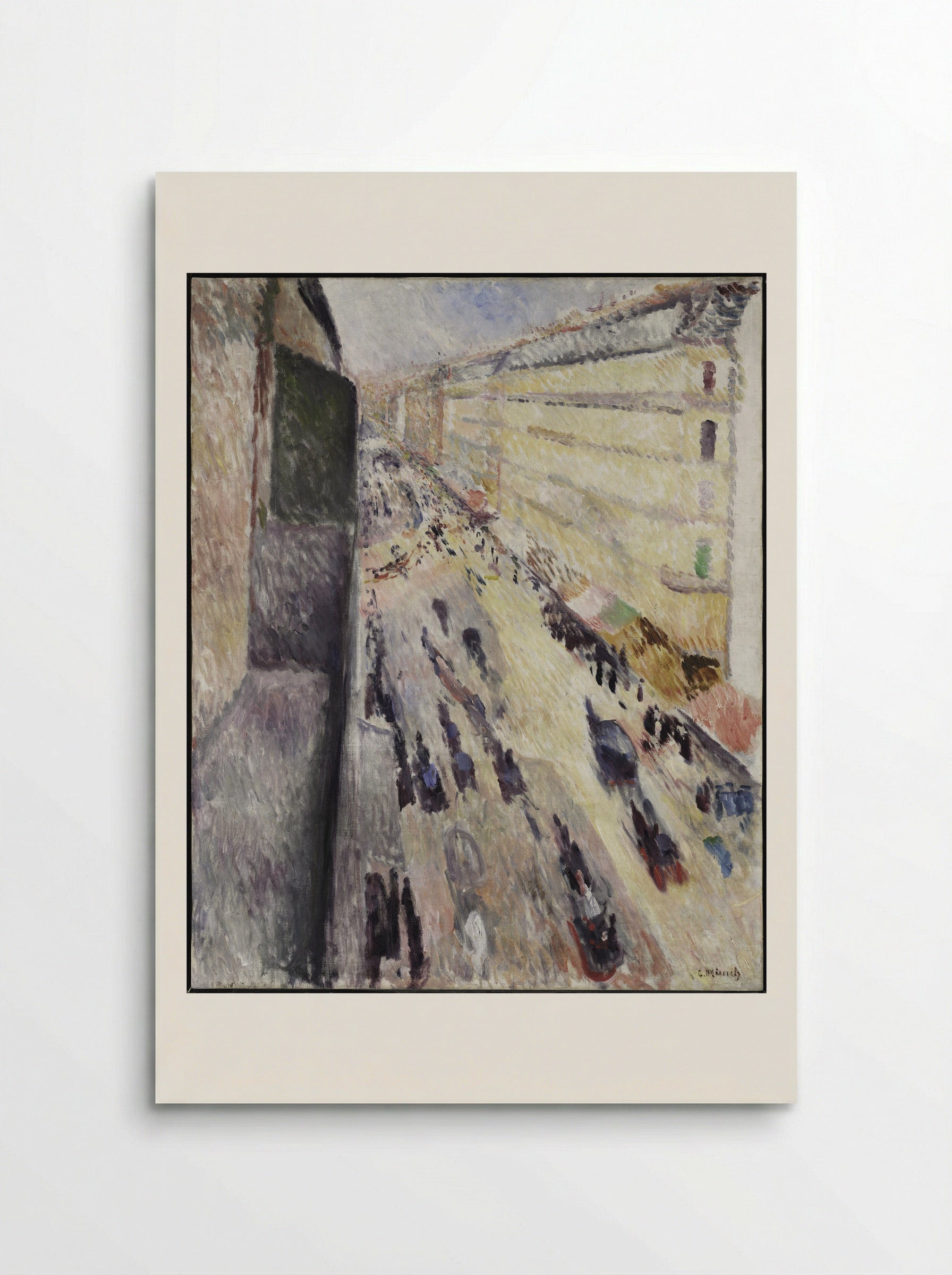
Rue de Rivoli - Edvard Munch
Archival giclée
Frames arrive ready to hang
Secure checkout
Made to order
Description
A dynamic, high-angle view of the Rue de Rivoli in Paris, captured with the loose, expressive brushwork characteristic of Munch's early time in France.
Painted during his first extended stay in Paris, this work captures the Rue de Rivoli from an elevated vantage point. Edvard Munch, typically associated with psychological intensity, here engages with the visual language of the French capital. The composition relies on a steep, diagonal perspective that draws the eye down the length of the thoroughfare. The architecture of the buildings is rendered in pale, yellowish tones, while the street below is a flurry of dark, indistinct figures and carriages. The brushwork is rapid and loose, reflecting the influence of Impressionist techniques on Munch during this period. He avoids fine detail, choosing instead to capture the movement and atmosphere of the city. The shadows are cast in shades of violet and grey, contrasting with the lighter, sun-drenched facades. This piece demonstrates a departure from his later, more symbolic works, showing an interest in the fleeting nature of urban life. The high angle creates a sense of detachment, as if the viewer is observing the bustle of Paris from the safety of a balcony or window. While the scene is recognisably Parisian, the application of paint retains a certain raw quality. Munch uses colour to define space rather than form, allowing the buildings to merge into the light of the sky. The work provides a glimpse into his experimentation with different styles before he fully developed his signature approach to emotional expression. It is a study of light, motion, and the geometry of a modern city street, presented with a directness that avoids unnecessary ornamentation.
Return policy
Because every print is made to order, we don't offer change-of-mind returns, refunds or exchanges. If your order arrives faulty, damaged or incorrect, we'll replace it free of charge — just contact us within 48 hours of delivery. See our refunds page for full details.
Shipping
We ship worldwide, printing at the production hub nearest to your delivery address. Delivery times and costs vary by destination — you'll see the options available to you at checkout.
Manufacturing
Each print is produced to order using 12-colour giclée printing on FSC-certified archival paper. Designed in Britain and printed at your nearest production hub to reduce waste and speed up delivery.
Rue de Rivoli - Edvard Munch

Artist Biography
Edvard Munch
Munch, a leading figure in both the Symbolism and Expressionism movements, sought to externalise internal states. His art became a canvas for raw emotion, exploring themes of love, death, and existential dread. He achieved this through bold colours, distorted forms, and a distinctive use of line that conveys a sense of perpetual motion and unease. Works like 'The Sick Child II' and 'The Voice / Summer Night' exemplify his ability to capture fleeting moments of intense feeling.
Munch's unflinching exploration of the human condition continues to resonate deeply. His art speaks to the anxieties and uncertainties of modern life, making his prints a powerful and evocative addition to any collection. His enduring influence can be seen in countless artists who have followed in his footsteps, daring to confront the darker aspects of the human experience. Owning a Munch print is not just acquiring a piece of art; it's embracing a conversation about what it means to be human.
Our Features
Designed for Lasting Impact
Specific Features
Every Solis piece is made to order with archival, gallery-quality materials built to last.
- Museum-grade giclée printing for rich, fade-resistant colour
- Archival matte fine-art paper, FSC-certified
- Multiple sizes and framing options available
- Frames in black, natural wood, dark wood or white
- Framed prints arrive ready to hang
Care & Cleaning
To keep your artwork looking its best:
- Dust gently with a soft, dry cloth
- Avoid prolonged direct sunlight
- Never use liquid cleaners on the print or canvas surface
- Keep in a dry, room-temperature space
- Handle prints with clean, dry hands
Materials & Sizing
Museum-grade giclée on FSC-certified archival matte paper, with framed and canvas options.
- Paper sizes: A4, A3, A2, A1, A0 and B2 (50×70 cm)
- Canvas: XS (20×30 cm) to Large (60×90 cm)
- Frames: black, natural wood, dark wood or white
Why Choose Us ?
Damage-free delivery guarantee
Fast Shipping
Museum-Quality Materials
Artist Biography
Edvard Munch
Munch, a leading figure in both the Symbolism and Expressionism movements, sought to externalise internal states. His art became a canvas for raw emotion, exploring themes of love, death, and existential dread. He achieved this through bold colours, distorted forms, and a distinctive use of line that conveys a sense of perpetual motion and unease. Works like 'The Sick Child II' and 'The Voice / Summer Night' exemplify his ability to capture fleeting moments of intense feeling.
Munch's unflinching exploration of the human condition continues to resonate deeply. His art speaks to the anxieties and uncertainties of modern life, making his prints a powerful and evocative addition to any collection. His enduring influence can be seen in countless artists who have followed in his footsteps, daring to confront the darker aspects of the human experience. Owning a Munch print is not just acquiring a piece of art; it's embracing a conversation about what it means to be human.
You May Also Like