

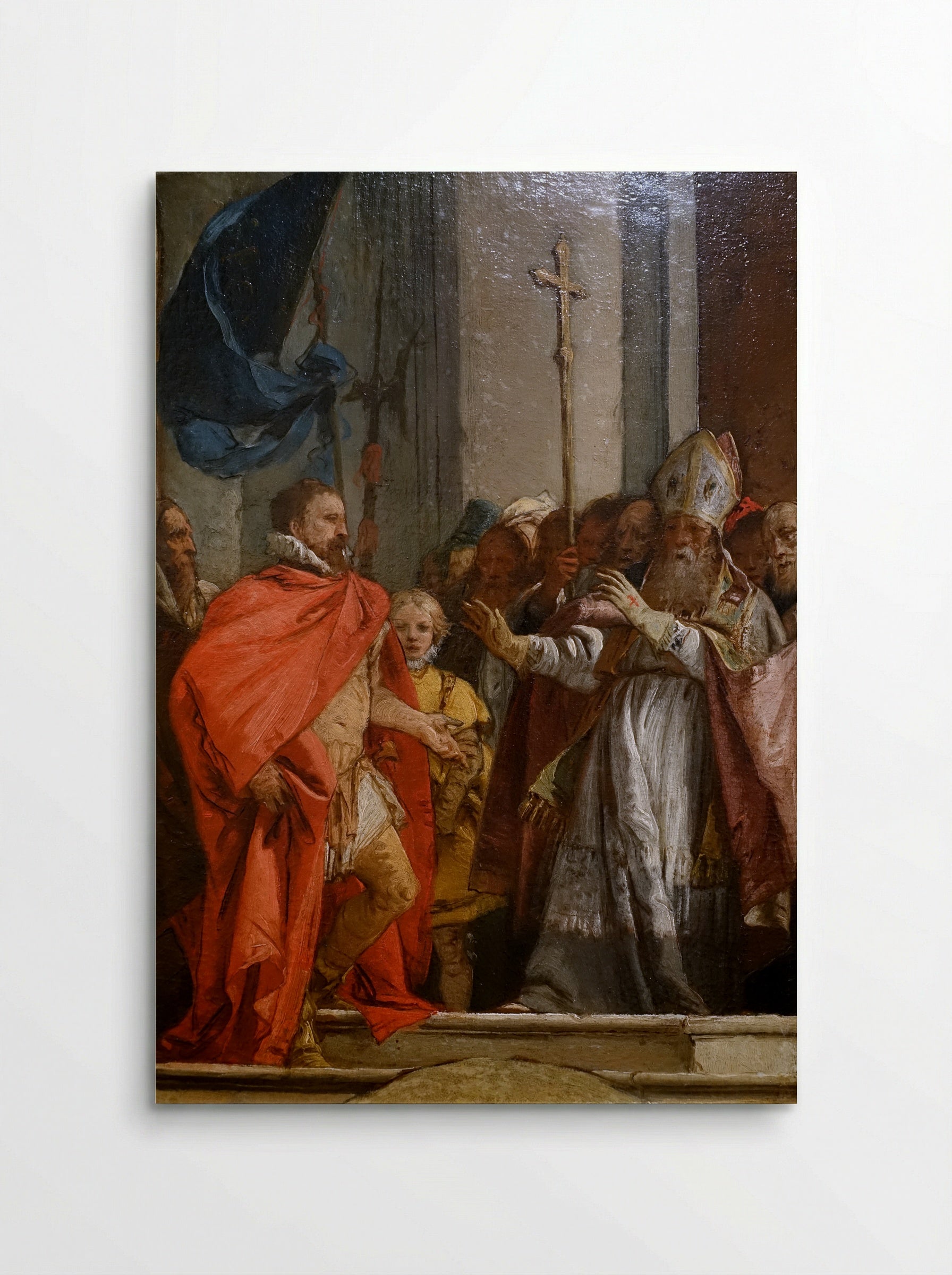
Saint Ambrose - Giovanni Domenico Tiepolo
Archival giclée
Frames arrive ready to hang
Secure checkout
Made to order
Description
A masterful oil painting by Giovanni Domenico Tiepolo, depicting Saint Ambrose with the fluid brushwork and expressive characterisation typical of the Venetian Rococo.
Giovanni Domenico Tiepolo, the son of the celebrated Venetian painter Giovanni Battista Tiepolo, demonstrates his technical facility in this depiction of Saint Ambrose. The composition captures a moment of ecclesiastical authority, where the saint is presented in his traditional episcopal vestments, complete with mitre and crozier. The scene is populated by a surrounding crowd, rendered with the fluid, rapid brushwork characteristic of the Venetian school during the mid-eighteenth century. Tiepolo employs a palette dominated by earthy tones, punctuated by the striking red of the central figure's cloak. This use of colour directs the viewer's eye across the canvas, balancing the weight of the figures against the architectural backdrop. The artist focuses on the interaction between the figures, utilising light to model their forms and create a sense of spatial depth. Unlike the grand, theatrical scale often associated with his father, Domenico frequently introduces a more grounded, observational quality to his religious subjects. The faces in the crowd exhibit individualised expressions, suggesting a study of character that moves beyond mere iconographic representation. This work reflects the transition in Venetian art as the Rococo style began to incorporate more naturalistic elements. The handling of the paint, particularly in the drapery and the loose application of highlights, reveals the artist's confidence in his medium. The composition remains focused on the narrative exchange, maintaining a sense of decorum while allowing for the expressive freedom that defined the later years of the Venetian Republic's artistic production. As a museum-grade print, this reproduction captures the texture of the original oil application, preserving the nuances of Tiepolo's brushwork and the specific tonal balance of his palette.
Return policy
Because every print is made to order, we don't offer change-of-mind returns, refunds or exchanges. If your order arrives faulty, damaged or incorrect, we'll replace it free of charge — just contact us within 48 hours of delivery. See our refunds page for full details.
Shipping
We ship worldwide, printing at the production hub nearest to your delivery address. Delivery times and costs vary by destination — you'll see the options available to you at checkout.
Manufacturing
Each print is produced to order using 12-colour giclée printing on FSC-certified archival paper. Designed in Britain and printed at your nearest production hub to reduce waste and speed up delivery.
Care and materials
Specific Features
Every Solis piece is made to order with archival, gallery-quality materials built to last.
- Museum-grade giclée printing for rich, fade-resistant colour
- Archival matte fine-art paper, FSC-certified
- Multiple sizes and framing options available
- Frames in black, natural wood, dark wood or white
- Framed prints arrive ready to hang
Care & Cleaning
To keep your artwork looking its best:
- Dust gently with a soft, dry cloth
- Avoid prolonged direct sunlight
- Never use liquid cleaners on the print or canvas surface
- Keep in a dry, room-temperature space
- Handle prints with clean, dry hands
Materials & Sizing
Museum-grade giclée on FSC-certified archival matte paper, with framed and canvas options.
- Paper sizes: A4, A3, A2, A1, A0 and B2 (50×70 cm)
- Canvas: XS (20×30 cm) to Large (60×90 cm)
- Frames: black, natural wood, dark wood or white
Saint Ambrose - Giovanni Domenico Tiepolo

Artist Biography
Giovanni Domenico Tiepolo
He was born in Venice in 1727, the eldest son of Giovanni Battista Tiepolo, the greatest ceiling painter in Europe. By thirteen he was his father's chief assistant; by twenty he was producing independent commissions. He assisted at Wurzburg (1751 to 1753), at the Villa Valmarana in Vicenza (1757), and at the Royal Palace in Madrid (1762 to 1770).
His father's death in Madrid in 1770 freed him to develop his own direction. He returned to Venice and turned increasingly away from the luminous Baroque grandeur of his father's work toward genre scenes, religious subjects treated with narrative intimacy, and the Punchinello drawings that became his finest achievement. In retirement at the family villa at Zianigo, he painted frescoes now in the Correr Museum and produced nearly two hundred etchings. He died in Venice in 1804, at seventy-six.
Why Choose Us ?
Damage-free delivery guarantee
Fast Shipping
Museum-Quality Materials
You May Also Like