

Fine Art Poster
From $29
A giclée print on 200gsm matte fine art paper, using a twelve-colour process for accurate, fade-resistant colour. Supplied unframed, delivered flat or rolled.



Archival giclée
Frames arrive ready to hang
Secure checkout
Made to order
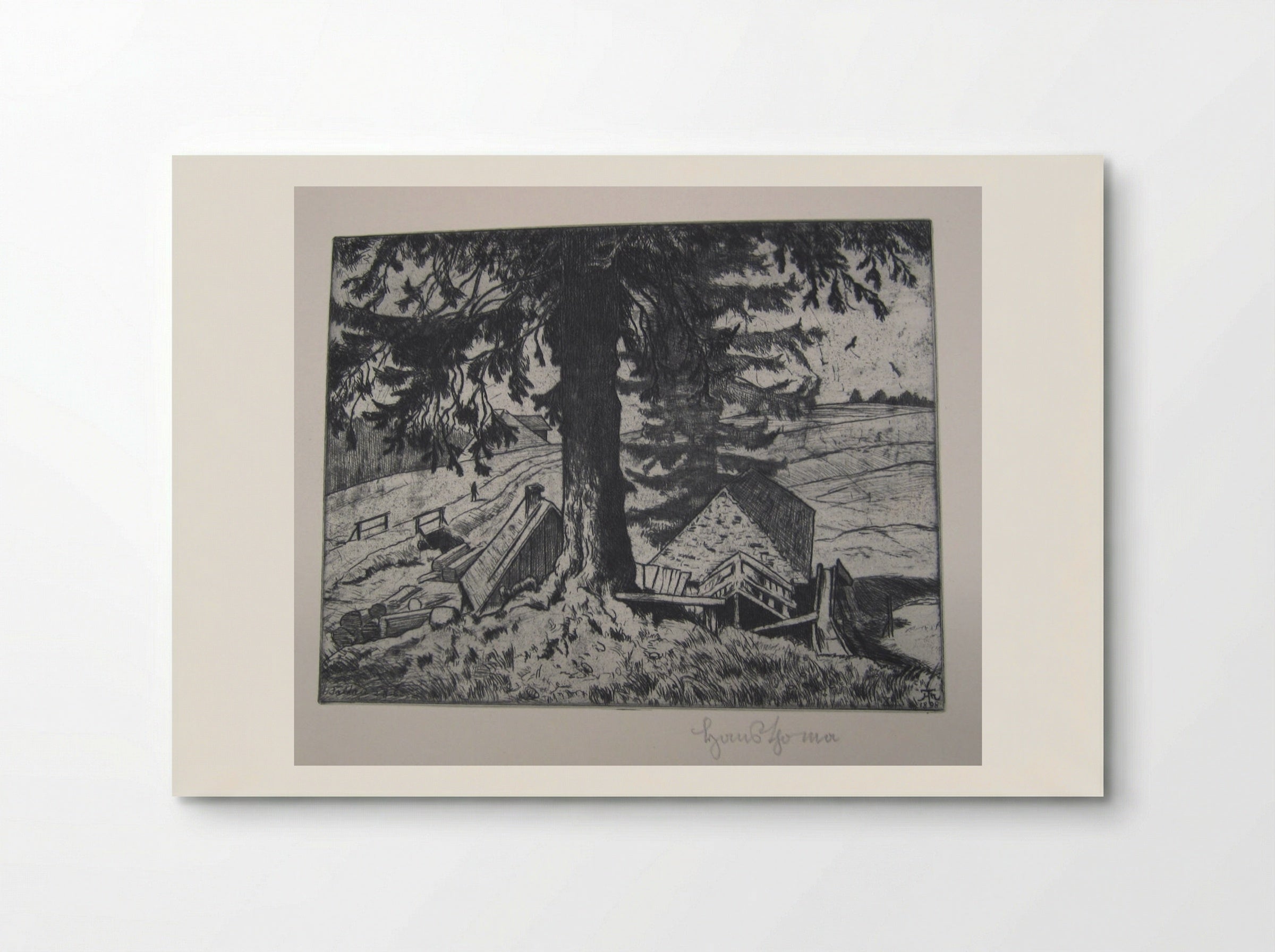
A detailed 1898 etching by Hans Thoma depicting a rural saw mill in the Black Forest village of Falkau.
Hans Thoma, a painter and printmaker from the Black Forest region of Germany, produced this etching in 1898. The work depicts a saw mill situated in Falkau, a village within his native Baden-Württemberg. Thoma often returned to the motifs of his home region, finding subjects in the quiet, rural life of the mountains and valleys. In this composition, a large, dark tree dominates the foreground, its branches casting a heavy shadow over the structures below. The etching technique allows for a range of textures, from the rough bark of the tree to the wooden planks of the mill and the grassy slope. A lone figure walks along a path in the distance, providing a sense of scale to the quiet environment. The lines are precise and deliberate, characteristic of Thoma's graphic work, which often prioritised clarity and a grounded, observational approach to the natural world. Thoma was associated with the Symbolist movement, yet his graphic output frequently leaned towards a direct, almost documentary style. He avoided the industrialisation of the era, preferring to capture traditional structures and the rhythms of rural labour. The print reflects his interest in the interplay between light and shadow, using the stark contrast of the etching process to define the forms of the buildings against the open, rolling terrain. This piece offers a glimpse into the late nineteenth-century German countryside, documented with the technical skill of an artist deeply familiar with his subject matter.
Because every print is made to order, we don't offer change-of-mind returns, refunds or exchanges. If your order arrives faulty, damaged or incorrect, we'll replace it free of charge — just contact us within 48 hours of delivery. See our refunds page for full details.
We ship worldwide, printing at the production hub nearest to your delivery address. Delivery times and costs vary by destination — you'll see the options available to you at checkout.
Each print is produced to order using 12-colour giclée printing on FSC-certified archival paper. Designed in Britain and printed at your nearest production hub to reduce waste and speed up delivery.

Artist Biography
Our Features
Designed for Lasting Impact
Every Solis piece is made to order with archival, gallery-quality materials built to last.
To keep your artwork looking its best:
Museum-grade giclée on FSC-certified archival matte paper, with framed and canvas options.
Made to order
Every piece is printed to order. These are the five finishes, and what makes each one different.
From $29
A giclée print on 200gsm matte fine art paper, using a twelve-colour process for accurate, fade-resistant colour. Supplied unframed, delivered flat or rolled.

From $89
The same fine art print in a solid wood frame with UV-protective acrylic glaze and rigid backing. Five frame colours. Arrives ready to hang.

From $169
A deeper solid wood frame: 33mm deep with a 20mm face and Perspex glaze. The print sits unmounted for a clean gallery presentation. Black, white or natural.

From $59
Hand-stretched canvas with neat gallery-wrapped edges, giving the artwork surface texture and depth. Arrives ready to hang.

From $175
Stretched canvas set in a floating wood frame, our most substantial finish. Arrives ready to hang.
Why Choose Us ?
Damage-free delivery guarantee
Fast Shipping
Museum-Quality Materials
Artist Biography
Hans Thoma
You May Also Like
Cookies show us which prints people love, so we hang the right art. Help us fill it?
Essential cookies only if you prefer · Privacy Policy