

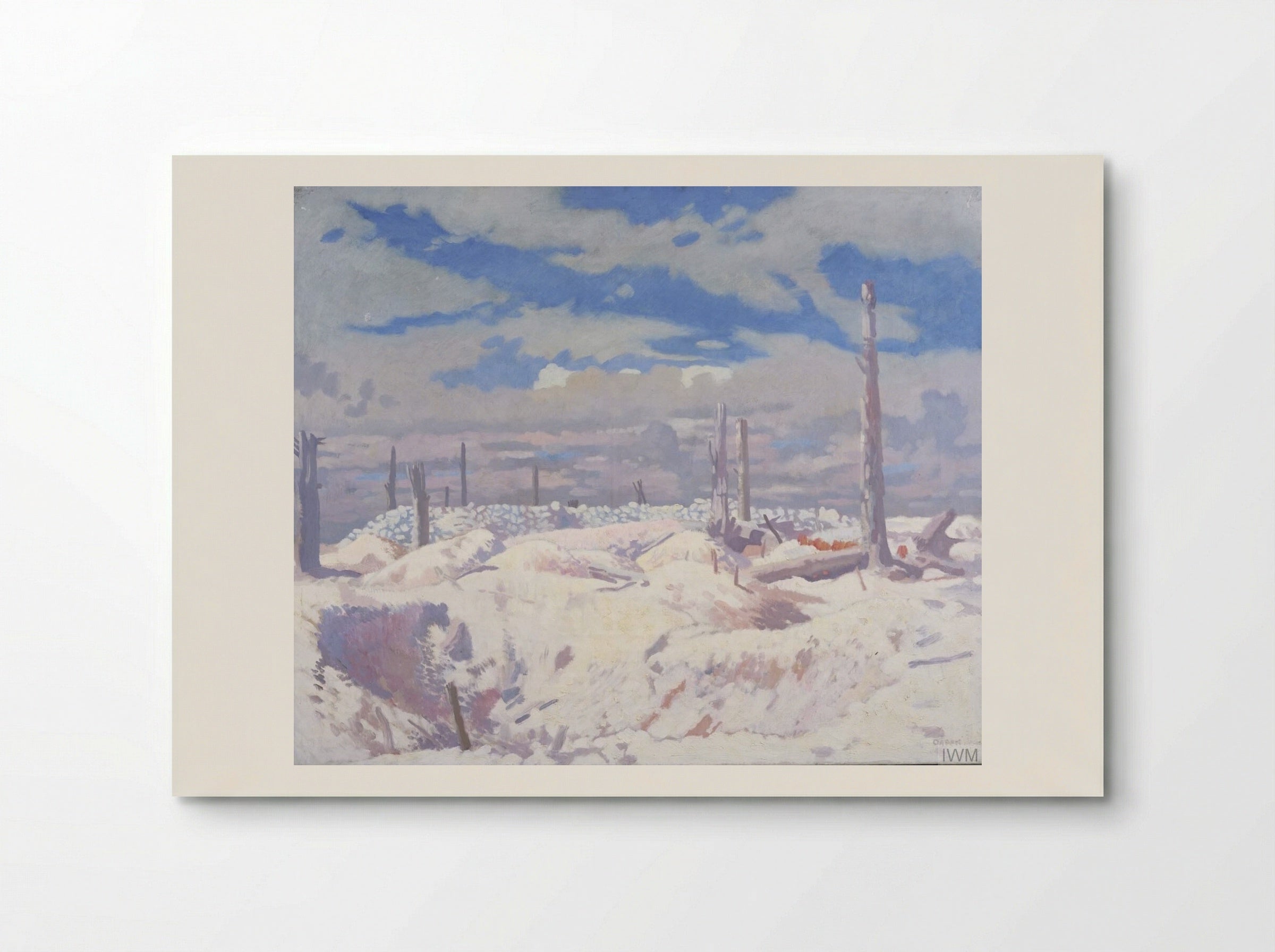
Schwaben Redoubt - William Orpen
Archival giclée
Frames arrive ready to hang
Secure checkout
Made to order
Description
A stark, observational painting of the Schwaben Redoubt battlefield in 1917, capturing the desolate, churned terrain of the Western Front.
Sir William Orpen, an official war artist during the First World War, produced this work in 1917. It depicts the Schwaben Redoubt, a German fortification near Thiepval on the Somme. The site was the scene of intense fighting during the 1916 offensive. Orpen captures the aftermath of the conflict with a focus on the physical transformation of the terrain. The composition presents a desolate, churned earth surface, stripped of vegetation and scarred by artillery. The skeletal remains of trees stand as vertical markers against a vast, pale sky. Orpen employs a palette dominated by chalky whites, greys, and soft blues, which creates a sense of cold detachment. The light appears diffused, casting long, faint shadows across the craters and mounds of soil. This approach avoids the sensationalism often found in contemporary depictions of the conflict, opting instead for a quiet, observational record of the ruined environment. Orpen was commissioned by the British government to document the war effort. His work from this period ranges from portraits of high-ranking officers to these stark depictions of the front lines. This painting is held in the collection of the Imperial War Museum. It provides a direct view of the Western Front, stripped of human presence, focusing entirely on the environmental impact of industrialised warfare. The brushwork is controlled, reflecting a technical precision that allows the viewer to examine the texture of the broken ground and the atmospheric quality of the sky. By removing the soldiers from the frame, Orpen forces an encounter with the physical reality of the battlefield, where the earth itself bears the evidence of the struggle.
Return policy
Because every print is made to order, we don't offer change-of-mind returns, refunds or exchanges. If your order arrives faulty, damaged or incorrect, we'll replace it free of charge — just contact us within 48 hours of delivery. See our refunds page for full details.
Shipping
We ship worldwide, printing at the production hub nearest to your delivery address. Delivery times and costs vary by destination — you'll see the options available to you at checkout.
Manufacturing
Each print is produced to order using 12-colour giclée printing on FSC-certified archival paper. Designed in Britain and printed at your nearest production hub to reduce waste and speed up delivery.
Schwaben Redoubt - William Orpen

Artist Biography
William Orpen
During the First World War he was sent to the Western Front as an official war artist for the British government. He was the most prolific of the war artists, producing 138 works: drawings and paintings of soldiers, dead men, German prisoners, ruined trenches, and the blank exhaustion that photographs of the period cannot quite capture. He donated all 138 to the British government. They are now in the Imperial War Museum.
After the war he painted The Signing of the Peace Treaty at Versailles, which should have been the capstone of his career. Instead it became a controversy. He also painted To the Unknown British Soldier in France, a composition that originally included ghostly military figures alongside a flag-draped coffin. The Imperial War Museum refused to accept it until he removed the figures in 1927.
He never fully recovered from the physical and mental effects of the war. He continued to paint society portraits at extraordinary prices (over 50,000 pounds a year by 1929), but those who knew him said something had changed.
He was Irish, from Stillorgan in County Dublin, a fact that became complicated as the independence movement gathered force during and after the war. He accepted a knighthood from the British crown. He died in 1931, aged fifty-two, and faded to near-total obscurity until 2001, when a portrait sold at Sotheby's for nearly two million pounds.
Our Features
Designed for Lasting Impact
Specific Features
Every Solis piece is made to order with archival, gallery-quality materials built to last.
- Museum-grade giclée printing for rich, fade-resistant colour
- Archival matte fine-art paper, FSC-certified
- Multiple sizes and framing options available
- Frames in black, natural wood, dark wood or white
- Framed prints arrive ready to hang
Care & Cleaning
To keep your artwork looking its best:
- Dust gently with a soft, dry cloth
- Avoid prolonged direct sunlight
- Never use liquid cleaners on the print or canvas surface
- Keep in a dry, room-temperature space
- Handle prints with clean, dry hands
Materials & Sizing
Museum-grade giclée on FSC-certified archival matte paper, with framed and canvas options.
- Paper sizes: A4, A3, A2, A1, A0 and B2 (50×70 cm)
- Canvas: XS (20×30 cm) to Large (60×90 cm)
- Frames: black, natural wood, dark wood or white
Why Choose Us ?
Damage-free delivery guarantee
Fast Shipping
Museum-Quality Materials
Artist Biography
William Orpen
During the First World War he was sent to the Western Front as an official war artist for the British government. He was the most prolific of the war artists, producing 138 works: drawings and paintings of soldiers, dead men, German prisoners, ruined trenches, and the blank exhaustion that photographs of the period cannot quite capture. He donated all 138 to the British government. They are now in the Imperial War Museum.
After the war he painted The Signing of the Peace Treaty at Versailles, which should have been the capstone of his career. Instead it became a controversy. He also painted To the Unknown British Soldier in France, a composition that originally included ghostly military figures alongside a flag-draped coffin. The Imperial War Museum refused to accept it until he removed the figures in 1927.
He never fully recovered from the physical and mental effects of the war. He continued to paint society portraits at extraordinary prices (over 50,000 pounds a year by 1929), but those who knew him said something had changed.
He was Irish, from Stillorgan in County Dublin, a fact that became complicated as the independence movement gathered force during and after the war. He accepted a knighthood from the British crown. He died in 1931, aged fifty-two, and faded to near-total obscurity until 2001, when a portrait sold at Sotheby's for nearly two million pounds.
You May Also Like