

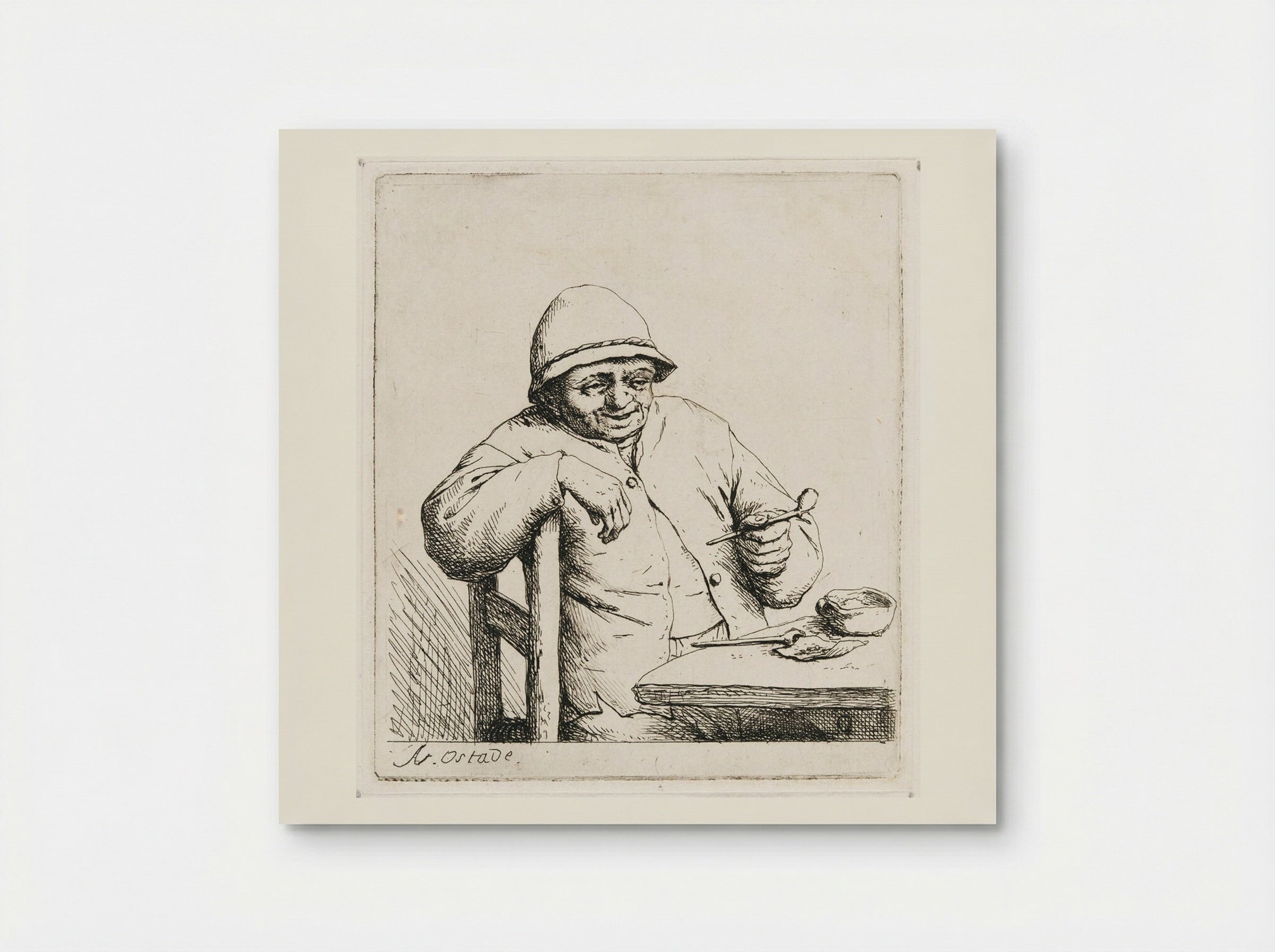
Smoker Leaning on the Back of a Chair - Adriaen van Ostade
Archival giclée
Frames arrive ready to hang
Secure checkout
Made to order
Description
An etching by Adriaen van Ostade, 'Smoker Leaning on the Back of a Chair' depicts a man enjoying a pipe, capturing a moment of everyday life in the Dutch Golden Age.
This etching by Adriaen van Ostade (1610-1685) depicts a man seated at a table, leaning back in his chair. The man, presumably a smoker, is holding a pipe in his right hand. On the table are a pipe, tobacco, and a small container. The composition is simple, focusing on the figure and the immediate surroundings. Van Ostade was a Dutch Golden Age painter and printmaker, known for his genre scenes of peasant life. His works often portray everyday activities, such as drinking, smoking, and playing music, set in taverns or rural settings. Van Ostade's etchings, like this one, demonstrate his skill in capturing the details of daily life with a fine line and subtle shading. The use of etching allowed for the creation of multiple copies, making his work accessible to a wider audience. This particular print exemplifies his interest in portraying the common man and the pleasures of simple living. The work is characterised by its intimate scale and careful observation of human behaviour. The artist's signature appears in the lower left corner.
Return policy
Because every print is made to order, we don't offer change-of-mind returns, refunds or exchanges. If your order arrives faulty, damaged or incorrect, we'll replace it free of charge — just contact us within 48 hours of delivery. See our refunds page for full details.
Shipping
We ship worldwide, printing at the production hub nearest to your delivery address. Delivery times and costs vary by destination — you'll see the options available to you at checkout.
Manufacturing
Each print is produced to order using 12-colour giclée printing on FSC-certified archival paper. Designed in Britain and printed at your nearest production hub to reduce waste and speed up delivery.
Care and materials
Specific Features
Every Solis piece is made to order with archival, gallery-quality materials built to last.
- Museum-grade giclée printing for rich, fade-resistant colour
- Archival matte fine-art paper, FSC-certified
- Multiple sizes and framing options available
- Frames in black, natural wood, dark wood or white
- Framed prints arrive ready to hang
Care & Cleaning
To keep your artwork looking its best:
- Dust gently with a soft, dry cloth
- Avoid prolonged direct sunlight
- Never use liquid cleaners on the print or canvas surface
- Keep in a dry, room-temperature space
- Handle prints with clean, dry hands
Materials & Sizing
Museum-grade giclée on FSC-certified archival matte paper, with framed and canvas options.
- Paper sizes: A4, A3, A2, A1, A0 and B2 (50×70 cm)
- Canvas: XS (20×30 cm) to Large (60×90 cm)
- Frames: black, natural wood, dark wood or white
Smoker Leaning on the Back of a Chair - Adriaen van Ostade

Artist Biography
Adriaen Van Ostade
He was born in Haarlem in 1610, the eldest son of a weaver from the hamlet of Ostade near Eindhoven. He and his younger brother Isaack (also a painter) adopted "van Ostade" as a professional name. Both studied under Frans Hals, though neither absorbed much of Hals's style. The stronger influence on Adriaen was Adriaen Brouwer, whose earthy peasant scenes and tavern interiors set the template that Van Ostade refined over five decades.
His subjects were the daily activities of common people: peasants drinking, smoking, fighting, making music, gathering at fairs. The early paintings are rough and dark; as his career progressed, the interiors became lighter, the compositions more carefully arranged, the figures less grotesque. He was enormously productive. Estimates of his total output range from 385 to over 900 paintings, and at his death his studio contained more than two hundred unsold works.
In 1657 he married Anna Ingels, a wealthy Catholic woman from Amsterdam, and appears to have converted to Catholicism himself. He continued painting without decline into old age; two of his latest dated works, from 1676, show no weakening. He was buried in Haarlem in 1685, at seventy-four.
Why Choose Us ?
Damage-free delivery guarantee
Fast Shipping
Museum-Quality Materials
You May Also Like