

Fine Art Poster
From $29
A giclée print on 200gsm matte fine art paper, using a twelve-colour process for accurate, fade-resistant colour. Supplied unframed, delivered flat or rolled.



Archival giclée
Frames arrive ready to hang
Secure checkout
Made to order
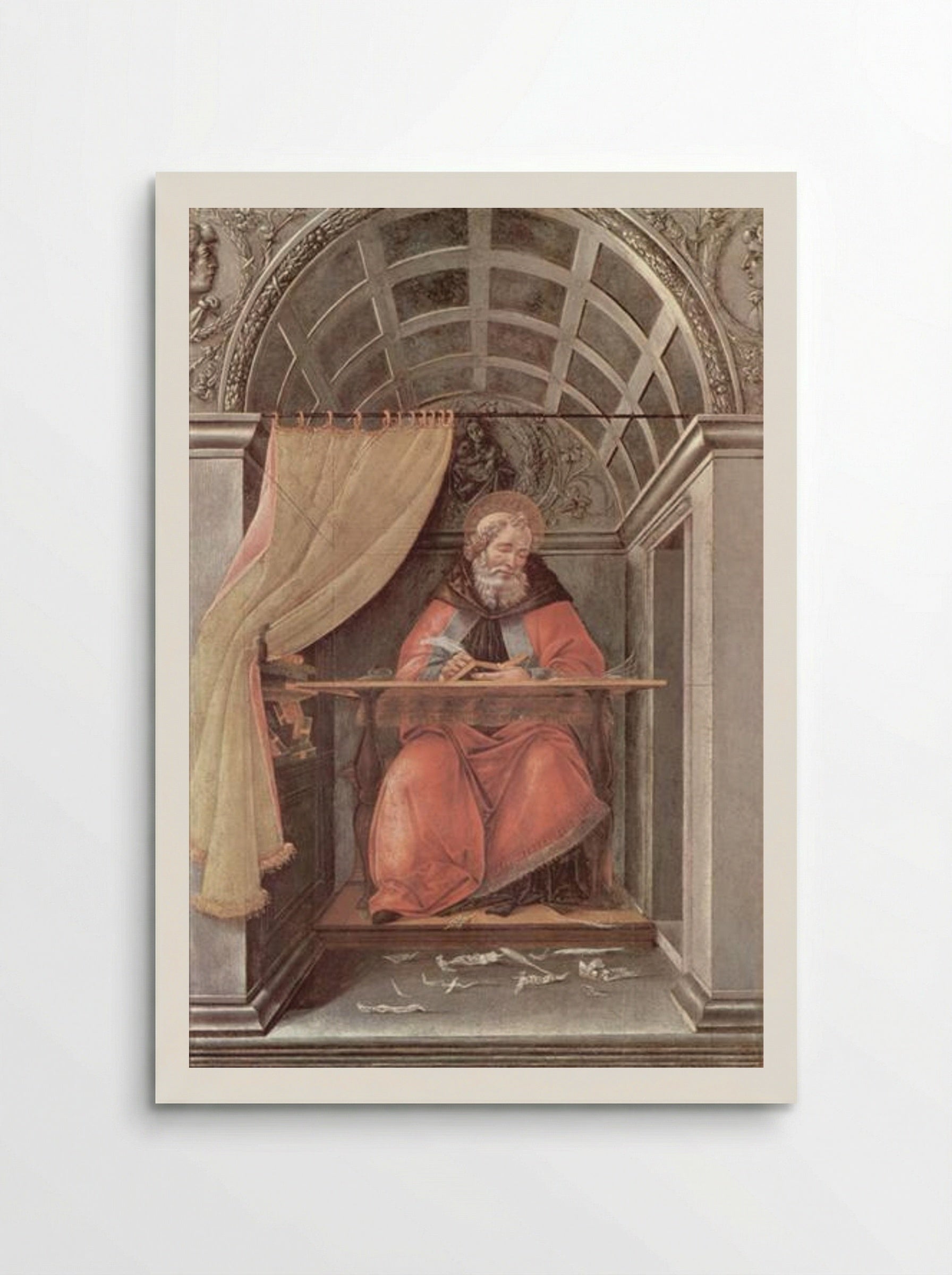
A Renaissance fresco by Sandro Botticelli depicting Saint Augustine at his desk, captured in a moment of scholarly focus within an architectural niche.
This work depicts Saint Augustine of Hippo seated within a confined, architectural space, engaged in his scholarly pursuits. Painted by Sandro Botticelli around 1480, the fresco forms part of a series of figures of saints located in the Church of Ognissanti in Florence. The composition is defined by a barrel-vaulted niche, which provides a sense of enclosure and focus on the figure of the saint. Botticelli employs a restrained palette, dominated by the deep red of the saint's robes and the muted tones of the surrounding stone architecture. The saint is shown in profile, hunched over a desk with a quill in hand, suggesting a moment of quiet contemplation and intellectual labour. The drapery of the curtain to the left adds a soft, vertical element that contrasts with the rigid geometry of the vaulted ceiling and the desk. Scattered papers on the floor beneath the desk introduce a human, lived-in quality to the scene, suggesting the ongoing nature of the saint's work. The architectural setting reflects the interest in classical forms and perspective that characterised the Florentine Renaissance. Botticelli balances the weight of the stone structure with the delicate handling of the saint's features and the flowing lines of his garments. The light enters from the left, casting soft shadows that define the volume of the figure and the depth of the niche. This piece demonstrates the artist's ability to combine theological subject matter with a rigorous approach to form and spatial organisation, typical of his work during this period in Florence.
Because every print is made to order, we don't offer change-of-mind returns, refunds or exchanges. If your order arrives faulty, damaged or incorrect, we'll replace it free of charge — just contact us within 48 hours of delivery. See our refunds page for full details.
We ship worldwide, printing at the production hub nearest to your delivery address. Delivery times and costs vary by destination — you'll see the options available to you at checkout.
Each print is produced to order using 12-colour giclée printing on FSC-certified archival paper. Designed in Britain and printed at your nearest production hub to reduce waste and speed up delivery.

Artist Biography
Our Features
Designed for Lasting Impact
Every Solis piece is made to order with archival, gallery-quality materials built to last.
To keep your artwork looking its best:
Museum-grade giclée on FSC-certified archival matte paper, with framed and canvas options.
Made to order
Every piece is printed to order. These are the five finishes, and what makes each one different.
From $29
A giclée print on 200gsm matte fine art paper, using a twelve-colour process for accurate, fade-resistant colour. Supplied unframed, delivered flat or rolled.

From $89
The same fine art print in a solid wood frame with UV-protective acrylic glaze and rigid backing. Five frame colours. Arrives ready to hang.

From $169
A deeper solid wood frame: 33mm deep with a 20mm face and Perspex glaze. The print sits unmounted for a clean gallery presentation. Black, white or natural.

From $59
Hand-stretched canvas with neat gallery-wrapped edges, giving the artwork surface texture and depth. Arrives ready to hang.

From $175
Stretched canvas set in a floating wood frame, our most substantial finish. Arrives ready to hang.
Why Choose Us ?
Damage-free delivery guarantee
Fast Shipping
Museum-Quality Materials
Artist Biography
Sandro Botticelli
You May Also Like
Cookies show us which prints people love, so we hang the right art. Help us fill it?
Essential cookies only if you prefer · Privacy Policy