

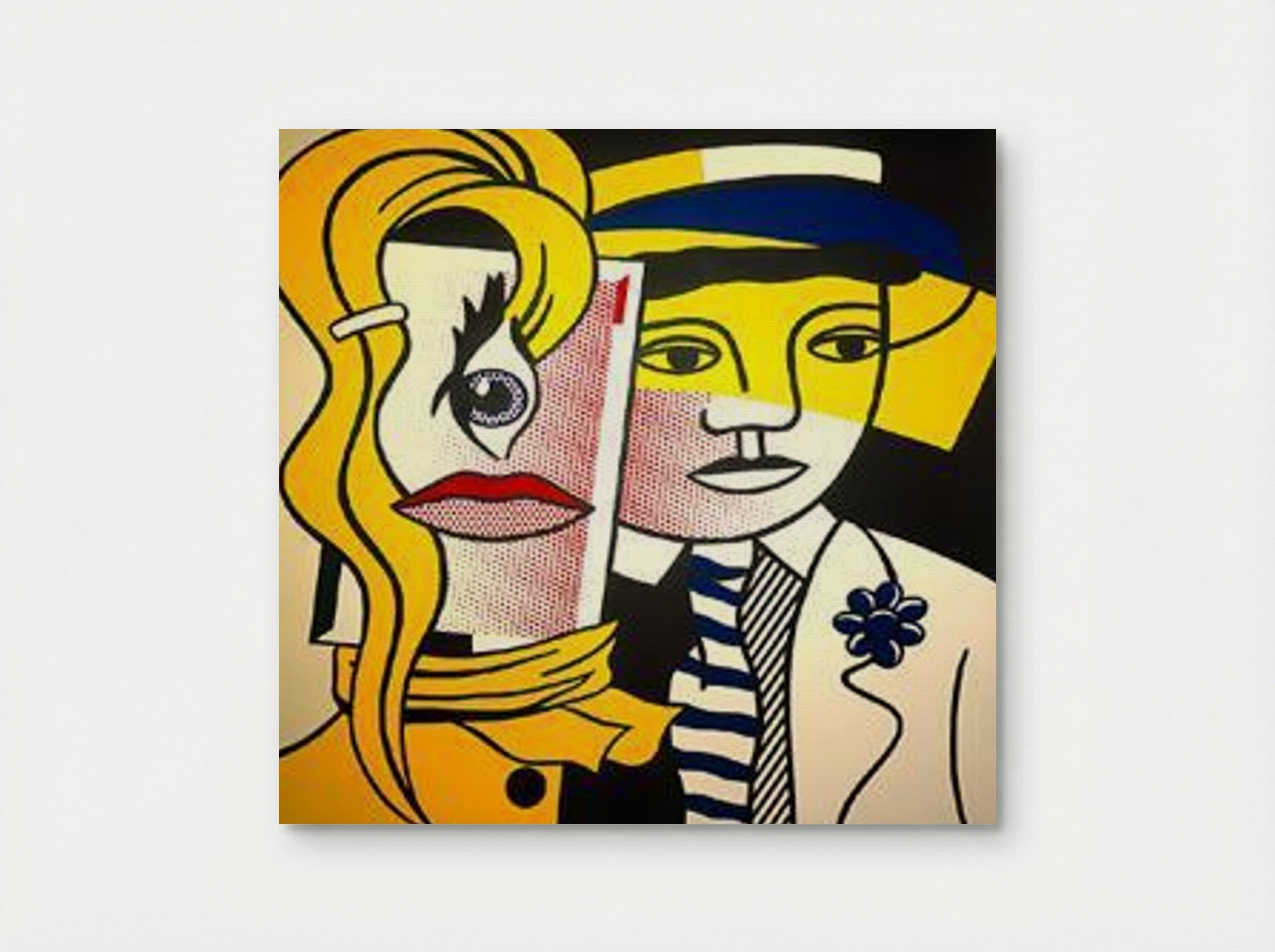
Stepping Out - Roy Lichtenstein
Archival giclée
Frames arrive ready to hang
Secure checkout
Made to order
Description
A 1978 Pop Art work by Roy Lichtenstein, blending Cubist-inspired abstraction with his signature Ben-Day dot technique and bold graphic lines.
Stepping Out, created in 1978, is a representative example of Roy Lichtenstein's later work, where he moved beyond the direct appropriation of comic book panels to engage with the history of modern art. In this piece, Lichtenstein adopts the fractured, multi-perspective approach of Cubism, specifically referencing the works of Fernand Léger and Pablo Picasso, while maintaining his signature Pop Art aesthetic. The composition features two figures, a man and a woman, depicted with the flattened forms and bold outlines characteristic of the artist's style. The woman's face is rendered with a single, oversized eye, a nod to the surrealist distortion of the human form. Lichtenstein employs his trademark Ben-Day dots, a mechanical printing technique he elevated to fine art, to provide shading and texture across the faces of the subjects. The colour palette is restricted to primary tones of yellow, red, and blue, set against stark black and white areas, which creates a high-contrast visual experience. Unlike his earlier works that focused on the melodrama of romance comics, this piece demonstrates a more analytical approach to the act of painting. The figures are presented as icons of urban life, their features simplified into geometric shapes and graphic lines. The man wears a hat and a striped tie, while the woman is adorned with flowing hair and a scarf, suggesting a night out in a metropolitan setting. By merging the high-art language of early twentieth-century modernism with the low-art techniques of commercial printing, Lichtenstein questions the boundaries between these two worlds. The work remains a clear demonstration of his ability to deconstruct visual language, turning familiar subjects into objects of formal study.
Return policy
Because every print is made to order, we don't offer change-of-mind returns, refunds or exchanges. If your order arrives faulty, damaged or incorrect, we'll replace it free of charge — just contact us within 48 hours of delivery. See our refunds page for full details.
Shipping
We ship worldwide, printing at the production hub nearest to your delivery address. Delivery times and costs vary by destination — you'll see the options available to you at checkout.
Manufacturing
Each print is produced to order using 12-colour giclée printing on FSC-certified archival paper. Designed in Britain and printed at your nearest production hub to reduce waste and speed up delivery.
Care and materials
Specific Features
Every Solis piece is made to order with archival, gallery-quality materials built to last.
- Museum-grade giclée printing for rich, fade-resistant colour
- Archival matte fine-art paper, FSC-certified
- Multiple sizes and framing options available
- Frames in black, natural wood, dark wood or white
- Framed prints arrive ready to hang
Care & Cleaning
To keep your artwork looking its best:
- Dust gently with a soft, dry cloth
- Avoid prolonged direct sunlight
- Never use liquid cleaners on the print or canvas surface
- Keep in a dry, room-temperature space
- Handle prints with clean, dry hands
Materials & Sizing
Museum-grade giclée on FSC-certified archival matte paper, with framed and canvas options.
- Paper sizes: A4, A3, A2, A1, A0 and B2 (50×70 cm)
- Canvas: XS (20×30 cm) to Large (60×90 cm)
- Frames: black, natural wood, dark wood or white
Stepping Out - Roy Lichtenstein

Artist Biography
Roy Lichtenstein
He was not young when this happened. He was thirty-eight, teaching art at Rutgers University, and had spent the previous decade painting Abstract Expressionist canvases that looked like everyone else's. The comic paintings were a deliberate rejection of the idea that art had to show the artist's inner emotional state. They showed Donald Duck instead.
Leo Castelli gave him his first show in 1962. Every painting sold before the exhibition opened. The speed was unusual. Warhol was doing similar things with soup cans and Coca-Cola bottles, but Lichtenstein's method was different: he hand-painted everything to look mechanically reproduced. The Ben-Day dots were applied through a stencil. The lines were drawn with a projector and then painted by hand. The process was laborious and precise, which was the joke: meticulous craftsmanship in the service of something that was supposed to look cheap.
He moved beyond comics into landscapes, brushstrokes (paintings of brushstrokes), Chinese landscapes, interiors, and nudes, all in the same flat, graphic style. The Brushstroke series, where he painted enormous images of painterly brushstrokes in the same deadpan comic-book technique, annoyed Abstract Expressionists specifically and delighted everyone else.
Why Choose Us ?
Damage-free delivery guarantee
Fast Shipping
Museum-Quality Materials
You May Also Like