

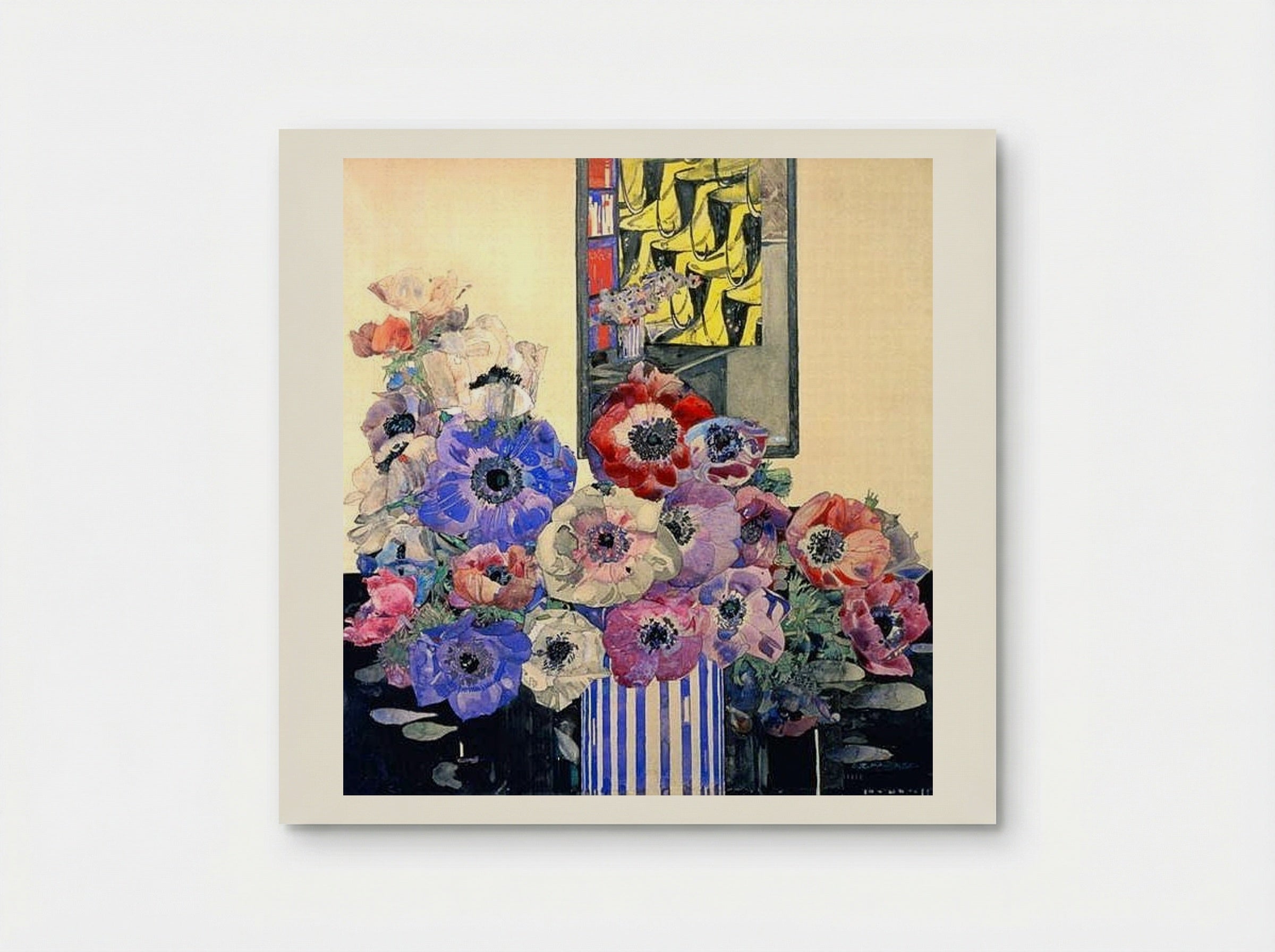
Still Life of Anemones - Charles Rennie Mackintosh
Archival giclée
Frames arrive ready to hang
Secure checkout
Made to order
Description
A watercolour painting by Charles Rennie Mackintosh, 'Still Life of Anemones' features a bouquet of anemones in a striped vase, rendered in delicate colours and set against a neutral background.
Charles Rennie Mackintosh (1868-1928) was a Scottish architect, designer, watercolourist, and artist. He was a leading figure of the Art Nouveau movement in the United Kingdom, known for his distinctive architectural designs and his contributions to the decorative arts. Mackintosh's style combined Scottish Baronial architecture with the flowing lines of Art Nouveau and the Japanese aesthetic. 'Still Life of Anemones' is a watercolour painting that exemplifies Mackintosh's skill as a watercolourist and his interest in floral subjects. The painting depicts a bouquet of anemones in a vase, set against a neutral background. The flowers are rendered in a range of colours, from deep blues and purples to soft pinks and whites. Mackintosh's use of watercolour creates a sense of transparency and luminosity, capturing the delicate nature of the flowers. The composition is carefully balanced, with the flowers arranged in a way that is both natural and aesthetically pleasing. The vase, decorated with blue and white stripes, adds a touch of geometric contrast to the organic forms of the flowers. In the background, a framed picture adds depth and complexity to the composition.
Return policy
Because every print is made to order, we don't offer change-of-mind returns, refunds or exchanges. If your order arrives faulty, damaged or incorrect, we'll replace it free of charge — just contact us within 48 hours of delivery. See our refunds page for full details.
Shipping
We ship worldwide, printing at the production hub nearest to your delivery address. Delivery times and costs vary by destination — you'll see the options available to you at checkout.
Manufacturing
Each print is produced to order using 12-colour giclée printing on FSC-certified archival paper. Designed in Britain and printed at your nearest production hub to reduce waste and speed up delivery.
Still Life of Anemones - Charles Rennie Mackintosh

Artist Biography
Charles Rennie Mackintosh
He was the fourth of eleven children, seven of whom survived infancy. His father was a police superintendent. The boy was probably dyslexic, struggled badly at school, and used sketchbooks to manage what appear to have been emotional difficulties. He had a contracted sinew in one foot that gave him a limp, and childhood rheumatic fever left one side of his face permanently drooped. None of this stopped him drawing.
He enrolled at Glasgow School of Art at fifteen, studying part-time while apprenticed to the architect John Hutchinson. In 1889 he joined Honeyman and Keppie, where he would remain for nearly two decades. He met Margaret Macdonald in 1892. Together with her sister Frances and Herbert McNair, they formed a group that became known as The Four. Mackintosh and Margaret married in 1900. He acknowledged publicly that Margaret had genius where he had only talent.
His greatest commission was the Glasgow School of Art building itself, won in competition in 1897. The library wing, completed in 1909, is considered one of the finest interiors of the twentieth century. He designed all four tea rooms for the entrepreneur Catherine Cranston, going so far as to specify the waitresses' dresses and order the flowers. In Vienna, at the eighth Secessionist Exhibition in 1900, his work was received with an enthusiasm Glasgow never matched.
His style fell from favour. He drank. He was asked to leave his firm. In 1914 he and Margaret moved to Walberswick in Suffolk, where he was briefly arrested as a suspected German spy because of his Vienna correspondence and unusual manner. He was released without charge but effectively driven from the village.
In 1923, they moved to Port Vendres in the south of France. The light and landscape revived him. He painted watercolours of the surrounding hills and harbour with an obsessive attention to geological detail, completing around forty before returning to London for the last time.
Our Features
Designed for Lasting Impact
Specific Features
Every Solis piece is made to order with archival, gallery-quality materials built to last.
- Museum-grade giclée printing for rich, fade-resistant colour
- Archival matte fine-art paper, FSC-certified
- Multiple sizes and framing options available
- Frames in black, natural wood, dark wood or white
- Framed prints arrive ready to hang
Care & Cleaning
To keep your artwork looking its best:
- Dust gently with a soft, dry cloth
- Avoid prolonged direct sunlight
- Never use liquid cleaners on the print or canvas surface
- Keep in a dry, room-temperature space
- Handle prints with clean, dry hands
Materials & Sizing
Museum-grade giclée on FSC-certified archival matte paper, with framed and canvas options.
- Paper sizes: A4, A3, A2, A1, A0 and B2 (50×70 cm)
- Canvas: XS (20×30 cm) to Large (60×90 cm)
- Frames: black, natural wood, dark wood or white
Why Choose Us ?
Damage-free delivery guarantee
Fast Shipping
Museum-Quality Materials
Artist Biography
Charles Rennie Mackintosh
He was the fourth of eleven children, seven of whom survived infancy. His father was a police superintendent. The boy was probably dyslexic, struggled badly at school, and used sketchbooks to manage what appear to have been emotional difficulties. He had a contracted sinew in one foot that gave him a limp, and childhood rheumatic fever left one side of his face permanently drooped. None of this stopped him drawing.
He enrolled at Glasgow School of Art at fifteen, studying part-time while apprenticed to the architect John Hutchinson. In 1889 he joined Honeyman and Keppie, where he would remain for nearly two decades. He met Margaret Macdonald in 1892. Together with her sister Frances and Herbert McNair, they formed a group that became known as The Four. Mackintosh and Margaret married in 1900. He acknowledged publicly that Margaret had genius where he had only talent.
His greatest commission was the Glasgow School of Art building itself, won in competition in 1897. The library wing, completed in 1909, is considered one of the finest interiors of the twentieth century. He designed all four tea rooms for the entrepreneur Catherine Cranston, going so far as to specify the waitresses' dresses and order the flowers. In Vienna, at the eighth Secessionist Exhibition in 1900, his work was received with an enthusiasm Glasgow never matched.
His style fell from favour. He drank. He was asked to leave his firm. In 1914 he and Margaret moved to Walberswick in Suffolk, where he was briefly arrested as a suspected German spy because of his Vienna correspondence and unusual manner. He was released without charge but effectively driven from the village.
In 1923, they moved to Port Vendres in the south of France. The light and landscape revived him. He painted watercolours of the surrounding hills and harbour with an obsessive attention to geological detail, completing around forty before returning to London for the last time.
You May Also Like