

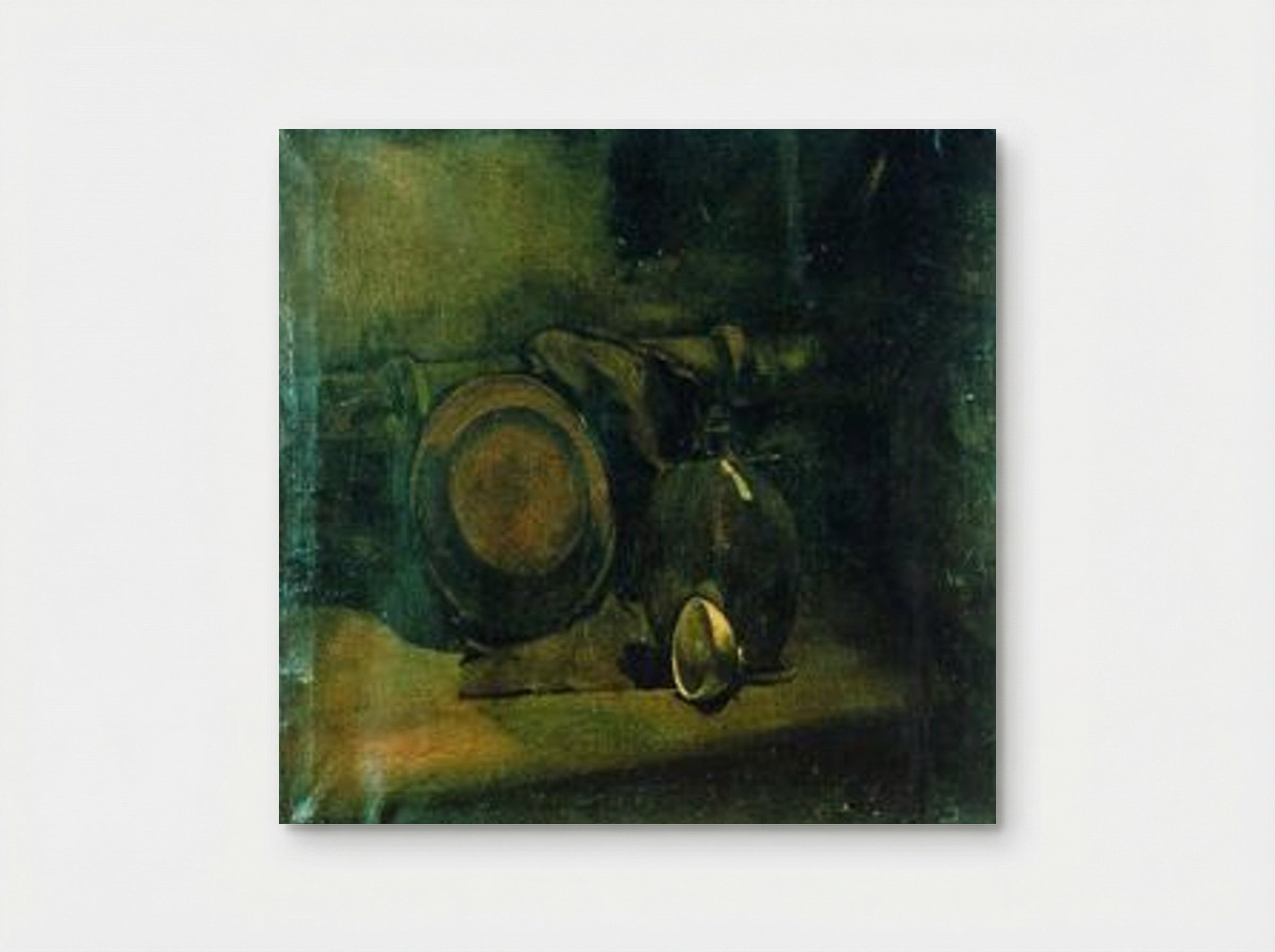
Still Life - Theo van Doesburg
Archival giclée
Frames arrive ready to hang
Secure checkout
Made to order
Description
An early, atmospheric still life by Theo van Doesburg, featuring a muted palette and a focus on form and shadow.
This early work by Theo van Doesburg captures a domestic scene rendered with a sombre, moody palette. Before he became a primary figure in the De Stijl movement and an advocate for geometric abstraction, van Doesburg explored traditional subjects through a lens influenced by late nineteenth-century Dutch painting. The composition focuses on a collection of everyday objects, including a circular plate and a dark vessel, arranged upon a flat surface. The artist employs a restricted range of deep greens, browns, and ochres to define the forms. Light is used sparingly, emerging from the gloom to catch the edge of the vessel and the surface of the plate. This approach creates a sense of quietude and weight, typical of his formative years. The brushwork is deliberate, building up the texture of the objects while allowing the background to recede into shadow. Unlike his later, strictly ordered compositions, this piece reveals a preoccupation with atmosphere and the physical presence of objects. It provides a view into the artist's early development, showing his initial engagement with the tonal qualities of oil paint. The work is a study in shadow and form, demonstrating how van Doesburg experimented with light before moving toward the primary colours and grid-based structures that defined his later career. This print offers an opportunity to observe the origins of an artist who would eventually reshape the visual language of modern art.
Return policy
Because every print is made to order, we don't offer change-of-mind returns, refunds or exchanges. If your order arrives faulty, damaged or incorrect, we'll replace it free of charge — just contact us within 48 hours of delivery. See our refunds page for full details.
Shipping
We ship worldwide, printing at the production hub nearest to your delivery address. Delivery times and costs vary by destination — you'll see the options available to you at checkout.
Manufacturing
Each print is produced to order using 12-colour giclée printing on FSC-certified archival paper. Designed in Britain and printed at your nearest production hub to reduce waste and speed up delivery.
Still Life - Theo van Doesburg

Artist Biography
Theo Van Doesburg
He was born in Utrecht in 1883. After encountering Mondrian's work around 1915, he sought him out and together they launched the magazine De Stijl in 1917, along with Bart van der Leck, Vilmos Huszar, J.J.P. Oud and Antony Kok. Van Doesburg was the movement's organiser, publicist and ambassador, travelling across Europe to promote Neoplasticism while Mondrian stayed in his studio.
In 1922 he moved to Weimar and set up an unofficial school near the Bauhaus to attract students to Constructivist and De Stijl ideas. Walter Gropius acknowledged the influence but refused to give Van Doesburg a teaching post. The rivalry was productive: Bauhaus design absorbed De Stijl principles without crediting the source.
The break with Mondrian came over diagonals. Mondrian insisted on strictly horizontal and vertical lines; Van Doesburg introduced the diagonal in his Counter-Compositions, arguing for dynamic rather than static geometry. They stopped speaking. In 1929 they met accidentally in a Paris cafe and reconciled.
He married three times. His third wife, Nelly van Moorsel, was an artist, pianist and choreographer. He died in Davos in 1931, at forty-seven, from a heart attack. De Stijl ended with him.
Our Features
Designed for Lasting Impact
Specific Features
Every Solis piece is made to order with archival, gallery-quality materials built to last.
- Museum-grade giclée printing for rich, fade-resistant colour
- Archival matte fine-art paper, FSC-certified
- Multiple sizes and framing options available
- Frames in black, natural wood, dark wood or white
- Framed prints arrive ready to hang
Care & Cleaning
To keep your artwork looking its best:
- Dust gently with a soft, dry cloth
- Avoid prolonged direct sunlight
- Never use liquid cleaners on the print or canvas surface
- Keep in a dry, room-temperature space
- Handle prints with clean, dry hands
Materials & Sizing
Museum-grade giclée on FSC-certified archival matte paper, with framed and canvas options.
- Paper sizes: A4, A3, A2, A1, A0 and B2 (50×70 cm)
- Canvas: XS (20×30 cm) to Large (60×90 cm)
- Frames: black, natural wood, dark wood or white
Why Choose Us ?
Damage-free delivery guarantee
Fast Shipping
Museum-Quality Materials
Artist Biography
Theo van Doesburg
He was born in Utrecht in 1883. After encountering Mondrian's work around 1915, he sought him out and together they launched the magazine De Stijl in 1917, along with Bart van der Leck, Vilmos Huszar, J.J.P. Oud and Antony Kok. Van Doesburg was the movement's organiser, publicist and ambassador, travelling across Europe to promote Neoplasticism while Mondrian stayed in his studio.
In 1922 he moved to Weimar and set up an unofficial school near the Bauhaus to attract students to Constructivist and De Stijl ideas. Walter Gropius acknowledged the influence but refused to give Van Doesburg a teaching post. The rivalry was productive: Bauhaus design absorbed De Stijl principles without crediting the source.
The break with Mondrian came over diagonals. Mondrian insisted on strictly horizontal and vertical lines; Van Doesburg introduced the diagonal in his Counter-Compositions, arguing for dynamic rather than static geometry. They stopped speaking. In 1929 they met accidentally in a Paris cafe and reconciled.
He married three times. His third wife, Nelly van Moorsel, was an artist, pianist and choreographer. He died in Davos in 1931, at forty-seven, from a heart attack. De Stijl ended with him.
You May Also Like