

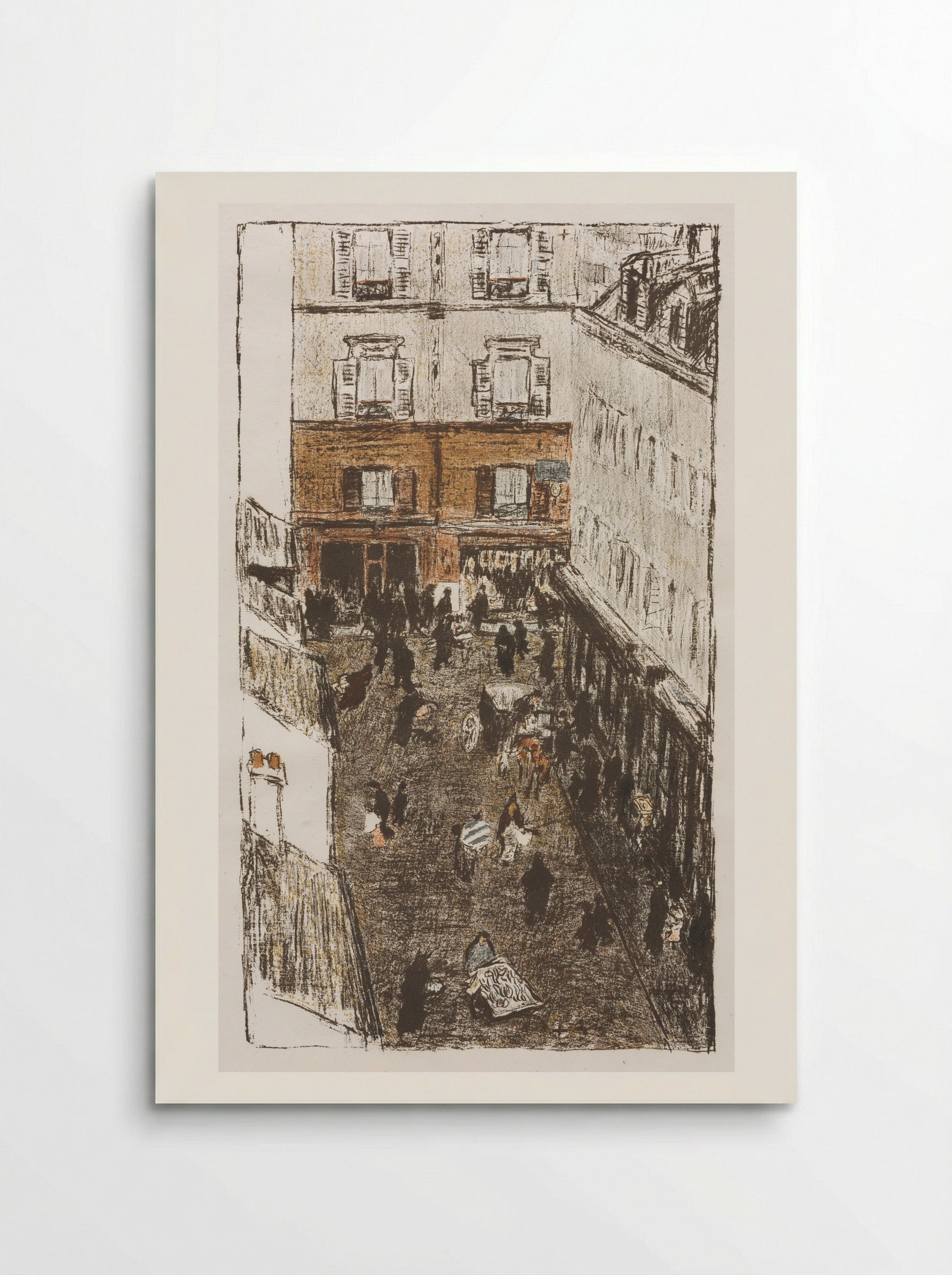
Street Corner seen from Above - Pierre Bonnard
Archival giclée
Frames arrive ready to hang
Secure checkout
Made to order
Description
A lithograph by Pierre Bonnard depicting a Parisian street from a high vantage point, capturing the rhythmic movement of city life through a flattened perspective.
This lithograph by Pierre Bonnard captures a Parisian street scene from a high vantage point, a perspective that reflects the artist's interest in the unconventional framing of urban life. As a member of the Nabis group, Bonnard often experimented with flattened space and decorative patterns, influenced by the aesthetic principles of Japanese woodblock prints. The composition relies on a steep, downward angle that compresses the street level, turning the movement of pedestrians and carriages into a rhythmic arrangement of dark, silhouetted forms. The work is part of the series 'Quelques aspects de la vie de Paris', published by Ambroise Vollard. Bonnard employs a muted palette, using earthy browns and ochres to define the architecture, while allowing the white of the paper to suggest light and atmosphere. The buildings are rendered with quick, sketch-like lines, conveying the texture of stone and the repetition of window shutters. The figures below are reduced to essential shapes, suggesting the anonymity and constant motion of the city. By omitting traditional horizon lines, Bonnard forces the viewer to engage with the scene as a graphic surface rather than a window into a three-dimensional space. This print demonstrates the artist's ability to transform a mundane observation into a structured visual experience. The contrast between the static, vertical lines of the buildings and the chaotic, scattered placement of the people creates a sense of balance. It is a study of urban observation, where the artist acts as a detached witness to the daily rhythms of the capital. The lithographic technique allows for a soft, granular quality that softens the edges of the architecture, lending the scene a sense of fleeting memory rather than rigid documentation. This piece remains a clear example of the graphic experimentation that defined late nineteenth-century French printmaking.
Return policy
Because every print is made to order, we don't offer change-of-mind returns, refunds or exchanges. If your order arrives faulty, damaged or incorrect, we'll replace it free of charge — just contact us within 48 hours of delivery. See our refunds page for full details.
Shipping
We ship worldwide, printing at the production hub nearest to your delivery address. Delivery times and costs vary by destination — you'll see the options available to you at checkout.
Manufacturing
Each print is produced to order using 12-colour giclée printing on FSC-certified archival paper. Designed in Britain and printed at your nearest production hub to reduce waste and speed up delivery.
Care and materials
Specific Features
Every Solis piece is made to order with archival, gallery-quality materials built to last.
- Museum-grade giclée printing for rich, fade-resistant colour
- Archival matte fine-art paper, FSC-certified
- Multiple sizes and framing options available
- Frames in black, natural wood, dark wood or white
- Framed prints arrive ready to hang
Care & Cleaning
To keep your artwork looking its best:
- Dust gently with a soft, dry cloth
- Avoid prolonged direct sunlight
- Never use liquid cleaners on the print or canvas surface
- Keep in a dry, room-temperature space
- Handle prints with clean, dry hands
Materials & Sizing
Museum-grade giclée on FSC-certified archival matte paper, with framed and canvas options.
- Paper sizes: A4, A3, A2, A1, A0 and B2 (50×70 cm)
- Canvas: XS (20×30 cm) to Large (60×90 cm)
- Frames: black, natural wood, dark wood or white
Street Corner seen from Above - Pierre Bonnard

Artist Biography
Pierre Bonnard
Bonnard's intensely personal style, developed through close observation and a deep connection to his surroundings, often featured his wife, Marthe de Méligny, as a recurring muse. His exploration of memory and sensation, evident in works such as 'Nude in the Bath' (1925), elevates the mundane to the sublime. Though sometimes labelled an Intimist, his artistic ambition extended far beyond mere depictions of private life, seeking to capture the very essence of lived experience.
Despite initial recognition, Bonnard's reputation waned in the mid-20th century as abstraction gained prominence. However, his unique vision and masterful use of colour have since been rightfully reassessed. Today, Pierre Bonnard is recognised as a major force in modern art, whose paintings offer a profound meditation on beauty, memory, and the quiet poetry of everyday existence. His art prints bring a touch of French modernism to any space.
Why Choose Us ?
Damage-free delivery guarantee
Fast Shipping
Museum-Quality Materials
You May Also Like