

Fine Art Poster
From $29
A giclée print on 200gsm matte fine art paper, using a twelve-colour process for accurate, fade-resistant colour. Supplied unframed, delivered flat or rolled.



Archival giclée
Frames arrive ready to hang
Secure checkout
Made to order
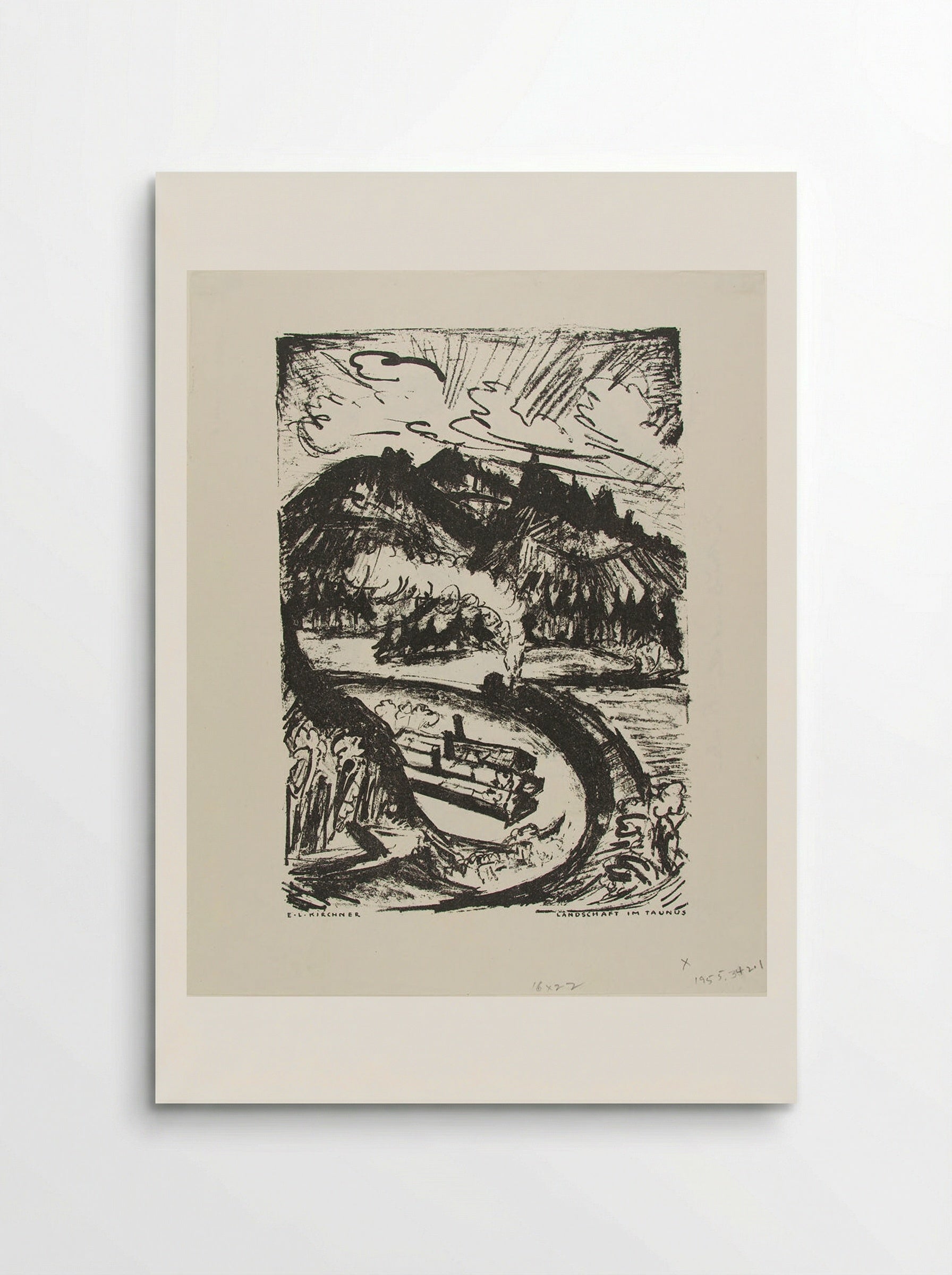
A striking 1916 lithograph by Ernst Ludwig Kirchner, featuring a train moving through the Taunus region with the bold, angular lines of German Expressionism.
This lithograph by Ernst Ludwig Kirchner, titled Taunus Landscape, appeared in the sixth issue of the periodical Der Bildermann in 1916. Kirchner, a founding member of the Die Brücke group, produced this work during a period of significant personal and artistic transition. The print captures a view of the Taunus region, rendered with the jagged, energetic lines characteristic of his graphic output during the First World War. The composition is dominated by a sense of movement, as a train curves through the foreground, its smoke rising to meet the turbulent sky. Kirchner employs a stark, high-contrast aesthetic, using bold black ink to define the forms of the hills and the mechanical structure of the locomotive. The trees and terrain are not depicted with photographic precision; rather, they are abstracted into rhythmic, angular shapes that convey the artist's subjective experience of the environment. The heavy, expressive mark-making reflects the urgency and emotional intensity often associated with German Expressionist printmaking. Der Bildermann was a short-lived publication that sought to bring contemporary art to a wider audience through affordable lithographic prints. Kirchner's contribution demonstrates his ability to translate his painterly concerns into the medium of lithography. The work avoids decorative detail, focusing instead on the raw energy of the scene. The interplay between the natural forms of the mountains and the industrial presence of the train creates a tension that is typical of Kirchner's work from this era. This print offers a direct look at the artist's graphic style, where the physical act of drawing on the stone remains visible in every stroke. It is a clear example of the Expressionist approach to capturing the spirit of a place through simplified, forceful forms.
Because every print is made to order, we don't offer change-of-mind returns, refunds or exchanges. If your order arrives faulty, damaged or incorrect, we'll replace it free of charge — just contact us within 48 hours of delivery. See our refunds page for full details.
We ship worldwide, printing at the production hub nearest to your delivery address. Delivery times and costs vary by destination — you'll see the options available to you at checkout.
Each print is produced to order using 12-colour giclée printing on FSC-certified archival paper. Designed in Britain and printed at your nearest production hub to reduce waste and speed up delivery.
Specific Features
Every Solis piece is made to order with archival, gallery-quality materials built to last.
Care & Cleaning
To keep your artwork looking its best:
Materials & Sizing
Museum-grade giclée on FSC-certified archival matte paper, with framed and canvas options.

Artist Biography
Made to order
Every piece is printed to order. These are the five finishes, and what makes each one different.
From $29
A giclée print on 200gsm matte fine art paper, using a twelve-colour process for accurate, fade-resistant colour. Supplied unframed, delivered flat or rolled.

From $89
The same fine art print in a solid wood frame with UV-protective acrylic glaze and rigid backing. Five frame colours. Arrives ready to hang.

From $169
A deeper solid wood frame: 33mm deep with a 20mm face and Perspex glaze. The print sits unmounted for a clean gallery presentation. Black, white or natural.

From $59
Hand-stretched canvas with neat gallery-wrapped edges, giving the artwork surface texture and depth. Arrives ready to hang.

From $175
Stretched canvas set in a floating wood frame, our most substantial finish. Arrives ready to hang.
Why Choose Us ?
Damage-free delivery guarantee
Fast Shipping
Museum-Quality Materials
You May Also Like
We use cookies to measure our marketing and see which prints people love.We use cookies to measure our marketing.
By continuing to browse, you agree · Privacy Policy