

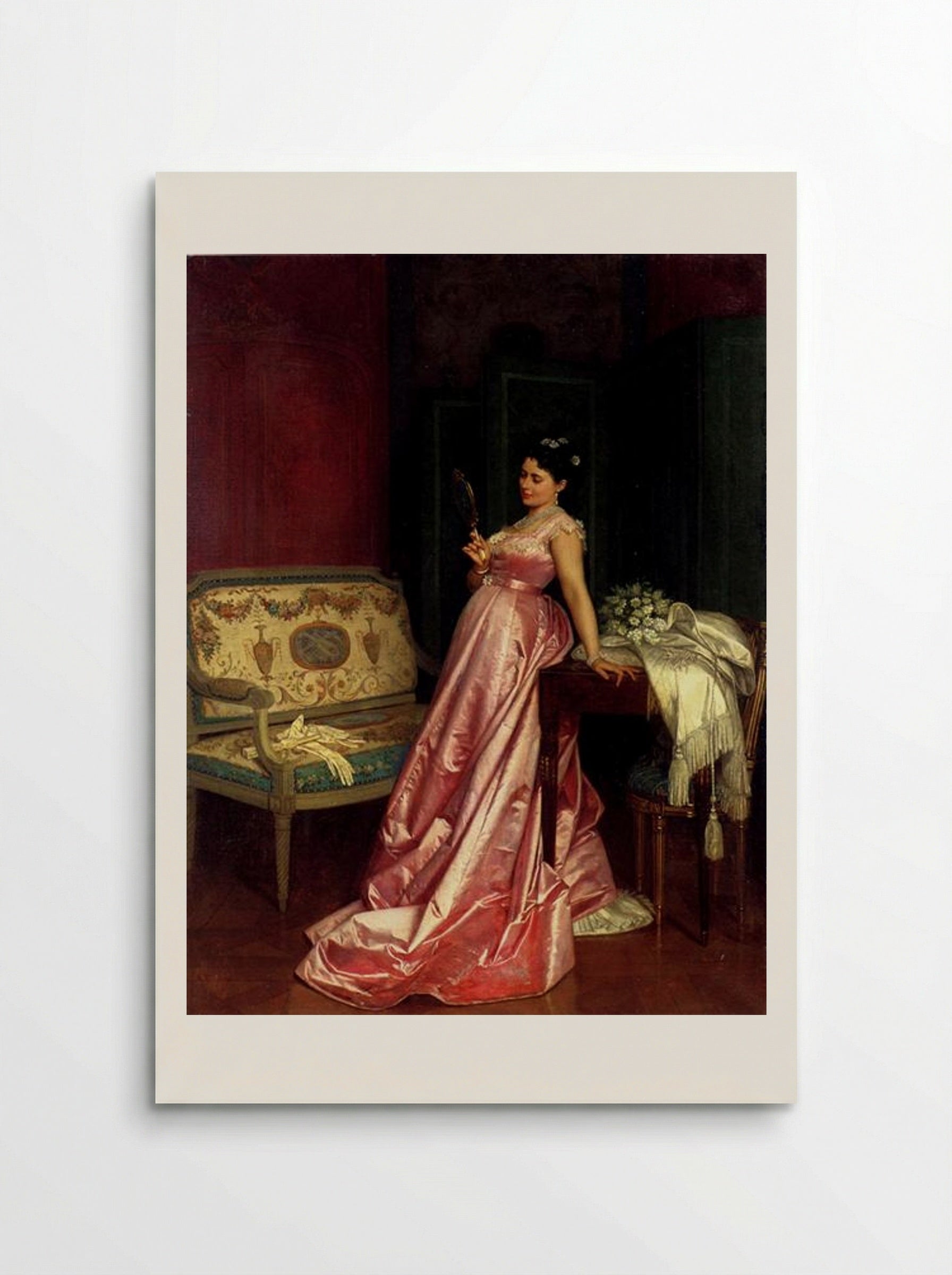
The Admiring Glance - Auguste Toulmouche
Archival giclée
Frames arrive ready to hang
Secure checkout
Made to order
Description
A refined genre painting by Auguste Toulmouche, capturing a woman in a pink satin gown observing her reflection in a hand mirror.
Auguste Toulmouche was a prominent figure in the Parisian art scene during the Second Empire, known for his polished depictions of the bourgeoisie. In this work, he captures a woman in a moment of private reflection. She stands in a dimly lit interior, holding a hand mirror to inspect her appearance. Her gown, rendered in a luminous shade of pink satin, dominates the composition. The fabric catches the light, creating deep folds and highlights that demonstrate the technical precision expected of the Academic tradition. The setting is typical of the period, featuring a Louis XVI style settee with floral upholstery and a dark, heavy interior. A pair of white gloves rests on the seat, suggesting she has recently returned from an outing or is preparing for one. The contrast between the soft, pale skin of the subject and the dark, moody background directs the viewer's attention to her posture and the texture of her attire. Toulmouche often focused on the domestic lives of women, providing a glimpse into the social rituals and material culture of the upper classes in nineteenth-century France. His work was frequently exhibited at the Paris Salon, where he gained a reputation for his ability to paint textiles and interior details with photographic accuracy. This painting reflects the era's fascination with luxury and the performative nature of social identity. By placing the subject in a quiet, controlled environment, Toulmouche invites the viewer to observe the subtle interplay between the individual and her surroundings. The composition is balanced, with the verticality of the figure offset by the horizontal lines of the furniture. This piece remains a clear example of the refined, narrative-driven style that defined the artist's career, prioritising technical finish and atmospheric detail over the more experimental approaches emerging in the art world at the time.
Return policy
Because every print is made to order, we don't offer change-of-mind returns, refunds or exchanges. If your order arrives faulty, damaged or incorrect, we'll replace it free of charge — just contact us within 48 hours of delivery. See our refunds page for full details.
Shipping
We ship worldwide, printing at the production hub nearest to your delivery address. Delivery times and costs vary by destination — you'll see the options available to you at checkout.
Manufacturing
Each print is produced to order using 12-colour giclée printing on FSC-certified archival paper. Designed in Britain and printed at your nearest production hub to reduce waste and speed up delivery.
The Admiring Glance - Auguste Toulmouche

Artist Biography
Auguste Toulmouche
Born in Nantes in 1829, Toulmouche studied at the École des Beaux-Arts under Thomas Couture, painter of *Romans of the Decadence*. It was through family connections that the young Claude Monet, arriving in Paris in 1862, came to Toulmouche's studio and was directed on to Charles Gleyre's atelier, where Monet met Renoir, Sisley, and Bazille. That brief intersection with Impressionism's future is now the most-cited fact in Toulmouche's biography, which says something about how thoroughly the academic tradition he represented was superseded by the movement it inadvertently helped to launch.
Toulmouche was awarded the Légion d'honneur and produced work that remained commercially popular throughout his lifetime. Later critics placed him alongside Jean Béraud and Raffaelli as painters whose primary interest lies in the period record they provide: precise documentation of the clothes, furnishings, and domestic arrangements of bourgeois Parisian life in the Second Empire and early Third Republic. He died in Paris in 1890.
Our Features
Designed for Lasting Impact
Specific Features
Every Solis piece is made to order with archival, gallery-quality materials built to last.
- Museum-grade giclée printing for rich, fade-resistant colour
- Archival matte fine-art paper, FSC-certified
- Multiple sizes and framing options available
- Frames in black, natural wood, dark wood or white
- Framed prints arrive ready to hang
Care & Cleaning
To keep your artwork looking its best:
- Dust gently with a soft, dry cloth
- Avoid prolonged direct sunlight
- Never use liquid cleaners on the print or canvas surface
- Keep in a dry, room-temperature space
- Handle prints with clean, dry hands
Materials & Sizing
Museum-grade giclée on FSC-certified archival matte paper, with framed and canvas options.
- Paper sizes: A4, A3, A2, A1, A0 and B2 (50×70 cm)
- Canvas: XS (20×30 cm) to Large (60×90 cm)
- Frames: black, natural wood, dark wood or white
Why Choose Us ?
Damage-free delivery guarantee
Fast Shipping
Museum-Quality Materials
Artist Biography
Auguste Toulmouche
Born in Nantes in 1829, Toulmouche studied at the École des Beaux-Arts under Thomas Couture, painter of *Romans of the Decadence*. It was through family connections that the young Claude Monet, arriving in Paris in 1862, came to Toulmouche's studio and was directed on to Charles Gleyre's atelier, where Monet met Renoir, Sisley, and Bazille. That brief intersection with Impressionism's future is now the most-cited fact in Toulmouche's biography, which says something about how thoroughly the academic tradition he represented was superseded by the movement it inadvertently helped to launch.
Toulmouche was awarded the Légion d'honneur and produced work that remained commercially popular throughout his lifetime. Later critics placed him alongside Jean Béraud and Raffaelli as painters whose primary interest lies in the period record they provide: precise documentation of the clothes, furnishings, and domestic arrangements of bourgeois Parisian life in the Second Empire and early Third Republic. He died in Paris in 1890.
You May Also Like