

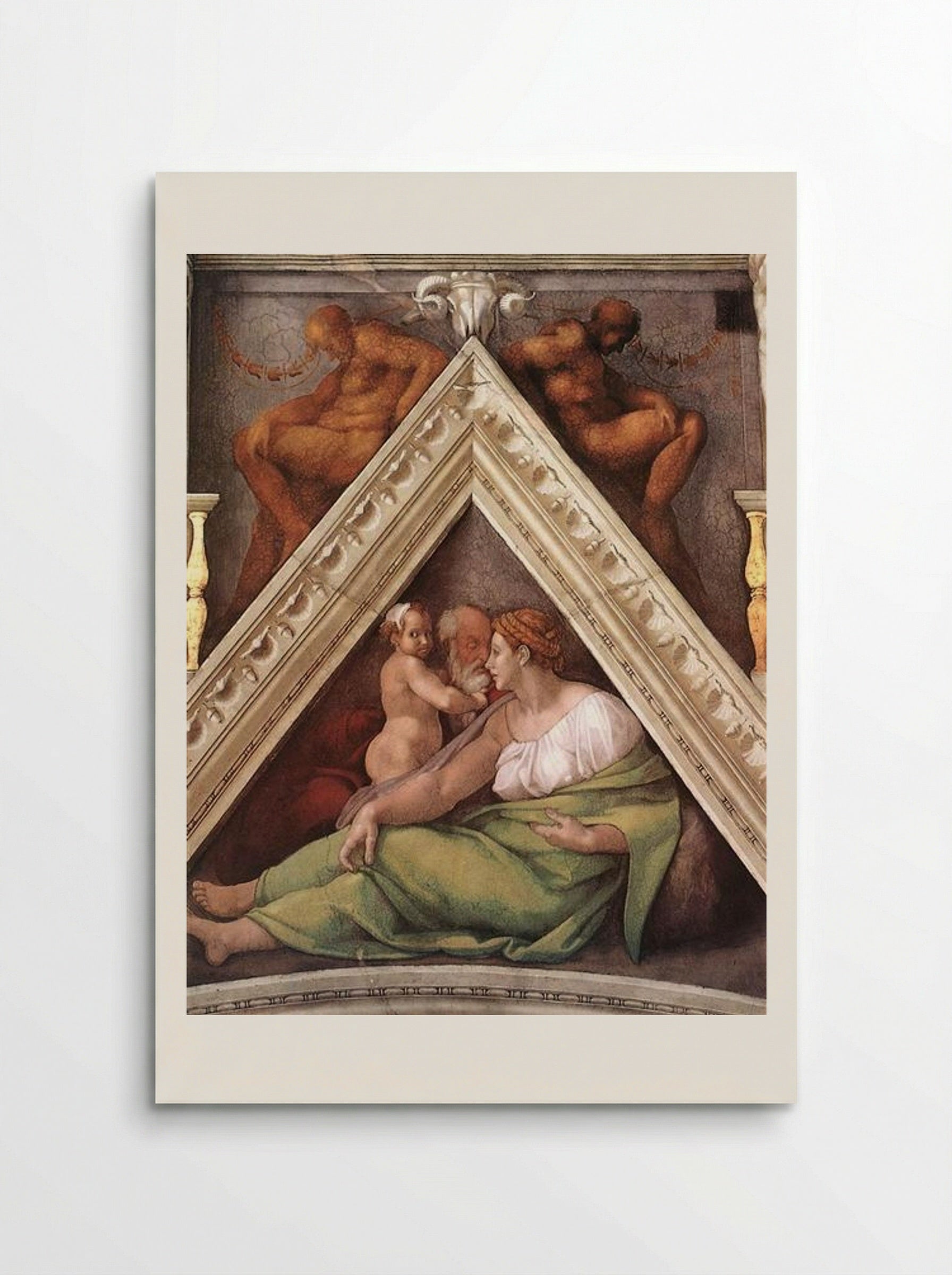
The Ancestors of Christ: Hezekiah - Michelangelo Buonarroti
Archival giclée
Frames arrive ready to hang
Secure checkout
Made to order
Description
A detail from the Sistine Chapel ceiling, this fresco depicts the ancestors of Christ within a triangular spandrel, showcasing Michelangelo's mastery of form.
This work forms part of the extensive decorative programme Michelangelo executed for the Sistine Chapel ceiling between 1508 and 1512. Located within one of the triangular spandrels, the composition depicts a family group identified as the ancestors of Christ, specifically associated with the lineage of Hezekiah. Michelangelo employs a triangular framing device that dictates the arrangement of the figures, forcing them into a compact, intimate space that contrasts with the monumental scale of the surrounding prophets and sibyls. The central figures include a woman, often identified as the mother, who reclines in the foreground draped in a pale green mantle. Her posture is relaxed, yet her gaze is directed toward the older male figure behind her. A small child stands between them, creating a sense of domestic quietude that is rare within the broader context of the chapel ceiling. Above this group, two nude figures are positioned in the upper corners of the spandrel. These figures are rendered with the muscular definition and sculptural quality characteristic of Michelangelo's approach to the human form, appearing almost as if they are carved from the stone architecture itself. The palette is restrained, relying on earthy tones and soft transitions of light and shadow to model the forms. The fresco technique allows for a matte finish, which emphasises the solidity of the figures. Michelangelo avoids excessive ornamentation, focusing instead on the anatomical precision and the psychological tension between the individuals. The architectural frame, painted to mimic stone, provides a rigid boundary for the organic, flowing lines of the human bodies. This work demonstrates the artist's ability to adapt complex narrative themes to the challenging geometry of the chapel's architecture, maintaining a balance between structural necessity and human expression.
Return policy
Because every print is made to order, we don't offer change-of-mind returns, refunds or exchanges. If your order arrives faulty, damaged or incorrect, we'll replace it free of charge — just contact us within 48 hours of delivery. See our refunds page for full details.
Shipping
We ship worldwide, printing at the production hub nearest to your delivery address. Delivery times and costs vary by destination — you'll see the options available to you at checkout.
Manufacturing
Each print is produced to order using 12-colour giclée printing on FSC-certified archival paper. Designed in Britain and printed at your nearest production hub to reduce waste and speed up delivery.
Care and materials
Specific Features
Every Solis piece is made to order with archival, gallery-quality materials built to last.
- Museum-grade giclée printing for rich, fade-resistant colour
- Archival matte fine-art paper, FSC-certified
- Multiple sizes and framing options available
- Frames in black, natural wood, dark wood or white
- Framed prints arrive ready to hang
Care & Cleaning
To keep your artwork looking its best:
- Dust gently with a soft, dry cloth
- Avoid prolonged direct sunlight
- Never use liquid cleaners on the print or canvas surface
- Keep in a dry, room-temperature space
- Handle prints with clean, dry hands
Materials & Sizing
Museum-grade giclée on FSC-certified archival matte paper, with framed and canvas options.
- Paper sizes: A4, A3, A2, A1, A0 and B2 (50×70 cm)
- Canvas: XS (20×30 cm) to Large (60×90 cm)
- Frames: black, natural wood, dark wood or white
The Ancestors of Christ: Hezekiah - Michelangelo Buonarroti

Artist Biography
Michelangelo
He was apprenticed to Domenico Ghirlandaio at thirteen, the standard arrangement for a Florentine boy showing artistic ability. Ghirlandaio ran the largest workshop in the city and was a master of fresco technique. Michelangelo left after one year, claiming there was nothing more to learn. He moved to the sculpture garden of Lorenzo de' Medici, where he studied ancient Roman fragments and attracted the patronage of the Medici family. He was sixteen.
The Pieta was finished when he was twenty-four. David when he was twenty-nine. Both before the age of thirty. He carved David from a block of marble that two previous sculptors had already attempted and abandoned: a narrow, shallow piece that dictated the figure's proportions and made the engineering problem as interesting as the artistic one.
Pope Julius II commissioned the Sistine Chapel ceiling in 1508. Michelangelo did not want the job. He considered himself a sculptor, not a painter, and suspected the commission was a political manoeuvre by rivals to set him up for public failure. He fired his assistants, built his own scaffolding, and painted the entire 65-foot ceiling himself over four years. The image of him lying on his back is a myth; he stood, bending backwards, paint dripping into his eyes.
He outlived both Leonardo and Raphael by more than forty years. His last significant work was the redesign of St Peter's Basilica in Rome. He took no fee.
Why Choose Us ?
Damage-free delivery guarantee
Fast Shipping
Museum-Quality Materials
You May Also Like