

Fine Art Poster
From $29
A giclée print on 200gsm matte fine art paper, using a twelve-colour process for accurate, fade-resistant colour. Supplied unframed, delivered flat or rolled.



Archival giclée
Frames arrive ready to hang
Secure checkout
Made to order
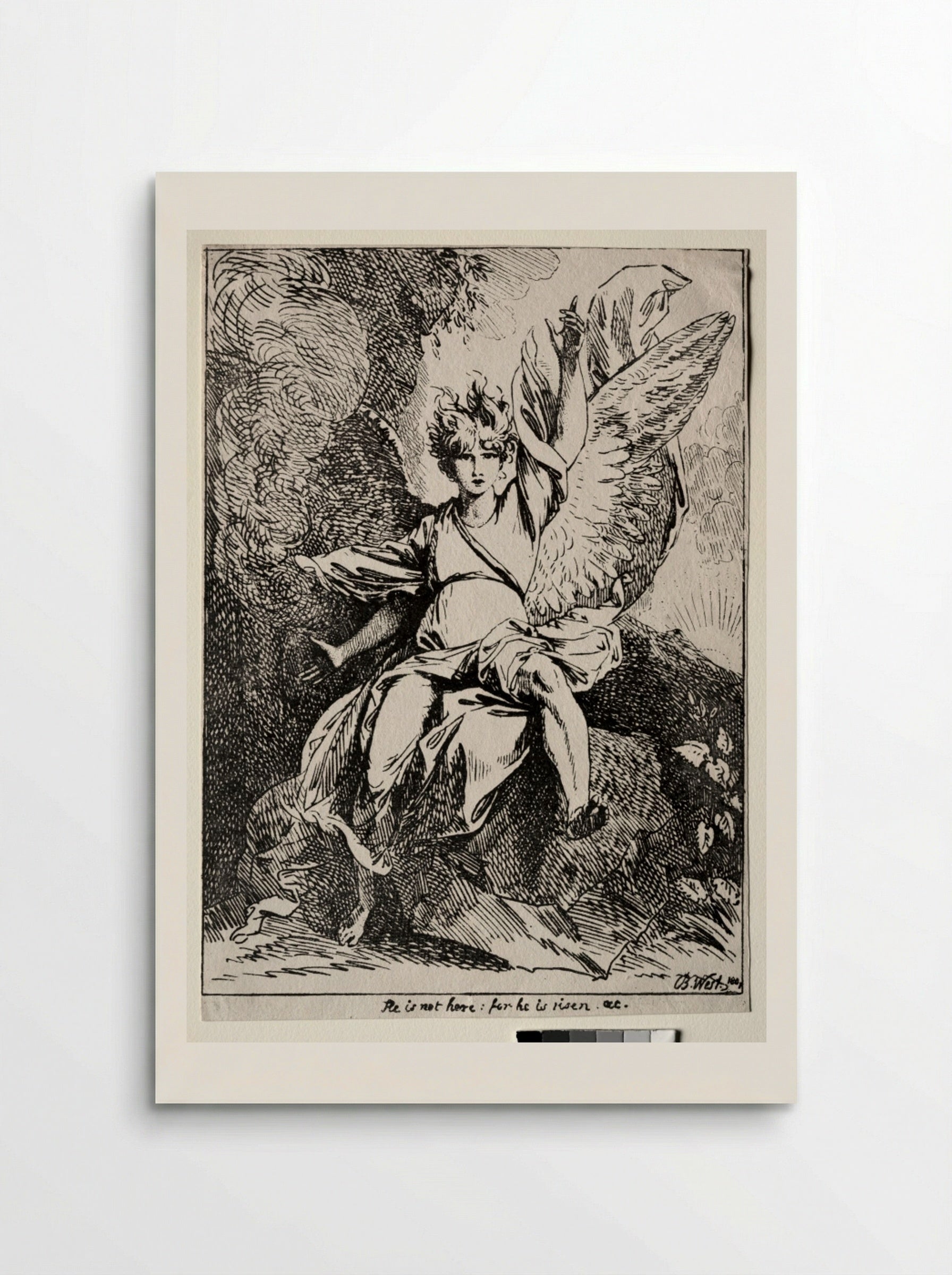
A rare 1801 lithograph by Benjamin West, depicting the angel at the tomb of Christ with expressive, energetic line work.
This print is a significant example of early lithography, appearing in the publication 'Specimens of Polyautography' in 1801. Benjamin West, an American painter who spent much of his career in London, was one of the first artists to experiment with this new medium. The process, then known as polyautography, allowed artists to draw directly onto stone, capturing the spontaneity of their hand without the mediation of an engraver. The composition depicts the angel seated at the entrance of the tomb, a subject drawn from the New Testament account of the Resurrection. West employs a dynamic arrangement, with the figure of the angel positioned centrally, wings unfurled, and one arm raised in a gesture of proclamation. The surrounding environment is rendered with energetic, cross-hatched lines that create a sense of atmospheric tension. The swirling forms behind the figure suggest a supernatural presence, while the rocky ground provides a solid base for the composition. West's approach to the medium reflects his broader interest in historical and religious themes, which defined his tenure as the second President of the Royal Academy. The lines are direct and expressive, showing the artist's comfort with the lithographic crayon. Below the image, the inscription 'He is not here: for he is risen' provides the narrative context for the scene. This work offers a glimpse into the technical infancy of lithography, demonstrating how established painters adapted their draughtsmanship to the requirements of the stone. The print remains a clear record of the intersection between traditional religious iconography and the emerging print technologies of the early nineteenth century.
Because every print is made to order, we don't offer change-of-mind returns, refunds or exchanges. If your order arrives faulty, damaged or incorrect, we'll replace it free of charge — just contact us within 48 hours of delivery. See our refunds page for full details.
We ship worldwide, printing at the production hub nearest to your delivery address. Delivery times and costs vary by destination — you'll see the options available to you at checkout.
Each print is produced to order using 12-colour giclée printing on FSC-certified archival paper. Designed in Britain and printed at your nearest production hub to reduce waste and speed up delivery.

Artist Biography
Our Features
Designed for Lasting Impact
Every Solis piece is made to order with archival, gallery-quality materials built to last.
To keep your artwork looking its best:
Museum-grade giclée on FSC-certified archival matte paper, with framed and canvas options.
Made to order
Every piece is printed to order. These are the five finishes, and what makes each one different.
From $29
A giclée print on 200gsm matte fine art paper, using a twelve-colour process for accurate, fade-resistant colour. Supplied unframed, delivered flat or rolled.

From $89
The same fine art print in a solid wood frame with UV-protective acrylic glaze and rigid backing. Five frame colours. Arrives ready to hang.

From $169
A deeper solid wood frame: 33mm deep with a 20mm face and Perspex glaze. The print sits unmounted for a clean gallery presentation. Black, white or natural.

From $59
Hand-stretched canvas with neat gallery-wrapped edges, giving the artwork surface texture and depth. Arrives ready to hang.

From $175
Stretched canvas set in a floating wood frame, our most substantial finish. Arrives ready to hang.
Why Choose Us ?
Damage-free delivery guarantee
Fast Shipping
Museum-Quality Materials
Artist Biography
Benjamin West
You May Also Like
Cookies show us which prints people love, so we hang the right art. Help us fill it?
Essential cookies only if you prefer · Privacy Policy