

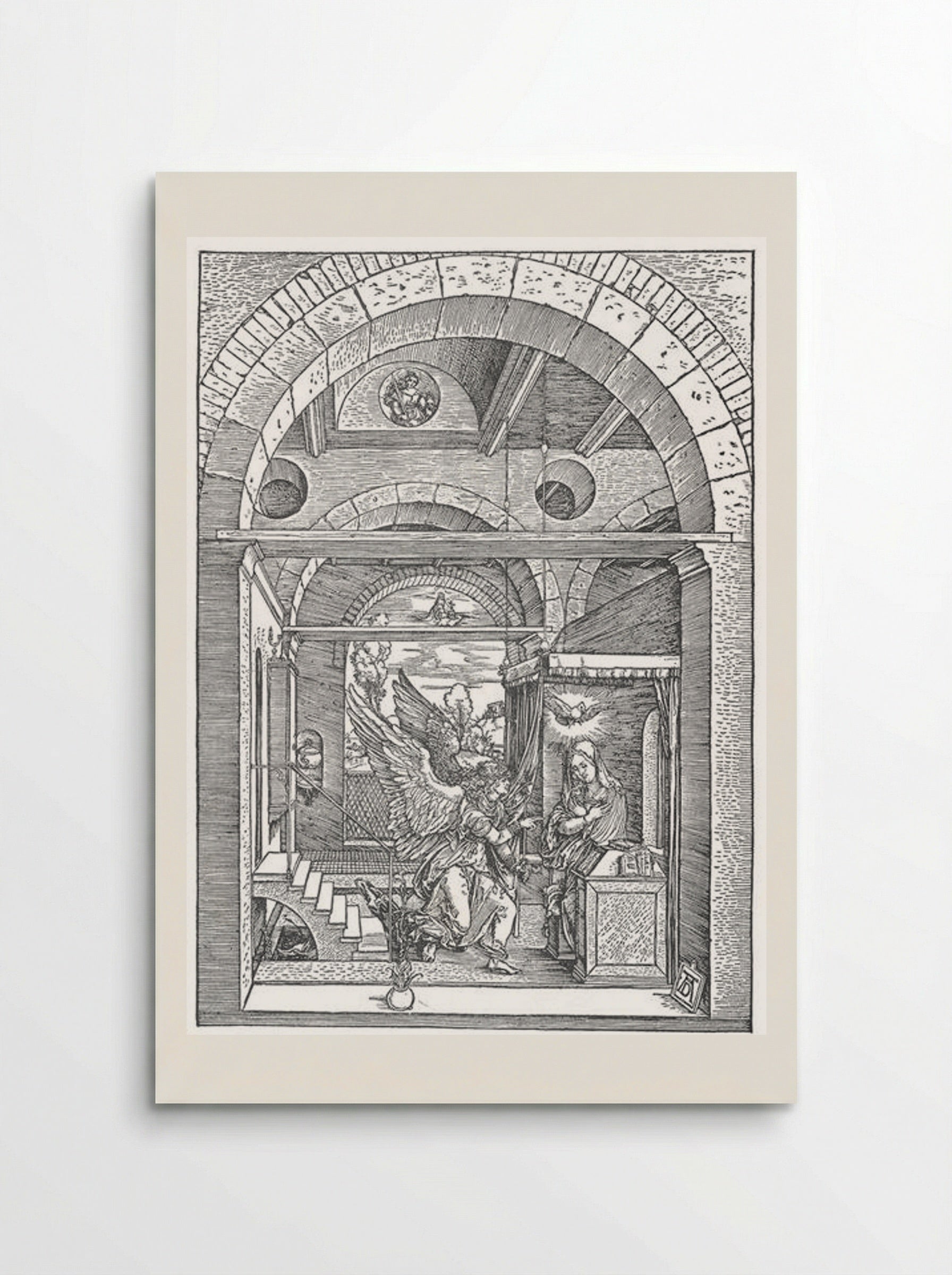
The Annunciation - Albrecht Dürer
Archival giclée
Frames arrive ready to hang
Secure checkout
Made to order
Description
A masterful woodcut from Albrecht Dürer's 'The Life of the Virgin' series, depicting the Annunciation with precise architectural detail and technical line work.
This woodcut by Albrecht Dürer depicts the biblical scene of the Annunciation, where the Archangel Gabriel appears to the Virgin Mary. Part of the series known as The Life of the Virgin, this work demonstrates Dürer's mastery of the woodcut medium. He employs a sophisticated system of hatching and cross-hatching to create depth, volume, and texture within a monochrome palette. The composition is structured around a complex architectural setting, featuring a barrel-vaulted interior that draws the eye toward the figures. Gabriel is shown in a dynamic pose, his wings spread wide as he gestures toward Mary, who sits in a humble, receptive posture. Above her, the Holy Spirit descends in the form of a dove, surrounded by rays of light. Dürer includes specific domestic details, such as the reading desk and the curtained bed, which ground the spiritual event in a recognisable, human space. Through the open archway in the background, a glimpse of a landscape provides a sense of atmospheric perspective, contrasting with the structured geometry of the interior. The print is signed with Dürer's characteristic monogram, the AD tablet, located in the lower right corner. This work reflects the artist's interest in Italian perspective theories, which he integrated into his Northern European aesthetic. The precision of the line work allows for a high degree of detail, from the folds of the drapery to the masonry of the arches. As a museum-grade print, this reproduction captures the clarity and technical rigour of the original woodblock, offering a clear view of Dürer's graphic skill.
Return policy
Because every print is made to order, we don't offer change-of-mind returns, refunds or exchanges. If your order arrives faulty, damaged or incorrect, we'll replace it free of charge — just contact us within 48 hours of delivery. See our refunds page for full details.
Shipping
We ship worldwide, printing at the production hub nearest to your delivery address. Delivery times and costs vary by destination — you'll see the options available to you at checkout.
Manufacturing
Each print is produced to order using 12-colour giclée printing on FSC-certified archival paper. Designed in Britain and printed at your nearest production hub to reduce waste and speed up delivery.
The Annunciation - Albrecht Dürer

Artist Biography
Albrecht Durer
He was born in Nuremberg, the son of a Hungarian goldsmith. He trained as a goldsmith himself before apprenticing with the painter and printmaker Michael Wolgemut. The metalwork training gave him the manual precision that made his prints extraordinary. Melencolia I, Knight, Death and the Devil, and Saint Jerome in His Study, all made between 1513 and 1514, are among the finest engravings ever produced. The density of cross-hatching, the control of tonal gradation, the rendering of fur, feathers, and stone: these are virtuoso performances in a medium that most artists treated as reproductive.
He drew a rhinoceros from a description and a sketch sent by letter. He had never seen one. Dürer's Rhinoceros (1515) is anatomically wrong in several respects (the animal has an extra horn and armour plating) but it remained the standard European image of a rhinoceros for three centuries.
He was one of the first artists to paint self-portraits as a primary subject. The Self-Portrait at Twenty-Eight (1500) shows him facing the viewer directly, with long hair and a fur coat, in a pose traditionally reserved for Christ. It was either an act of supreme confidence or deliberate blasphemy. Probably both.
Our Features
Designed for Lasting Impact
Specific Features
Every Solis piece is made to order with archival, gallery-quality materials built to last.
- Museum-grade giclée printing for rich, fade-resistant colour
- Archival matte fine-art paper, FSC-certified
- Multiple sizes and framing options available
- Frames in black, natural wood, dark wood or white
- Framed prints arrive ready to hang
Care & Cleaning
To keep your artwork looking its best:
- Dust gently with a soft, dry cloth
- Avoid prolonged direct sunlight
- Never use liquid cleaners on the print or canvas surface
- Keep in a dry, room-temperature space
- Handle prints with clean, dry hands
Materials & Sizing
Museum-grade giclée on FSC-certified archival matte paper, with framed and canvas options.
- Paper sizes: A4, A3, A2, A1, A0 and B2 (50×70 cm)
- Canvas: XS (20×30 cm) to Large (60×90 cm)
- Frames: black, natural wood, dark wood or white
Why Choose Us ?
Damage-free delivery guarantee
Fast Shipping
Museum-Quality Materials
Artist Biography
Albrecht Dürer
He was born in Nuremberg, the son of a Hungarian goldsmith. He trained as a goldsmith himself before apprenticing with the painter and printmaker Michael Wolgemut. The metalwork training gave him the manual precision that made his prints extraordinary. Melencolia I, Knight, Death and the Devil, and Saint Jerome in His Study, all made between 1513 and 1514, are among the finest engravings ever produced. The density of cross-hatching, the control of tonal gradation, the rendering of fur, feathers, and stone: these are virtuoso performances in a medium that most artists treated as reproductive.
He drew a rhinoceros from a description and a sketch sent by letter. He had never seen one. Dürer's Rhinoceros (1515) is anatomically wrong in several respects (the animal has an extra horn and armour plating) but it remained the standard European image of a rhinoceros for three centuries.
He was one of the first artists to paint self-portraits as a primary subject. The Self-Portrait at Twenty-Eight (1500) shows him facing the viewer directly, with long hair and a fur coat, in a pose traditionally reserved for Christ. It was either an act of supreme confidence or deliberate blasphemy. Probably both.
You May Also Like