


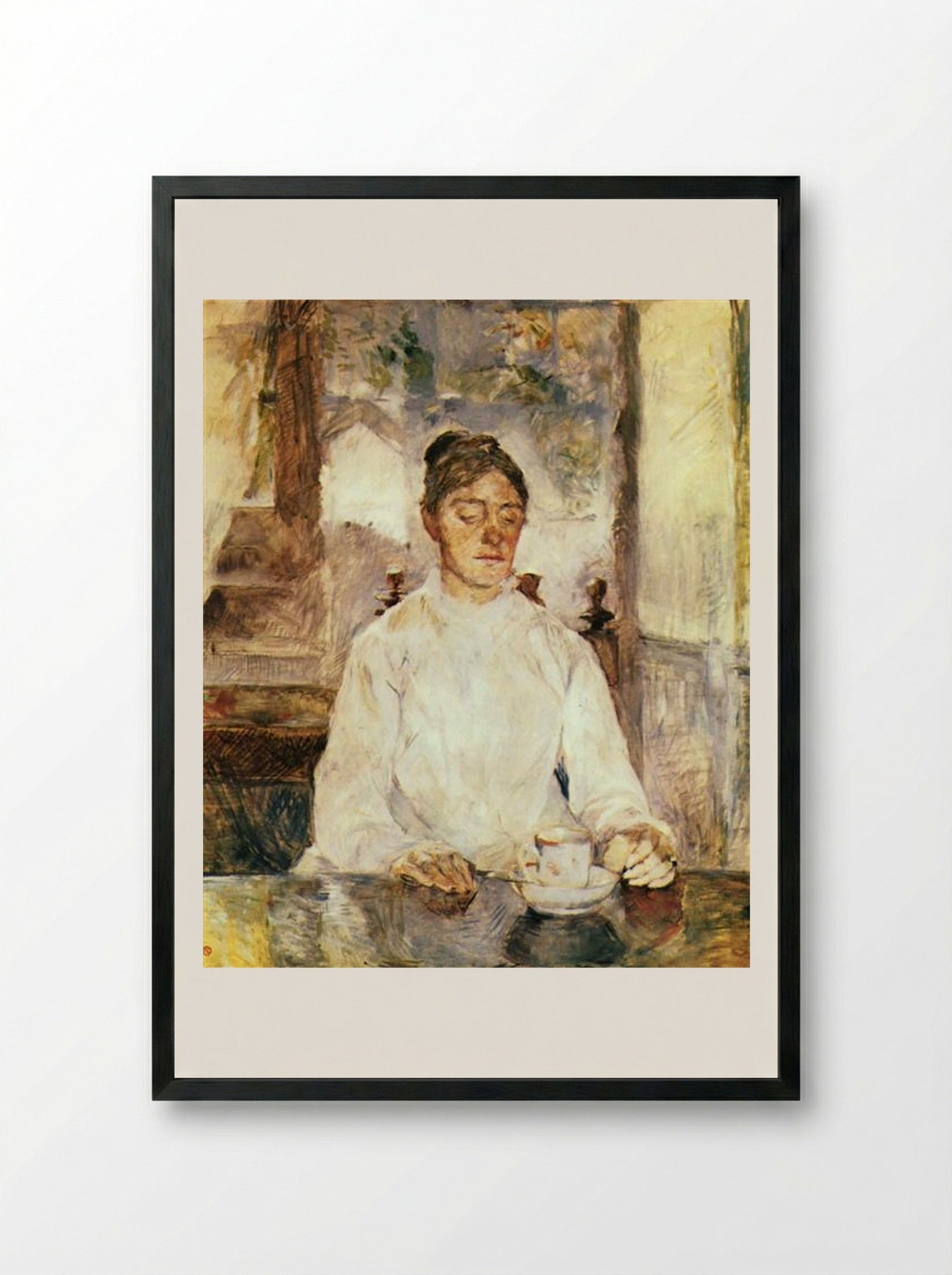

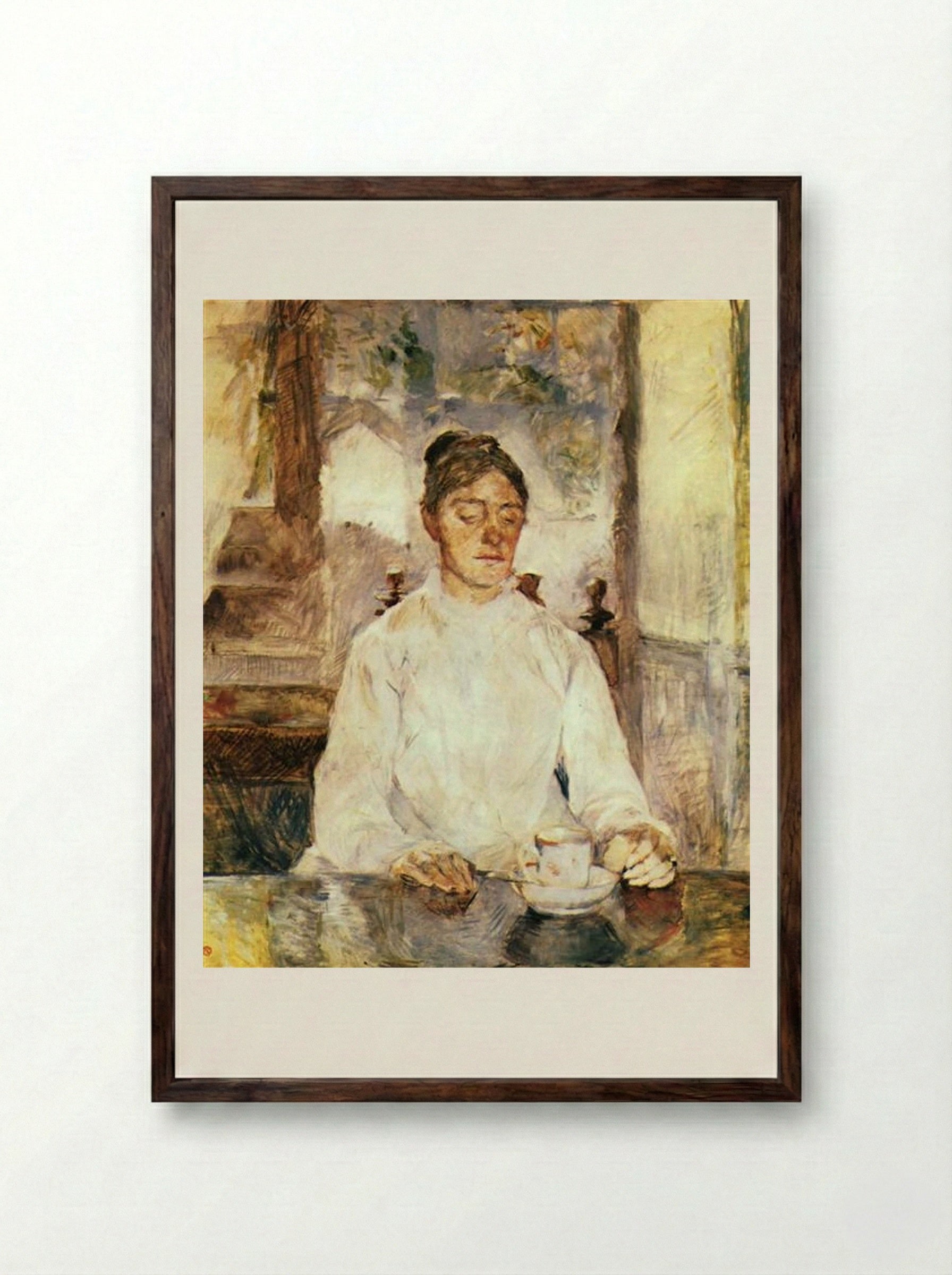
The Artist's Mother, Countess Adèle de Toulouse-Lautrec, at Breakfast - Henri de Toulouse-Lautrec
Archival giclée
Ready to hang
Secure checkout
Made to order
Description
A tender portrait by Henri de Toulouse-Lautrec depicts his mother, Countess Adèle de Toulouse-Lautrec, at breakfast. The painting's soft palette and loose brushwork create a quiet, intimate scene.
Henri de Toulouse-Lautrec's portrait of his mother, Countess Adèle de Toulouse-Lautrec, offers an intimate glimpse into the artist's personal life. Painted with loose, expressive brushstrokes characteristic of Post-Impressionism, the work captures the Countess seated at a table, presumably during breakfast. The palette is restrained, dominated by soft browns, creams, and whites, which contribute to the work's quiet, contemplative mood. The Countess is depicted in a simple white blouse, her gaze lowered, perhaps lost in thought. A cup and saucer sit before her on the polished table, reflecting the light from a nearby window. The background is softly rendered, suggesting a domestic interior. Toulouse-Lautrec's ability to convey character and emotion through subtle details is evident in this portrait, which is less a formal depiction and more an informal study of a familiar subject. Toulouse-Lautrec, known for his depictions of Parisian nightlife and portraits of performers, also frequently painted members of his own family. This particular work provides a contrast to his more public-facing subjects, revealing a more private and introspective side of the artist.
Return policy
Because every print is made to order, we don't offer change-of-mind returns, refunds or exchanges. If your order arrives faulty, damaged or incorrect, we'll replace it free of charge — just contact us within 48 hours of delivery. EU customers have a 14-day cooling-off right. See our refunds page for full details.
Shipping
We ship worldwide, printing at the production hub nearest to your delivery address. Delivery times and costs vary by destination — you'll see the options available to you at checkout.
Manufacturing
Each print is produced to order using 12-colour giclée printing on FSC-certified archival paper. Designed in Britain and printed at your nearest production hub to reduce waste and speed up delivery.
The Artist's Mother, Countess Adèle de Toulouse-Lautrec, at Breakfast - Henri de Toulouse-Lautrec
Our Features
Designed for Lasting Impact
Specific Features
Every Solis piece is made to order with archival, gallery-quality materials built to last.
- Museum-grade giclée printing for rich, fade-resistant colour
- Archival matte fine-art paper, FSC-certified
- Choose poster, framed print, canvas or framed canvas
- Frames in black, natural wood, dark wood or white
- Framed prints arrive ready to hang
Care & Cleaning
To keep your artwork looking its best:
- Dust gently with a soft, dry cloth
- Avoid prolonged direct sunlight
- Never use liquid cleaners on the print or canvas surface
- Keep in a dry, room-temperature space
- Handle prints with clean, dry hands
Materials & Sizing
Museum-grade giclée on FSC-certified archival matte paper, with framed and canvas options.
- Paper sizes: A4, A3, A2, A1, A0 and B2 (50×70 cm)
- Canvas: XS (20×30 cm) to Large (60×90 cm)
- Frames: black, natural wood, dark wood or white
Why Choose Us ?
100% Satisfaction Guarantee
Fast Shipping
Museum-Quality Materials

Artist Biography
Henri de Toulouse-Lautrec
Toulouse-Lautrec's posters and paintings, such as 'At the Moulin Rouge' and 'Jane Avril,' immortalised the iconic figures of the era. He elevated the art of lithography, using bold colours and innovative compositions to create striking advertisements and artworks. His distinctive style, characterised by flattened perspectives and expressive line work, defied academic convention and embraced the energy of modern life.
Despite his tragically short life, cut short by alcoholism and syphilis at just 36, Toulouse-Lautrec left an indelible mark on art history. He bridged the gap between fine art and commercial design, influencing generations of artists and solidifying his place as a key figure in Post-Impressionism. His works offer a glimpse into a vibrant and often overlooked side of Parisian society, capturing the spirit of a bygone era with enduring appeal.
You May Also Like