

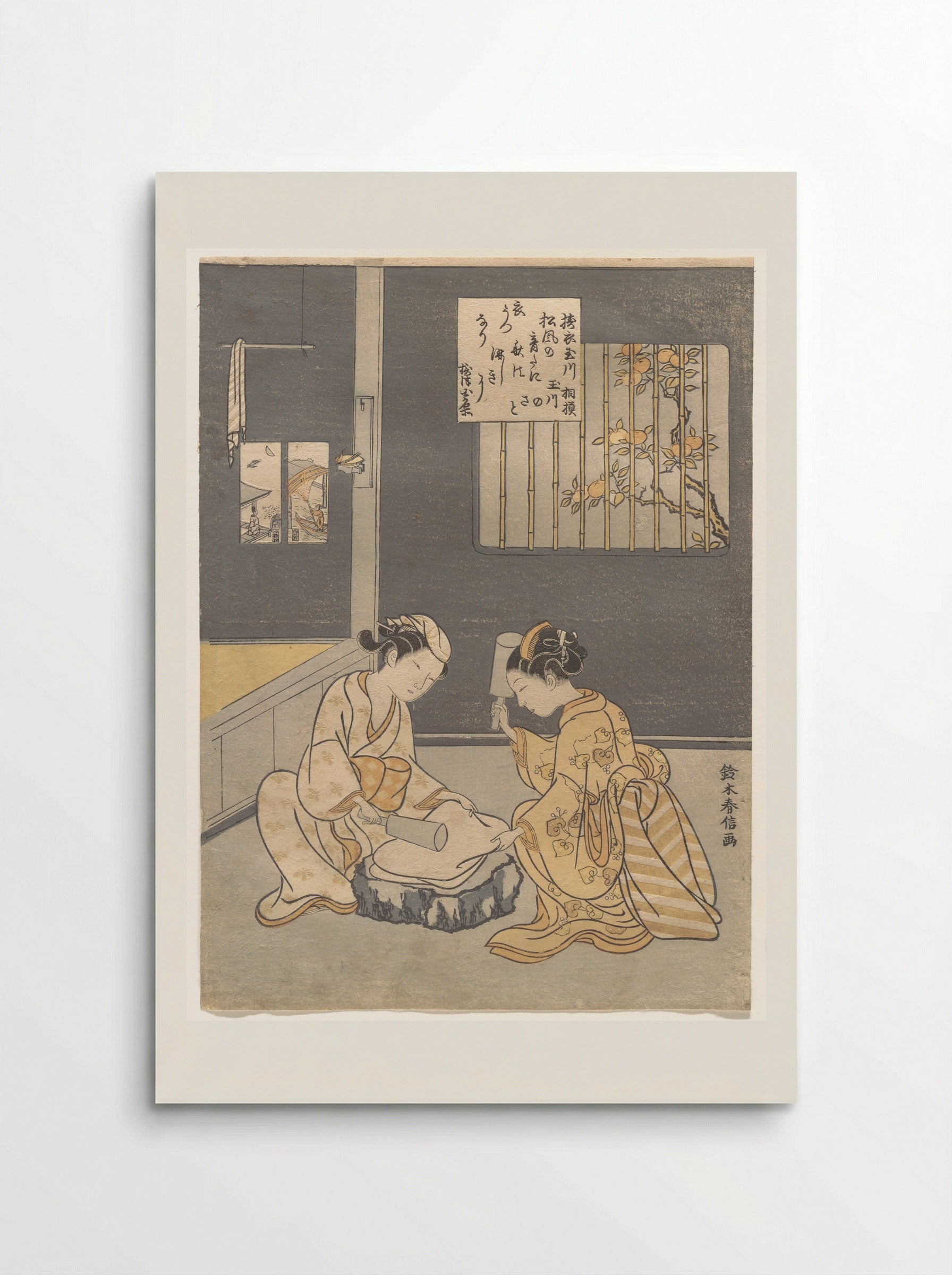
The Cloth-Fulling Jewel River, a Famous Place in Settsu Province - Suzuki Harunobu
Archival giclée
Frames arrive ready to hang
Secure checkout
Made to order
Description
A refined woodblock print by Suzuki Harunobu depicting two women fulling cloth, a traditional scene linked to the famous Jewel Rivers of Japan.
This woodblock print by Suzuki Harunobu depicts two women engaged in the traditional task of cloth-fulling. The process involves beating fabric to soften it, a motif frequently associated with the Jewel Rivers of Japan in classical poetry. Harunobu, a pioneer of the nishiki-e (brocade print) technique, uses a refined palette to balance the domestic activity with the surrounding architectural elements. The composition is structured around the two figures, who are positioned in a quiet, interior space. Their garments feature subtle patterns, rendered with the precision characteristic of Harunobu's work. To the right, a window reveals a view of bamboo stalks and fruit, providing a sense of depth and connecting the indoor scene to the natural world. A small inset image in the upper left corner depicts a river scene, reinforcing the thematic link to the famous Settsu location. The inclusion of calligraphy in the upper centre adds a layer of literary context, common in prints that draw upon historical and poetic references. Harunobu's approach to the human form is distinct, often favouring slender, graceful figures. The print demonstrates his mastery of colour registration and line work, which allowed for the production of multi-coloured images that were previously difficult to achieve. The muted tones of the background contrast with the lighter hues of the women's robes, creating a sense of harmony. This work is part of a series exploring the theme of the Six Jewel Rivers, a subject that allowed artists to combine landscape elements with the depiction of daily life. The print remains a clear example of the aesthetic values prevalent in the mid-Edo period, focusing on elegance and the integration of text with visual imagery.
Return policy
Because every print is made to order, we don't offer change-of-mind returns, refunds or exchanges. If your order arrives faulty, damaged or incorrect, we'll replace it free of charge — just contact us within 48 hours of delivery. See our refunds page for full details.
Shipping
We ship worldwide, printing at the production hub nearest to your delivery address. Delivery times and costs vary by destination — you'll see the options available to you at checkout.
Manufacturing
Each print is produced to order using 12-colour giclée printing on FSC-certified archival paper. Designed in Britain and printed at your nearest production hub to reduce waste and speed up delivery.
Care and materials
Specific Features
Every Solis piece is made to order with archival, gallery-quality materials built to last.
- Museum-grade giclée printing for rich, fade-resistant colour
- Archival matte fine-art paper, FSC-certified
- Multiple sizes and framing options available
- Frames in black, natural wood, dark wood or white
- Framed prints arrive ready to hang
Care & Cleaning
To keep your artwork looking its best:
- Dust gently with a soft, dry cloth
- Avoid prolonged direct sunlight
- Never use liquid cleaners on the print or canvas surface
- Keep in a dry, room-temperature space
- Handle prints with clean, dry hands
Materials & Sizing
Museum-grade giclée on FSC-certified archival matte paper, with framed and canvas options.
- Paper sizes: A4, A3, A2, A1, A0 and B2 (50×70 cm)
- Canvas: XS (20×30 cm) to Large (60×90 cm)
- Frames: black, natural wood, dark wood or white
The Cloth-Fulling Jewel River, a Famous Place in Settsu Province - Suzuki Harunobu
Artist Biography
Suzuki Harunobu
Harunobu moved away from the stiff portraits of kabuki actors common in his era. He preferred to depict young women in their daily lives, often using an elevated viewpoint to look into private spaces. His series Zashiki hakkei, or Eight Parlour Views, provides a clear example of his method. He took classical Chinese themes and reimagined them as domestic scenes. A temple bell might become a chiming clock. A distant storm is represented by a woman drying herself after a bath.
Modern collectors value these prints for their quiet atmosphere and precise compositions. Harunobu avoided the aggressive energy of later ukiyo-e artists. He chose instead to focus on slender figures and soft colour harmonies. His work captures specific moments of leisure, such as playing cat's cradle or walking by the shore. These scenes offer a calm window into eighteenth-century Japan. They remain popular because they balance historical detail with a clean, graphic sensibility that suits contemporary interiors.
Why Choose Us ?
Damage-free delivery guarantee
Fast Shipping
Museum-Quality Materials
You May Also Like