

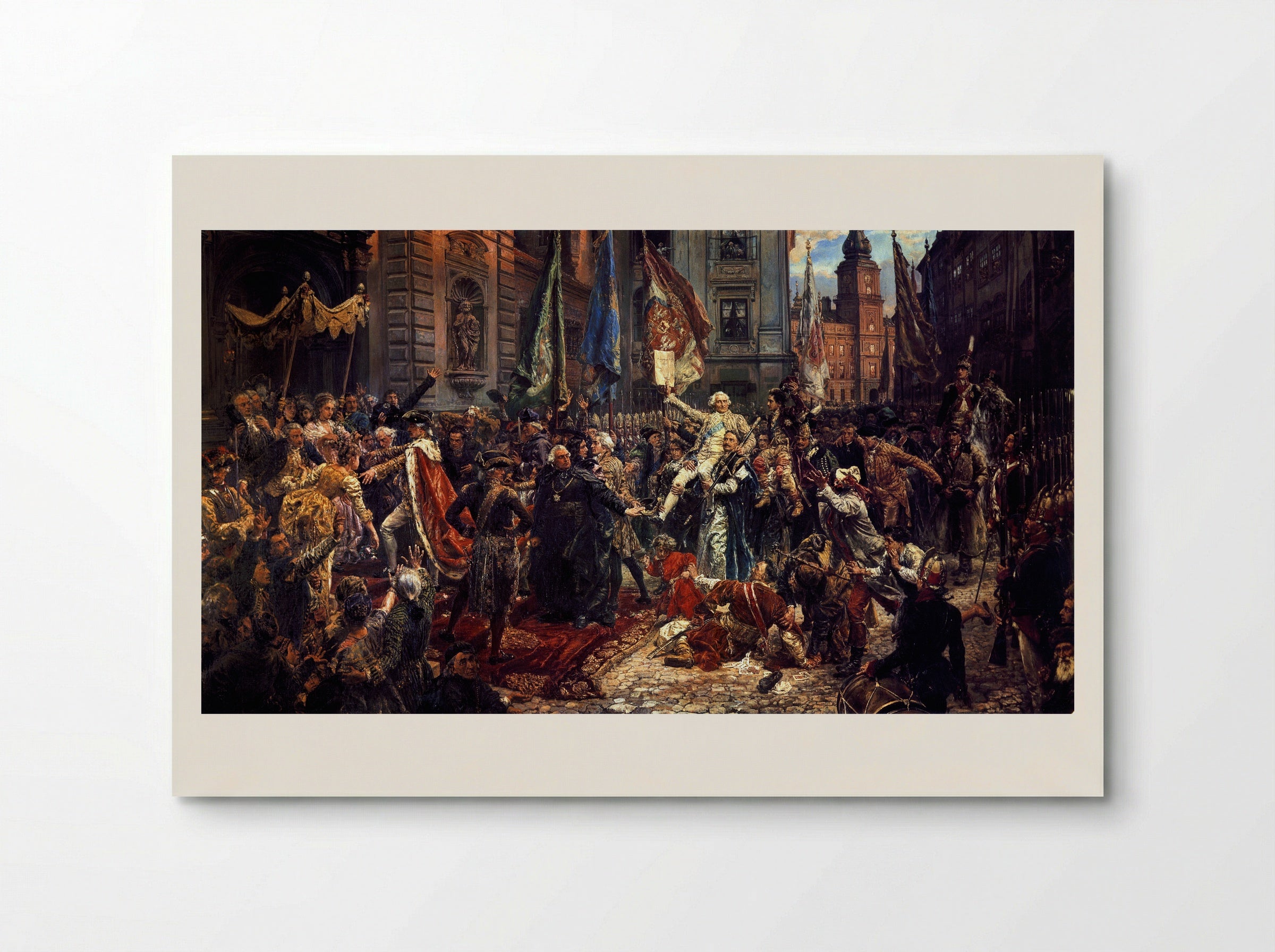
The Constitution of 3 May 1791 - Jan Matejko
Archival giclée
Frames arrive ready to hang
Secure checkout
Made to order
Description
A detailed historical painting by Jan Matejko depicting the procession of the Polish Constitution of 3 May 1791 in Warsaw.
Jan Matejko, a master of Polish historical painting, completed this large-scale work in 1891 to commemorate the centenary of the Constitution of 3 May 1791. The painting depicts the procession of deputies and citizens moving from the Royal Castle in Warsaw towards St. John's Cathedral, where the document was to be ratified. Matejko fills the canvas with a dense crowd of figures, capturing the chaotic energy and collective fervour of the period. At the centre, King Stanisław August Poniatowski is carried aloft by deputies, holding the text of the Constitution high above his head. The composition is complex, featuring a multitude of historical figures, including Marshal Stanisław Małachowski and Hugo Kołłątaj, rendered with meticulous attention to period costume and architectural detail. The scene is set against the backdrop of Warsaw, with the Royal Castle visible in the distance. Technically, the work demonstrates Matejko's ability to manage large groups of people within a single frame, using light and shadow to guide the viewer through the narrative. The palette is dominated by deep, earthy tones, punctuated by the brighter colours of the flags and the royal robes. The artist employs a realistic approach to texture, from the rough cobblestones of the street to the fine fabrics of the nobility. This painting remains a primary visual record of Polish national identity, reflecting the political aspirations of the late eighteenth century. It is currently held in the collection of the Royal Castle in Warsaw, serving as a detailed documentation of the events surrounding the adoption of Europe's first modern written constitution.
Return policy
Because every print is made to order, we don't offer change-of-mind returns, refunds or exchanges. If your order arrives faulty, damaged or incorrect, we'll replace it free of charge — just contact us within 48 hours of delivery. See our refunds page for full details.
Shipping
We ship worldwide, printing at the production hub nearest to your delivery address. Delivery times and costs vary by destination — you'll see the options available to you at checkout.
Manufacturing
Each print is produced to order using 12-colour giclée printing on FSC-certified archival paper. Designed in Britain and printed at your nearest production hub to reduce waste and speed up delivery.
The Constitution of 3 May 1791 - Jan Matejko

Artist Biography
Jan Matejko
Matejko was born in Krakow in 1838 to a Czech father and a half-German, half-Polish mother. Despite being only one-quarter Polish by blood, his household was fiercely patriotic: Polish books, portraits of Polish heroes, and a brother who followed General Jozef Bem into the Hungarian Revolution of 1848 (and died in battle). He enrolled at the Krakow Academy of Fine Arts at fourteen, studying under Wojciech Stattler. He never mastered a foreign language and struggled even with Polish, which made the public appearances demanded of him throughout his career an ordeal.
His ambition was to paint Polish history on a monumental scale. Stanczyk (1862) showed the royal jester alone with the news of a military defeat, a painting that reads as an editorial cartoon stretched to the size of a wall. Battle of Grunwald (1878) and Rejtan (1866) followed, each canvas an argument about national identity dressed as historical spectacle. Wilhelm von Kaulbach's method of "historical symbolism", which prioritised interpretation over documentary accuracy, shaped Matejko's approach. His brother Franciszek, a historian at the Jagiellonian Library, fed him archival detail.
As director of the Krakow School of Fine Arts, he trained over eighty students. Maurycy Gottlieb, Jacek Malczewski, Jozef Mehoffer and Stanislaw Wyspianski all passed through his studio; several became leading figures in the Young Poland movement, earning Matejko the title "Father of Young Poland". In 1887 he attended the opening of Queen Jadwiga's sarcophagus to sketch her skull for a portrait. He died in 1893, aged fifty-five.
Our Features
Designed for Lasting Impact
Specific Features
Every Solis piece is made to order with archival, gallery-quality materials built to last.
- Museum-grade giclée printing for rich, fade-resistant colour
- Archival matte fine-art paper, FSC-certified
- Multiple sizes and framing options available
- Frames in black, natural wood, dark wood or white
- Framed prints arrive ready to hang
Care & Cleaning
To keep your artwork looking its best:
- Dust gently with a soft, dry cloth
- Avoid prolonged direct sunlight
- Never use liquid cleaners on the print or canvas surface
- Keep in a dry, room-temperature space
- Handle prints with clean, dry hands
Materials & Sizing
Museum-grade giclée on FSC-certified archival matte paper, with framed and canvas options.
- Paper sizes: A4, A3, A2, A1, A0 and B2 (50×70 cm)
- Canvas: XS (20×30 cm) to Large (60×90 cm)
- Frames: black, natural wood, dark wood or white
Why Choose Us ?
Damage-free delivery guarantee
Fast Shipping
Museum-Quality Materials
Artist Biography
Jan Matejko
Matejko was born in Krakow in 1838 to a Czech father and a half-German, half-Polish mother. Despite being only one-quarter Polish by blood, his household was fiercely patriotic: Polish books, portraits of Polish heroes, and a brother who followed General Jozef Bem into the Hungarian Revolution of 1848 (and died in battle). He enrolled at the Krakow Academy of Fine Arts at fourteen, studying under Wojciech Stattler. He never mastered a foreign language and struggled even with Polish, which made the public appearances demanded of him throughout his career an ordeal.
His ambition was to paint Polish history on a monumental scale. Stanczyk (1862) showed the royal jester alone with the news of a military defeat, a painting that reads as an editorial cartoon stretched to the size of a wall. Battle of Grunwald (1878) and Rejtan (1866) followed, each canvas an argument about national identity dressed as historical spectacle. Wilhelm von Kaulbach's method of "historical symbolism", which prioritised interpretation over documentary accuracy, shaped Matejko's approach. His brother Franciszek, a historian at the Jagiellonian Library, fed him archival detail.
As director of the Krakow School of Fine Arts, he trained over eighty students. Maurycy Gottlieb, Jacek Malczewski, Jozef Mehoffer and Stanislaw Wyspianski all passed through his studio; several became leading figures in the Young Poland movement, earning Matejko the title "Father of Young Poland". In 1887 he attended the opening of Queen Jadwiga's sarcophagus to sketch her skull for a portrait. He died in 1893, aged fifty-five.
You May Also Like