

Fine Art Poster
From $29
A giclée print on 200gsm matte fine art paper, using a twelve-colour process for accurate, fade-resistant colour. Supplied unframed, delivered flat or rolled.



Archival giclée
Frames arrive ready to hang
Secure checkout
Made to order
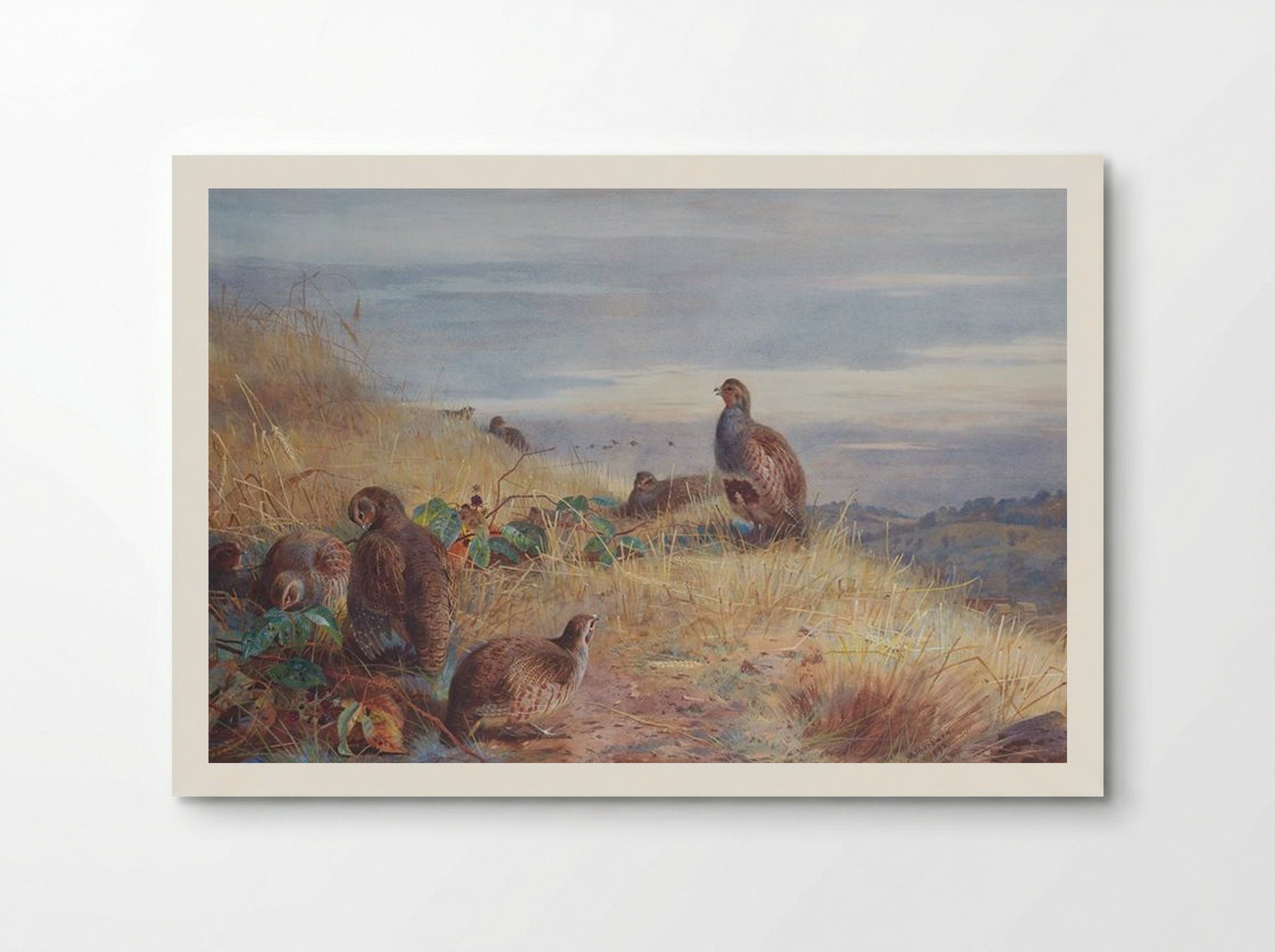
A detailed watercolour study of grey partridges in a field at dawn, capturing the quiet observation and technical precision of Archibald Thorburn.
Archibald Thorburn was a master of British wildlife illustration, particularly noted for his precise depictions of game birds. In this work, he captures a covey of grey partridges resting in a field at the first light of dawn. The composition focuses on the subtle textures of the birds' plumage, rendered with fine brushwork that distinguishes the individual feathers and the mottled patterns of their wings. Thorburn utilised a muted palette to reflect the early morning atmosphere. The soft, diffused light of daybreak washes over the dry grasses and the rolling hills in the distance, creating a sense of quiet observation. His approach to the natural world was rooted in careful study, as he spent much of his life observing birds in their native habitats across the British Isles. The foreground details, including the brambles and the dry stalks of grain, provide a sense of place, grounding the birds within their environment without distracting from the primary subjects. This piece demonstrates the technical skill that made Thorburn a preferred illustrator for ornithological publications of the late nineteenth and early twentieth centuries. His ability to combine scientific accuracy with a painterly sensitivity to light and mood remains a defining characteristic of his work. The partridges are shown in various postures, some alert and others resting, which suggests a fleeting moment captured in the wild. The work is signed and dated by the artist in the lower right corner, confirming its provenance within his extensive body of ornithological studies.
Because every print is made to order, we don't offer change-of-mind returns, refunds or exchanges. If your order arrives faulty, damaged or incorrect, we'll replace it free of charge — just contact us within 48 hours of delivery. See our refunds page for full details.
We ship worldwide, printing at the production hub nearest to your delivery address. Delivery times and costs vary by destination — you'll see the options available to you at checkout.
Each print is produced to order using 12-colour giclée printing on FSC-certified archival paper. Designed in Britain and printed at your nearest production hub to reduce waste and speed up delivery.
Specific Features
Every Solis piece is made to order with archival, gallery-quality materials built to last.
Care & Cleaning
To keep your artwork looking its best:
Materials & Sizing
Museum-grade giclée on FSC-certified archival matte paper, with framed and canvas options.

Artist Biography
Made to order
Every piece is printed to order. These are the five finishes, and what makes each one different.
From $29
A giclée print on 200gsm matte fine art paper, using a twelve-colour process for accurate, fade-resistant colour. Supplied unframed, delivered flat or rolled.

From $89
The same fine art print in a solid wood frame with UV-protective acrylic glaze and rigid backing. Five frame colours. Arrives ready to hang.

From $169
A deeper solid wood frame: 33mm deep with a 20mm face and Perspex glaze. The print sits unmounted for a clean gallery presentation. Black, white or natural.

From $59
Hand-stretched canvas with neat gallery-wrapped edges, giving the artwork surface texture and depth. Arrives ready to hang.

From $175
Stretched canvas set in a floating wood frame, our most substantial finish. Arrives ready to hang.
Why Choose Us ?
Damage-free delivery guarantee
Fast Shipping
Museum-Quality Materials
You May Also Like
We use cookies to measure our marketing and see which prints people love.We use cookies to measure our marketing.
By continuing to browse, you agree · Privacy Policy