

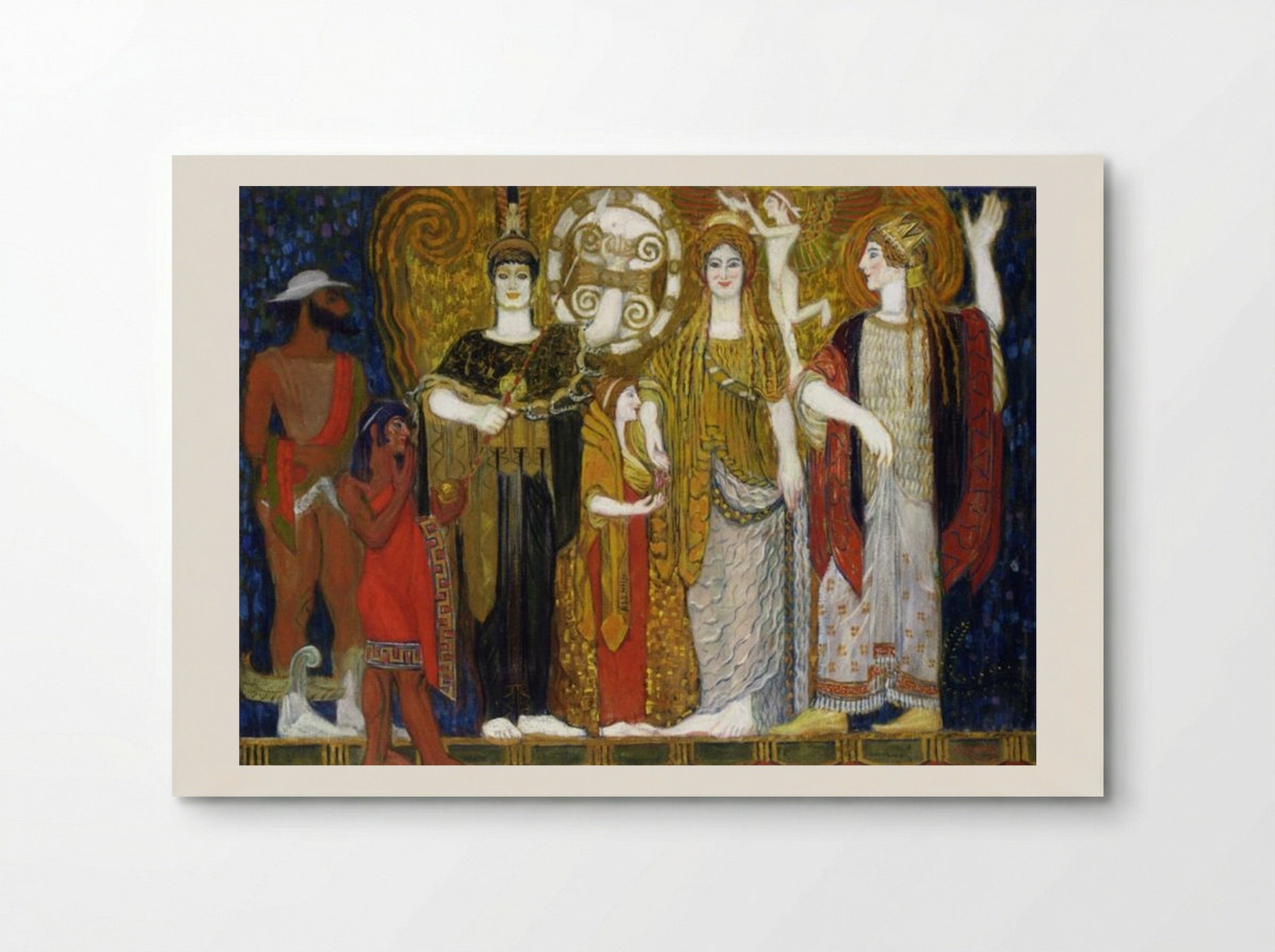
The Crowning of Helen - Frantisek Kupka
Archival giclée
Frames arrive ready to hang
Secure checkout
Made to order
Description
A striking Symbolist work by Frantisek Kupka, depicting the mythological figure of Helen of Troy through a decorative, frieze-like composition.
Frantisek Kupka, a Czech artist who spent much of his career in Paris, produced this work during his transition from traditional illustration to the symbolic and eventually abstract modes for which he is known. The Crowning of Helen draws upon classical Greek mythology, depicting the legendary figure of Helen of Troy. The composition is arranged in a frieze-like manner, reminiscent of ancient relief sculpture, which aligns with the Symbolist interest in mythic archetypes and timeless narratives. The visual language here is distinct from his later geometric abstractions. Kupka employs a decorative approach, using flattened space and a heavy emphasis on pattern within the drapery and background elements. The figures are rendered with a stylised quality, their forms defined by clear outlines rather than atmospheric perspective. The palette is dominated by deep blues, ochres, and metallic golds, creating a sense of ritualistic solemnity. A small winged figure, likely Eros, hovers near the central group, reinforcing the romantic and tragic themes associated with Helen. The work reflects the artist's early engagement with the decorative arts and his fascination with the intersection of history and allegory. Kupka's approach to this subject avoids the naturalism typical of academic painting in the late nineteenth century. Instead, he opts for a rhythmic, almost musical arrangement of forms. The figures stand in a shallow, stage-like space, their gestures formal and deliberate. This piece offers a glimpse into the artist's formative years, showing his ability to synthesise classical subject matter with a modern, decorative sensibility. It remains a compelling example of his early output, demonstrating the technical skill and thematic curiosity that would eventually lead him toward the development of Orphism and pure abstraction in the following decade.
Return policy
Because every print is made to order, we don't offer change-of-mind returns, refunds or exchanges. If your order arrives faulty, damaged or incorrect, we'll replace it free of charge — just contact us within 48 hours of delivery. See our refunds page for full details.
Shipping
We ship worldwide, printing at the production hub nearest to your delivery address. Delivery times and costs vary by destination — you'll see the options available to you at checkout.
Manufacturing
Each print is produced to order using 12-colour giclée printing on FSC-certified archival paper. Designed in Britain and printed at your nearest production hub to reduce waste and speed up delivery.
Care and materials
Specific Features
Every Solis piece is made to order with archival, gallery-quality materials built to last.
- Museum-grade giclée printing for rich, fade-resistant colour
- Archival matte fine-art paper, FSC-certified
- Multiple sizes and framing options available
- Frames in black, natural wood, dark wood or white
- Framed prints arrive ready to hang
Care & Cleaning
To keep your artwork looking its best:
- Dust gently with a soft, dry cloth
- Avoid prolonged direct sunlight
- Never use liquid cleaners on the print or canvas surface
- Keep in a dry, room-temperature space
- Handle prints with clean, dry hands
Materials & Sizing
Museum-grade giclée on FSC-certified archival matte paper, with framed and canvas options.
- Paper sizes: A4, A3, A2, A1, A0 and B2 (50×70 cm)
- Canvas: XS (20×30 cm) to Large (60×90 cm)
- Frames: black, natural wood, dark wood or white
The Crowning of Helen - Frantisek Kupka

Artist Biography
Frantisek Kupka
Kupka's artistic approach involved a synthesis of Symbolism and abstraction, evident in works such as "Danse Macabre" and "Ballad of Epona". He sought to capture movement and energy through colour and form, often drawing inspiration from music and mathematics. His Orphist style, characterised by its use of vibrant colours and geometric shapes, aimed to evoke spiritual and emotional responses in the viewer, rather than depicting the external world.
Today, Kupka's art appeals to collectors seeking pieces that bridge the gap between historical movements and contemporary sensibilities. His works offer a unique combination of intellectual depth and visual appeal, making them a compelling addition to modern collections. The enduring quality of Kupka's vision lies in his ability to transform complex ideas into visually arresting compositions.
Why Choose Us ?
Damage-free delivery guarantee
Fast Shipping
Museum-Quality Materials
You May Also Like