

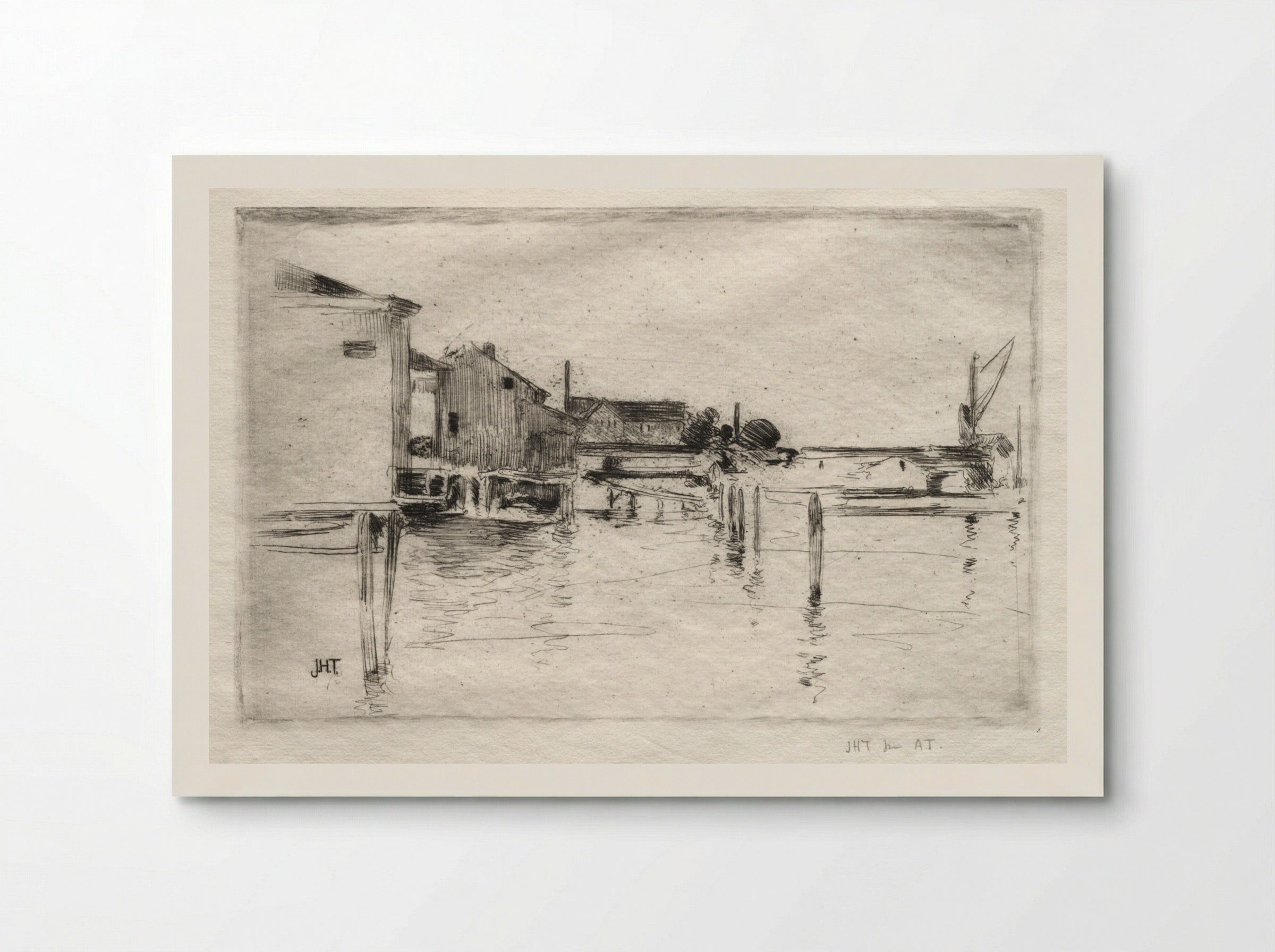
The Dock, Bridgeport, Connecticut - John Henry Twachtman
Archival giclée
Frames arrive ready to hang
Secure checkout
Made to order
Description
A delicate etching by American Impressionist John Henry Twachtman, capturing the quiet atmosphere of a Bridgeport dock with precise, minimal lines.
John Henry Twachtman, a central figure in the American Impressionist movement, produced this etching during a period when he focused on the quiet, atmospheric qualities of the New England coastline. The work depicts a dockside scene in Bridgeport, Connecticut, rendered with a delicate economy of line that characterises his graphic output. Twachtman often favoured subjects that allowed for the exploration of light and reflection, and here, the water serves as a mirror for the simple wooden structures of the wharf. The composition relies on the interplay between the solid, vertical forms of the pilings and the horizontal expanse of the water. Twachtman uses sparse, precise marks to suggest the texture of the weathered wood and the gentle movement of the tide. By avoiding excessive detail, he allows the viewer to focus on the spatial relationships and the stillness of the scene. The etching process provides a tactile quality to the print, with the ink sitting softly against the paper to create a sense of depth and atmosphere. This piece reflects the artist's interest in tonal values rather than bold colour. It is a study in restraint, capturing a fleeting moment of calm in a working harbour. Twachtman's approach to printmaking mirrors his painting style, where the suggestion of form is often more important than the literal representation of objects. The inclusion of his initials in the lower corner provides a modest signature to a work that prioritises mood and observation over narrative. This print offers a glimpse into the quieter side of American maritime life at the turn of the twentieth century, presented through the lens of an artist who valued subtlety above all else.
Return policy
Because every print is made to order, we don't offer change-of-mind returns, refunds or exchanges. If your order arrives faulty, damaged or incorrect, we'll replace it free of charge — just contact us within 48 hours of delivery. See our refunds page for full details.
Shipping
We ship worldwide, printing at the production hub nearest to your delivery address. Delivery times and costs vary by destination — you'll see the options available to you at checkout.
Manufacturing
Each print is produced to order using 12-colour giclée printing on FSC-certified archival paper. Designed in Britain and printed at your nearest production hub to reduce waste and speed up delivery.
Care and materials
Specific Features
Every Solis piece is made to order with archival, gallery-quality materials built to last.
- Museum-grade giclée printing for rich, fade-resistant colour
- Archival matte fine-art paper, FSC-certified
- Multiple sizes and framing options available
- Frames in black, natural wood, dark wood or white
- Framed prints arrive ready to hang
Care & Cleaning
To keep your artwork looking its best:
- Dust gently with a soft, dry cloth
- Avoid prolonged direct sunlight
- Never use liquid cleaners on the print or canvas surface
- Keep in a dry, room-temperature space
- Handle prints with clean, dry hands
Materials & Sizing
Museum-grade giclée on FSC-certified archival matte paper, with framed and canvas options.
- Paper sizes: A4, A3, A2, A1, A0 and B2 (50×70 cm)
- Canvas: XS (20×30 cm) to Large (60×90 cm)
- Frames: black, natural wood, dark wood or white
The Dock, Bridgeport, Connecticut - John Henry Twachtman

Artist Biography
John Henry Twachtman
He was born in Cincinnati in 1853, studied there under Frank Duveneck, then enrolled at the Academy of Fine Arts in Munich in 1875, where he acquired the dark, heavy manner of the Munich school. A trip to Venice with Duveneck and William Merritt Chase in 1878 began to loosen him. By 1883 he was in Paris at the Academie Julian, and the brownish palette was gone. Whistler's tonal subtlety and the Impressionists' light replaced it; Theodore Robinson and Childe Hassam encouraged the shift further.
He bought a farm in Greenwich, Connecticut, in 1890, and it became his primary subject. The waterfall, the pool, the hemlock trees and the snow-covered fields appeared in compositions influenced by Japanese prints, with high horizon lines and flattened perspectives that anticipated abstract thinking. His winter paintings are studies in whiteness that sit somewhere between Impressionism and Tonalism, quieter than either label suggests.
In 1898 he became a founding member of The Ten, a group of American artists dissatisfied with the conservative exhibition system. He also founded an informal art school at Cos Cob, Connecticut, and was known for practical jokes and irreverent wit. He died in 1902, at forty-nine. The recognition he expected in his lifetime came after it.
Why Choose Us ?
Damage-free delivery guarantee
Fast Shipping
Museum-Quality Materials
You May Also Like