

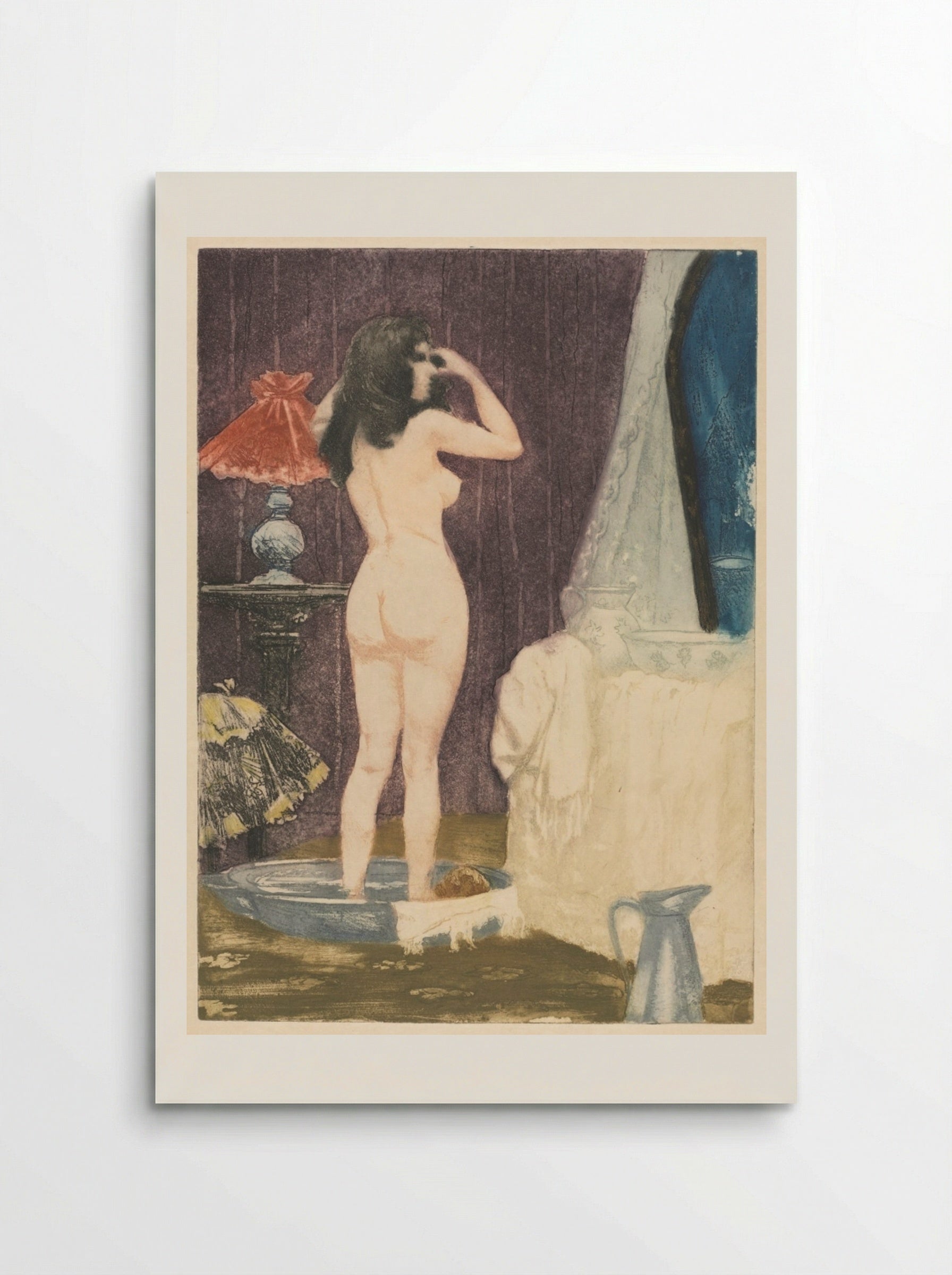
The Dressing Room - Charles Maurin
Archival giclée
Frames arrive ready to hang
Secure checkout
Made to order
Description
A refined etching and aquatint by Charles Maurin, depicting a woman in a private domestic setting with soft, atmospheric lighting.
Charles Maurin was a French artist known for his technical mastery of printmaking, particularly the use of aquatint to achieve soft, atmospheric effects. This work, The Dressing Room, captures a private moment of a woman at her toilette. The composition focuses on the figure standing within a washbasin, her back to the viewer, as she attends to her hair. The scene is set against a deep, textured purple backdrop that provides a sense of intimacy and seclusion. Maurin employs a delicate application of colour through the aquatint process, creating subtle gradients that define the contours of the body and the surrounding domestic objects. To the left, a lamp with a red shade casts a warm glow, while to the right, a mirror reflects a portion of the room, adding depth to the interior space. The presence of a washbasin, a pitcher, and draped linens reinforces the domestic nature of the subject. This print reflects the late nineteenth-century interest in capturing fleeting, private moments of daily life, a theme explored by many of Maurin's contemporaries in the Parisian art scene. The artist's approach to the female form is grounded in observation, yet the overall mood remains quiet and contemplative. The contrast between the pale skin of the subject and the darker tones of the room creates a visual balance that draws the eye towards the centre of the composition. Maurin's work in printmaking was highly regarded for its innovative use of colour and texture, and this piece demonstrates his ability to translate the nuances of light and shadow into a printed medium. The work remains a representative example of his contribution to the graphic arts during the turn of the century.
Return policy
Because every print is made to order, we don't offer change-of-mind returns, refunds or exchanges. If your order arrives faulty, damaged or incorrect, we'll replace it free of charge — just contact us within 48 hours of delivery. See our refunds page for full details.
Shipping
We ship worldwide, printing at the production hub nearest to your delivery address. Delivery times and costs vary by destination — you'll see the options available to you at checkout.
Manufacturing
Each print is produced to order using 12-colour giclée printing on FSC-certified archival paper. Designed in Britain and printed at your nearest production hub to reduce waste and speed up delivery.
Care and materials
Specific Features
Every Solis piece is made to order with archival, gallery-quality materials built to last.
- Museum-grade giclée printing for rich, fade-resistant colour
- Archival matte fine-art paper, FSC-certified
- Multiple sizes and framing options available
- Frames in black, natural wood, dark wood or white
- Framed prints arrive ready to hang
Care & Cleaning
To keep your artwork looking its best:
- Dust gently with a soft, dry cloth
- Avoid prolonged direct sunlight
- Never use liquid cleaners on the print or canvas surface
- Keep in a dry, room-temperature space
- Handle prints with clean, dry hands
Materials & Sizing
Museum-grade giclée on FSC-certified archival matte paper, with framed and canvas options.
- Paper sizes: A4, A3, A2, A1, A0 and B2 (50×70 cm)
- Canvas: XS (20×30 cm) to Large (60×90 cm)
- Frames: black, natural wood, dark wood or white
The Dressing Room - Charles Maurin

Artist Biography
Charles Maurin
He was born in Le Puy-en-Velay in 1856. The Prix Crozatier funded his move to Paris, where he studied at the Ecole des Beaux-Arts under Jules Lefebvre and at the Academie Julian, where he later taught. He exhibited at the Salon from 1883 and participated in the Rose+Croix exhibitions between 1892 and 1897.
His dual mastery of painting and printmaking made him a bridging figure between Symbolism and the 1890s revival of colour printmaking. His colour etchings and wood engravings from this period are technically accomplished and compositionally inventive. His painted work, particularly his Symbolist studies of maternity, combines academic draughtsmanship with the decorative flatness of the Nabis. He was among a handful of artists who understood both the chemical processes of printmaking and the aesthetic possibilities of colour on paper, and his technical innovations influenced the next generation of French printmakers. He died in 1914, at fifty-eight, on the eve of the war that would scatter the world he had helped build.
Why Choose Us ?
Damage-free delivery guarantee
Fast Shipping
Museum-Quality Materials
You May Also Like