

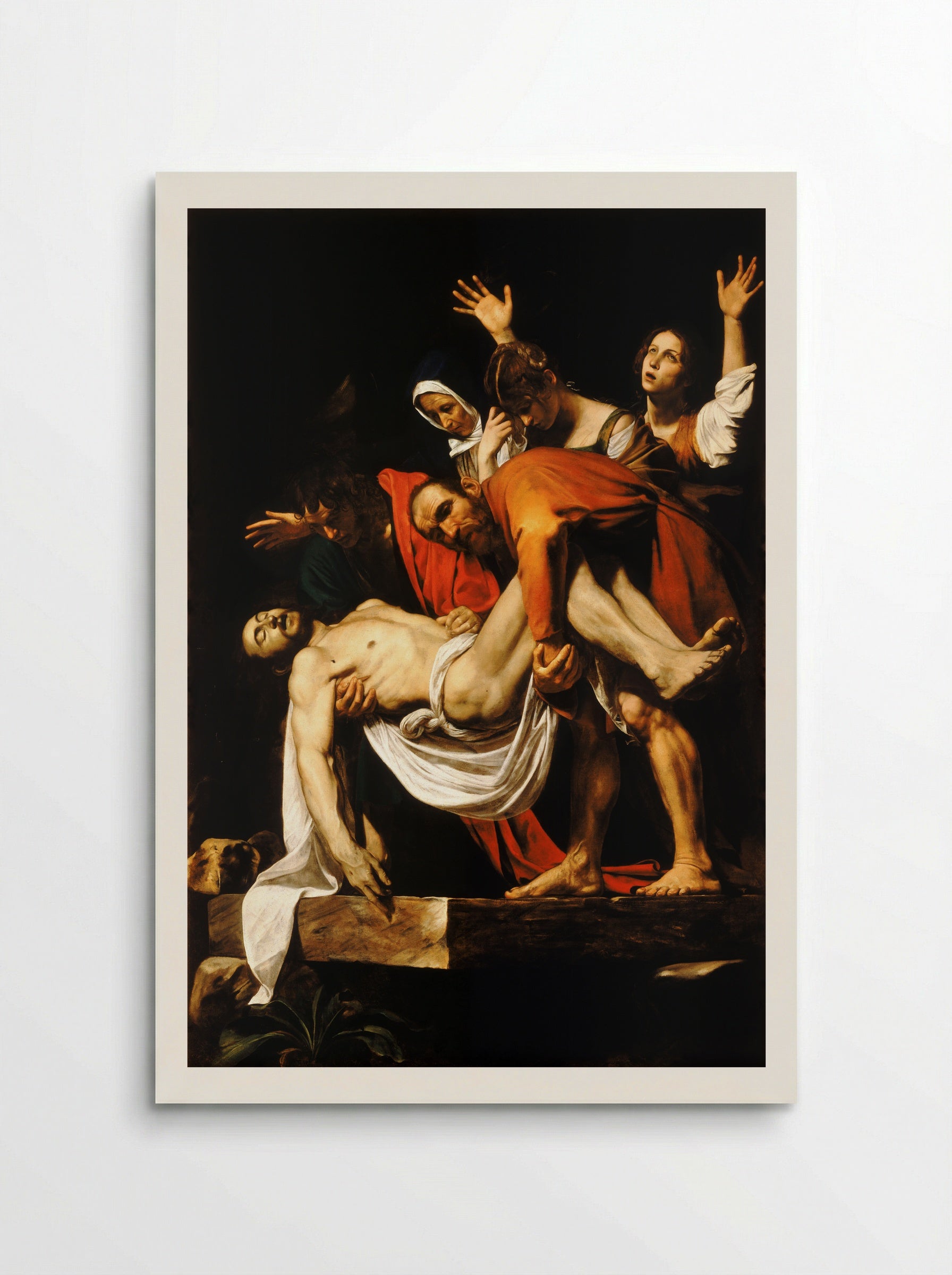
The Entombment of Christ - Caravaggio
Archival giclée
Frames arrive ready to hang
Secure checkout
Made to order
Description
A masterpiece of Baroque realism, this work captures the solemnity of the burial of Christ through dramatic lighting and raw, human emotion.
Painted for the Vittrice Chapel in the Chiesa Nuova in Rome, The Entombment of Christ is a defining work of the early Baroque period. Caravaggio employs his signature tenebrism, a technique defined by the stark contrast between deep, impenetrable shadows and focused, dramatic light. This approach directs the viewer's attention to the physical weight of the figures and the tactile reality of the scene. The composition is arranged in a descending diagonal, guiding the eye from the raised arms of the mourning women down to the body of Christ. Nicodemus and John the Evangelist support the weight of the deceased, their strained muscles and grounded stances providing a sense of immediate, human gravity. Unlike the idealised figures of the Renaissance, Caravaggio depicts his subjects with unvarnished realism, showing the weathered skin and weary expressions of those present at the burial. The stone slab serves as a physical anchor for the composition, projecting outward into the viewer's space. This spatial device invites the observer to participate in the solemnity of the moment. The palette is restrained, dominated by deep ochres, blacks, and the striking red of the garments, which provides a visual counterpoint to the pallor of Christ's body. The painting avoids decorative excess, focusing instead on the emotional weight of the narrative and the interplay of light across the human form. It remains a primary example of how Caravaggio transformed religious iconography into a visceral, human experience.
Return policy
Because every print is made to order, we don't offer change-of-mind returns, refunds or exchanges. If your order arrives faulty, damaged or incorrect, we'll replace it free of charge — just contact us within 48 hours of delivery. See our refunds page for full details.
Shipping
We ship worldwide, printing at the production hub nearest to your delivery address. Delivery times and costs vary by destination — you'll see the options available to you at checkout.
Manufacturing
Each print is produced to order using 12-colour giclée printing on FSC-certified archival paper. Designed in Britain and printed at your nearest production hub to reduce waste and speed up delivery.
The Entombment of Christ - Caravaggio

Artist Biography
Caravaggio
Before the killing, he had already transformed European painting. He arrived in Rome from Milan in the early 1590s, hungry and unknown, and within a decade had developed a method of painting from life, using strong directional light against deep shadow, that made the prevailing Mannerist style look theatrical and empty. He used real people as models: prostitutes, street boys, labourers. His saints had dirty feet. The Church commissioned altarpieces and then rejected them for being too vulgar, too real, too much like the people who actually attended church.
The Calling of Saint Matthew, painted for the Contarelli Chapel in San Luigi dei Francesi, is his method at its clearest. The light enters from the upper right like a blade. Matthew sits at a tax collector's table with his companions. Christ points. The scene looks like something you might see through a doorway, which is roughly the viewer's position. Nothing is idealised. The moment is ordinary and sacred simultaneously.
After the killing he fled to Naples, then Malta, then Sicily, then back to Naples. He kept painting. The late works are darker, faster, more desperate. He received a papal pardon and boarded a boat north. He died on a beach in Porto Ercole in July 1610, at thirty-eight. The cause is unknown: fever, infection, possibly lead poisoning from his paints. His influence on Rembrandt, Velazquez, Georges de La Tour, and every painter who has ever used a spotlight is difficult to overstate.
Our Features
Designed for Lasting Impact
Specific Features
Every Solis piece is made to order with archival, gallery-quality materials built to last.
- Museum-grade giclée printing for rich, fade-resistant colour
- Archival matte fine-art paper, FSC-certified
- Multiple sizes and framing options available
- Frames in black, natural wood, dark wood or white
- Framed prints arrive ready to hang
Care & Cleaning
To keep your artwork looking its best:
- Dust gently with a soft, dry cloth
- Avoid prolonged direct sunlight
- Never use liquid cleaners on the print or canvas surface
- Keep in a dry, room-temperature space
- Handle prints with clean, dry hands
Materials & Sizing
Museum-grade giclée on FSC-certified archival matte paper, with framed and canvas options.
- Paper sizes: A4, A3, A2, A1, A0 and B2 (50×70 cm)
- Canvas: XS (20×30 cm) to Large (60×90 cm)
- Frames: black, natural wood, dark wood or white
Why Choose Us ?
Damage-free delivery guarantee
Fast Shipping
Museum-Quality Materials
Artist Biography
Caravaggio
Before the killing, he had already transformed European painting. He arrived in Rome from Milan in the early 1590s, hungry and unknown, and within a decade had developed a method of painting from life, using strong directional light against deep shadow, that made the prevailing Mannerist style look theatrical and empty. He used real people as models: prostitutes, street boys, labourers. His saints had dirty feet. The Church commissioned altarpieces and then rejected them for being too vulgar, too real, too much like the people who actually attended church.
The Calling of Saint Matthew, painted for the Contarelli Chapel in San Luigi dei Francesi, is his method at its clearest. The light enters from the upper right like a blade. Matthew sits at a tax collector's table with his companions. Christ points. The scene looks like something you might see through a doorway, which is roughly the viewer's position. Nothing is idealised. The moment is ordinary and sacred simultaneously.
After the killing he fled to Naples, then Malta, then Sicily, then back to Naples. He kept painting. The late works are darker, faster, more desperate. He received a papal pardon and boarded a boat north. He died on a beach in Porto Ercole in July 1610, at thirty-eight. The cause is unknown: fever, infection, possibly lead poisoning from his paints. His influence on Rembrandt, Velazquez, Georges de La Tour, and every painter who has ever used a spotlight is difficult to overstate.
You May Also Like