

Fine Art Poster
From $29
A giclée print on 200gsm matte fine art paper, using a twelve-colour process for accurate, fade-resistant colour. Supplied unframed, delivered flat or rolled.



Archival giclée
Frames arrive ready to hang
Secure checkout
Made to order
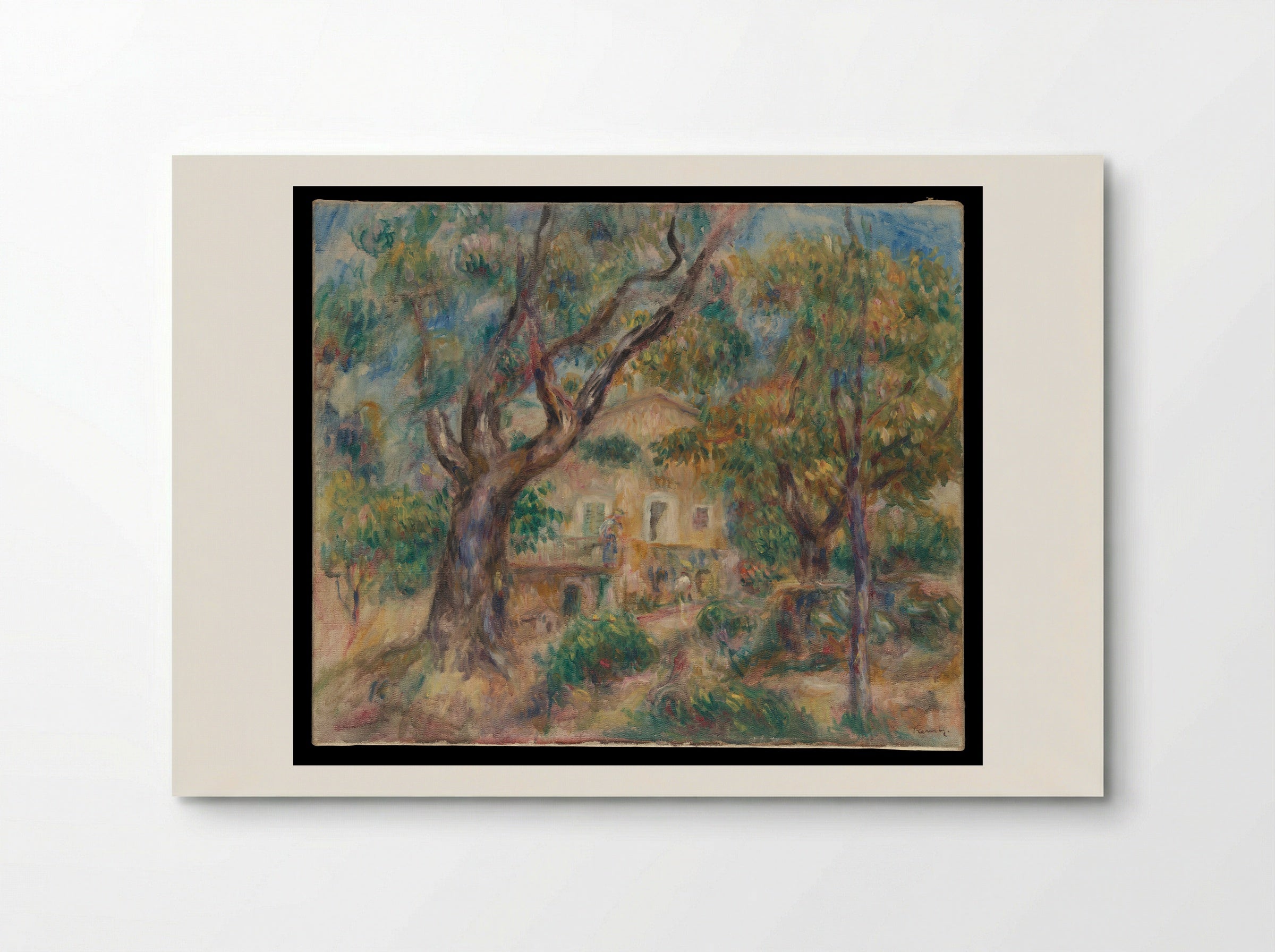
A late-period Impressionist study of the farmhouse at Les Collettes, capturing the soft light and olive trees of Renoir's Mediterranean garden.
Pierre-Auguste Renoir moved to the Les Collettes estate in Cagnes-sur-Mer in 1907, seeking relief from his rheumatoid arthritis in the warm climate of the south of France. This painting captures the farmhouse on his property, a subject he returned to frequently during his later years. The composition is dominated by the gnarled, ancient olive trees that defined the Mediterranean terrain of his garden. Renoir employs a soft, feathered brushwork that dissolves the architectural edges of the farmhouse into the surrounding foliage. The palette consists of warm ochres, earthy browns, and dappled greens, punctuated by hints of blue in the sky and shadows. Rather than focusing on precise detail, the artist prioritises the atmospheric quality of the light filtering through the branches. The figure near the house is rendered with minimal definition, functioning as a component of the overall colour harmony rather than a distinct narrative element. This work reflects the shift in Renoir's later style, where the rigorous structure of his earlier Impressionist period gives way to a more fluid, painterly approach. The paint application is thin in areas, allowing the texture of the canvas to contribute to the visual effect. By this stage in his career, Renoir was less concerned with the optical accuracy of the scene and more focused on the integration of form and colour. The farmhouse, while central to the composition, remains secondary to the rhythmic movement of the trees and the play of light across the garden. This piece offers a view into the domestic environment of the artist during his final decade, documenting the quiet, sun-drenched surroundings that occupied his attention.
Because every print is made to order, we don't offer change-of-mind returns, refunds or exchanges. If your order arrives faulty, damaged or incorrect, we'll replace it free of charge — just contact us within 48 hours of delivery. See our refunds page for full details.
We ship worldwide, printing at the production hub nearest to your delivery address. Delivery times and costs vary by destination — you'll see the options available to you at checkout.
Each print is produced to order using 12-colour giclée printing on FSC-certified archival paper. Designed in Britain and printed at your nearest production hub to reduce waste and speed up delivery.

Artist Biography
Our Features
Designed for Lasting Impact
Every Solis piece is made to order with archival, gallery-quality materials built to last.
To keep your artwork looking its best:
Museum-grade giclée on FSC-certified archival matte paper, with framed and canvas options.
Made to order
Every piece is printed to order. These are the five finishes, and what makes each one different.
From $29
A giclée print on 200gsm matte fine art paper, using a twelve-colour process for accurate, fade-resistant colour. Supplied unframed, delivered flat or rolled.

From $89
The same fine art print in a solid wood frame with UV-protective acrylic glaze and rigid backing. Five frame colours. Arrives ready to hang.

From $169
A deeper solid wood frame: 33mm deep with a 20mm face and Perspex glaze. The print sits unmounted for a clean gallery presentation. Black, white or natural.

From $59
Hand-stretched canvas with neat gallery-wrapped edges, giving the artwork surface texture and depth. Arrives ready to hang.

From $175
Stretched canvas set in a floating wood frame, our most substantial finish. Arrives ready to hang.
Why Choose Us ?
Damage-free delivery guarantee
Fast Shipping
Museum-Quality Materials
Artist Biography
Pierre-Auguste Renoir
You May Also Like
We use cookies to measure our marketing and see which prints people love.We use cookies to measure our marketing.
By continuing to browse, you agree · Privacy Policy