

Fine Art Poster
From $29
A giclée print on 200gsm matte fine art paper, using a twelve-colour process for accurate, fade-resistant colour. Supplied unframed, delivered flat or rolled.



Archival giclée
Frames arrive ready to hang
Secure checkout
Made to order
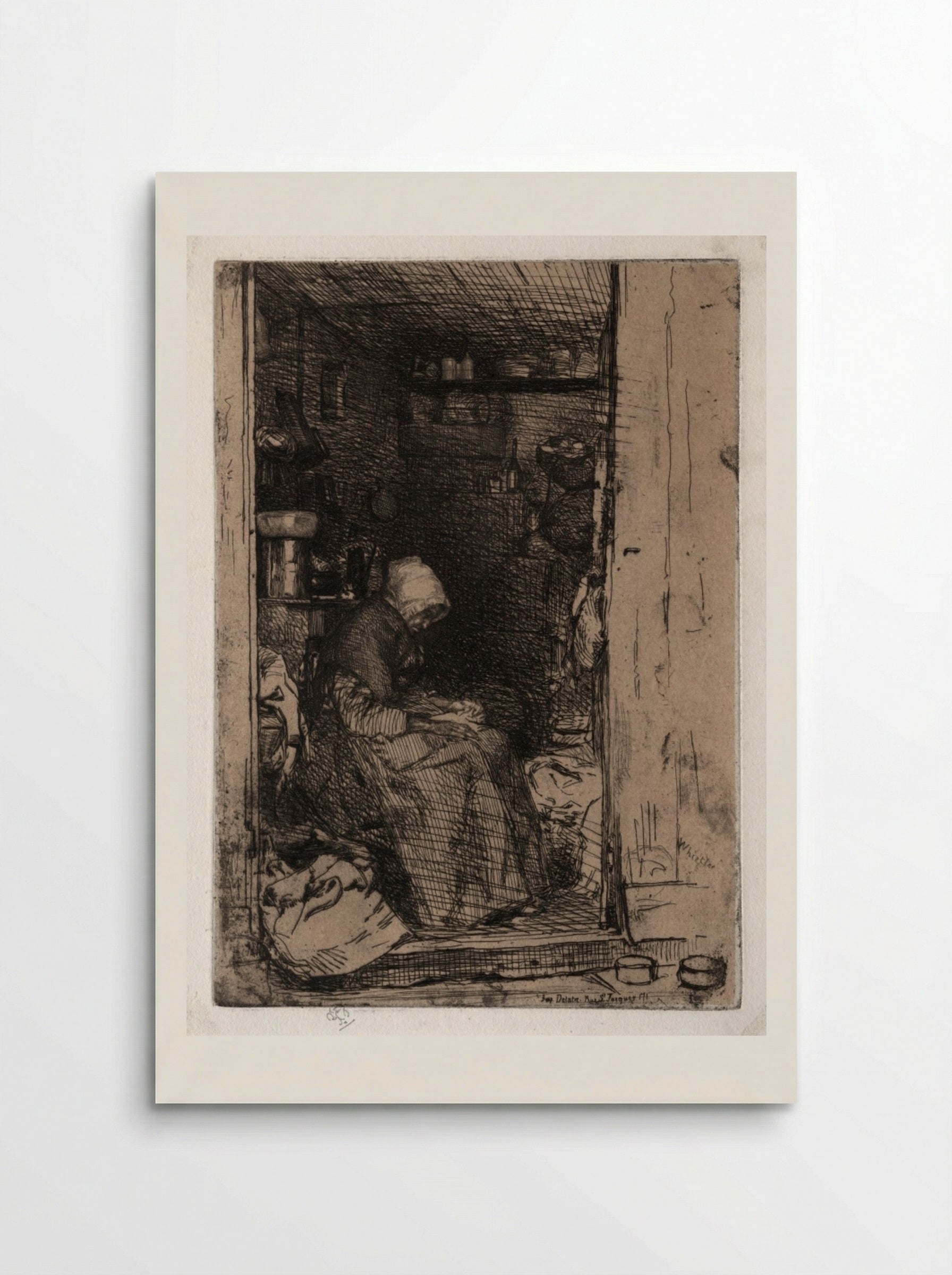
An evocative 1858 etching by James McNeill Whistler, capturing a quiet, atmospheric moment of an elderly woman at work in a dimly lit interior.
James McNeill Whistler produced this etching in 1858 as part of his 'French Set', a collection of twelve prints documenting his travels through France and Germany. The work depicts an elderly woman seated within the confines of a cramped, dimly lit interior. Her posture is hunched, focused entirely on the task at hand, while the surrounding space is filled with the clutter of daily life. Shelves laden with objects and various containers create a sense of claustrophobic density, typical of the modest living conditions Whistler observed during this period. Technically, the print demonstrates Whistler's mastery of the etching needle. He employs a variety of line weights to define the form of the figure and the texture of the room. The cross-hatching in the background serves to deepen the shadows, pushing the figure forward and creating a distinct sense of atmosphere. The light source, though subtle, draws the eye to the woman's hands and her bent head, isolating her in a moment of quiet labour. Whistler was deeply influenced by the Dutch masters, particularly Rembrandt, whose approach to light and shadow is evident here. By choosing to depict a figure from the margins of society, Whistler aligns himself with the Realist movement, which sought to document the lives of ordinary people without idealisation. The print is not merely a study of light, but a careful observation of human presence in a confined environment. The plate shows signs of wear and specific ink wiping techniques, which were characteristic of Whistler's experimental approach to the printing process. This work remains a fine example of his early graphic output, capturing a fleeting, mundane moment with technical precision and a sombre, observational tone.
Because every print is made to order, we don't offer change-of-mind returns, refunds or exchanges. If your order arrives faulty, damaged or incorrect, we'll replace it free of charge — just contact us within 48 hours of delivery. See our refunds page for full details.
We ship worldwide, printing at the production hub nearest to your delivery address. Delivery times and costs vary by destination — you'll see the options available to you at checkout.
Each print is produced to order using 12-colour giclée printing on FSC-certified archival paper. Designed in Britain and printed at your nearest production hub to reduce waste and speed up delivery.

Artist Biography
Our Features
Designed for Lasting Impact
Every Solis piece is made to order with archival, gallery-quality materials built to last.
To keep your artwork looking its best:
Museum-grade giclée on FSC-certified archival matte paper, with framed and canvas options.
Made to order
Every piece is printed to order. These are the five finishes, and what makes each one different.
From $29
A giclée print on 200gsm matte fine art paper, using a twelve-colour process for accurate, fade-resistant colour. Supplied unframed, delivered flat or rolled.

From $89
The same fine art print in a solid wood frame with UV-protective acrylic glaze and rigid backing. Five frame colours. Arrives ready to hang.

From $169
A deeper solid wood frame: 33mm deep with a 20mm face and Perspex glaze. The print sits unmounted for a clean gallery presentation. Black, white or natural.

From $59
Hand-stretched canvas with neat gallery-wrapped edges, giving the artwork surface texture and depth. Arrives ready to hang.

From $175
Stretched canvas set in a floating wood frame, our most substantial finish. Arrives ready to hang.
Why Choose Us ?
Damage-free delivery guarantee
Fast Shipping
Museum-Quality Materials
Artist Biography
James McNeill Whistler
You May Also Like
Cookies show us which prints people love, so we hang the right art. Help us fill it?
Essential cookies only if you prefer · Privacy Policy