

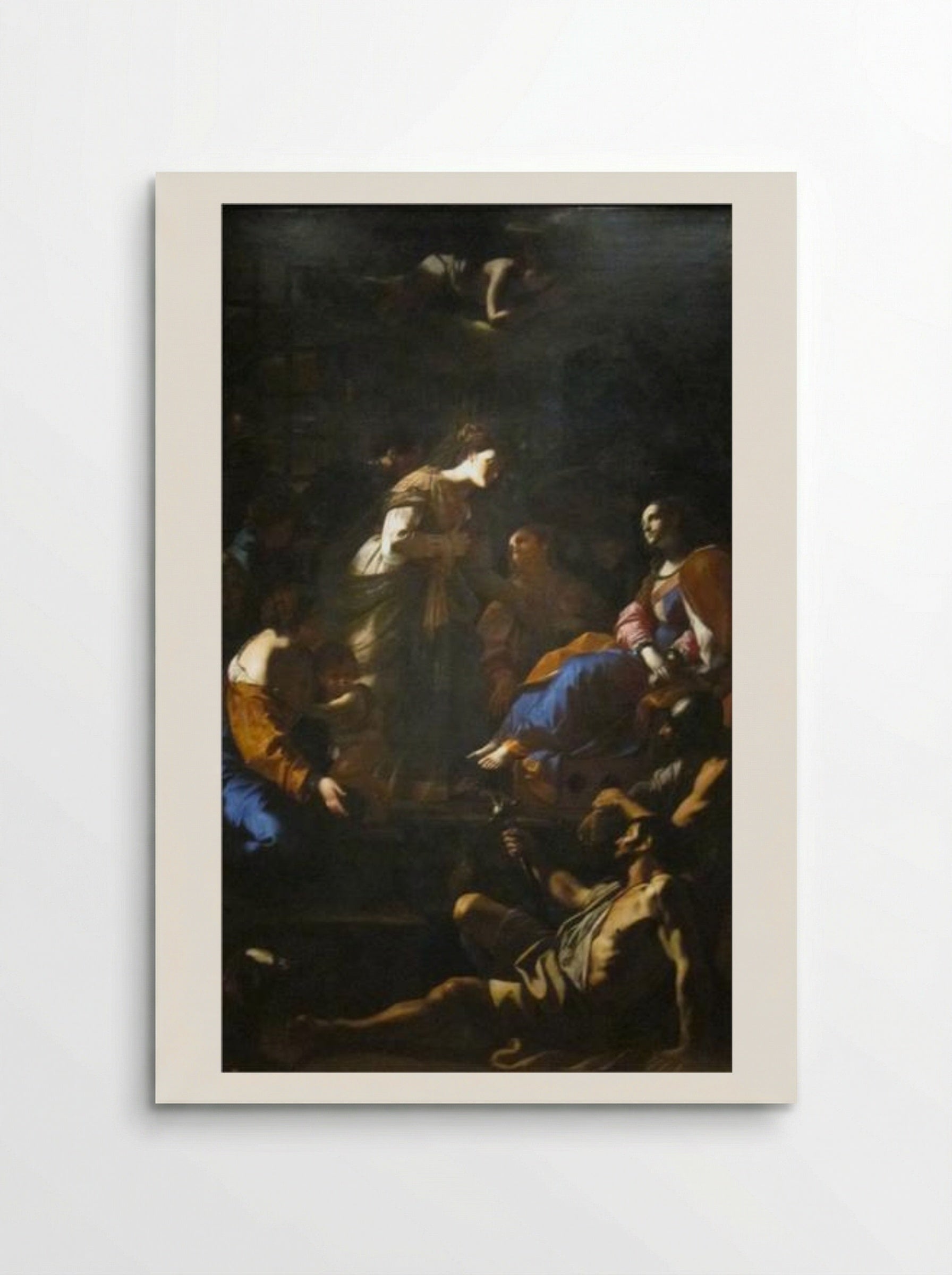
The Roman Empress Faustina Visiting Saint Catherine of Alexandria in Prison - Mattia Preti
Archival giclée
Frames arrive ready to hang
Secure checkout
Made to order
Description
A dramatic Baroque oil painting by Mattia Preti, featuring the intense chiaroscuro and emotional narrative typical of the 17th-century Neapolitan school.
This composition by Mattia Preti depicts a narrative from the life of Saint Catherine of Alexandria. The scene captures the moment Empress Faustina visits the saint during her imprisonment. Preti employs a dramatic use of chiaroscuro, a hallmark of the Baroque period, to direct the viewer's attention toward the central figures. The light source, seemingly emanating from an unseen point, illuminates the faces and drapery of the women, while the surrounding prison environment remains shrouded in deep shadow. Preti, known as Il Cavalier Calabrese, was heavily influenced by the tenebrism of Caravaggio. This influence is evident in the heavy contrast between the illuminated subjects and the dark, atmospheric background. The figures are arranged in a theatrical manner, with the Empress standing as a figure of authority and compassion, contrasting with the seated, composed form of Saint Catherine. The presence of secondary figures, including a guard in the foreground, adds a sense of grounded reality to the spiritual narrative. The textures of the fabric, from the heavy folds of the robes to the subtle sheen of the garments, demonstrate Preti's technical proficiency in oil painting. As a practitioner of the Neapolitan school, Preti often focused on themes of martyrdom and religious devotion. This work avoids excessive ornamentation, choosing instead to focus on the psychological interaction between the two primary women. The composition is balanced, with the verticality of the standing Empress providing a counterpoint to the horizontal orientation of the seated saint. The muted palette, dominated by earth tones and deep shadows, creates a sombre mood appropriate for the prison setting. This print captures the depth and tonal range of the original canvas, offering a clear view of the artist's brushwork and the dramatic lighting effects that define this period of Italian art.
Return policy
Because every print is made to order, we don't offer change-of-mind returns, refunds or exchanges. If your order arrives faulty, damaged or incorrect, we'll replace it free of charge — just contact us within 48 hours of delivery. See our refunds page for full details.
Shipping
We ship worldwide, printing at the production hub nearest to your delivery address. Delivery times and costs vary by destination — you'll see the options available to you at checkout.
Manufacturing
Each print is produced to order using 12-colour giclée printing on FSC-certified archival paper. Designed in Britain and printed at your nearest production hub to reduce waste and speed up delivery.
Care and materials
Specific Features
Every Solis piece is made to order with archival, gallery-quality materials built to last.
- Museum-grade giclée printing for rich, fade-resistant colour
- Archival matte fine-art paper, FSC-certified
- Multiple sizes and framing options available
- Frames in black, natural wood, dark wood or white
- Framed prints arrive ready to hang
Care & Cleaning
To keep your artwork looking its best:
- Dust gently with a soft, dry cloth
- Avoid prolonged direct sunlight
- Never use liquid cleaners on the print or canvas surface
- Keep in a dry, room-temperature space
- Handle prints with clean, dry hands
Materials & Sizing
Museum-grade giclée on FSC-certified archival matte paper, with framed and canvas options.
- Paper sizes: A4, A3, A2, A1, A0 and B2 (50×70 cm)
- Canvas: XS (20×30 cm) to Large (60×90 cm)
- Frames: black, natural wood, dark wood or white
The Roman Empress Faustina Visiting Saint Catherine of Alexandria in Prison - Mattia Preti

Artist Biography
Mattia Preti
He was born in Taverna, Calabria, in 1613 and moved to Rome in 1630 to join his elder brother Gregorio, already a painter there. His style combined Caravaggio's drama with the colour of Guido Reni and the theatricality of Rubens. In 1661 he moved to Malta, where he spent his most productive decades painting the vast ceiling cycle of the life of Saint John the Baptist in Valletta's Co-Cathedral (1661 to 1666). The scale of the Maltese work, covering the entire barrel vault, is among the largest fresco programmes of the seventeenth century. He is buried in the Co-Cathedral alongside fellow Knights.
His colour sensibility, drawn from Reni and filtered through Roman experience, gives even his most dramatically lit compositions a warmth that separates him from the colder tenebrism of other Caravaggisti. He died in 1699, at eighty-six, having worked across Italy and Malta for nearly seven decades.
Why Choose Us ?
Damage-free delivery guarantee
Fast Shipping
Museum-Quality Materials
You May Also Like