

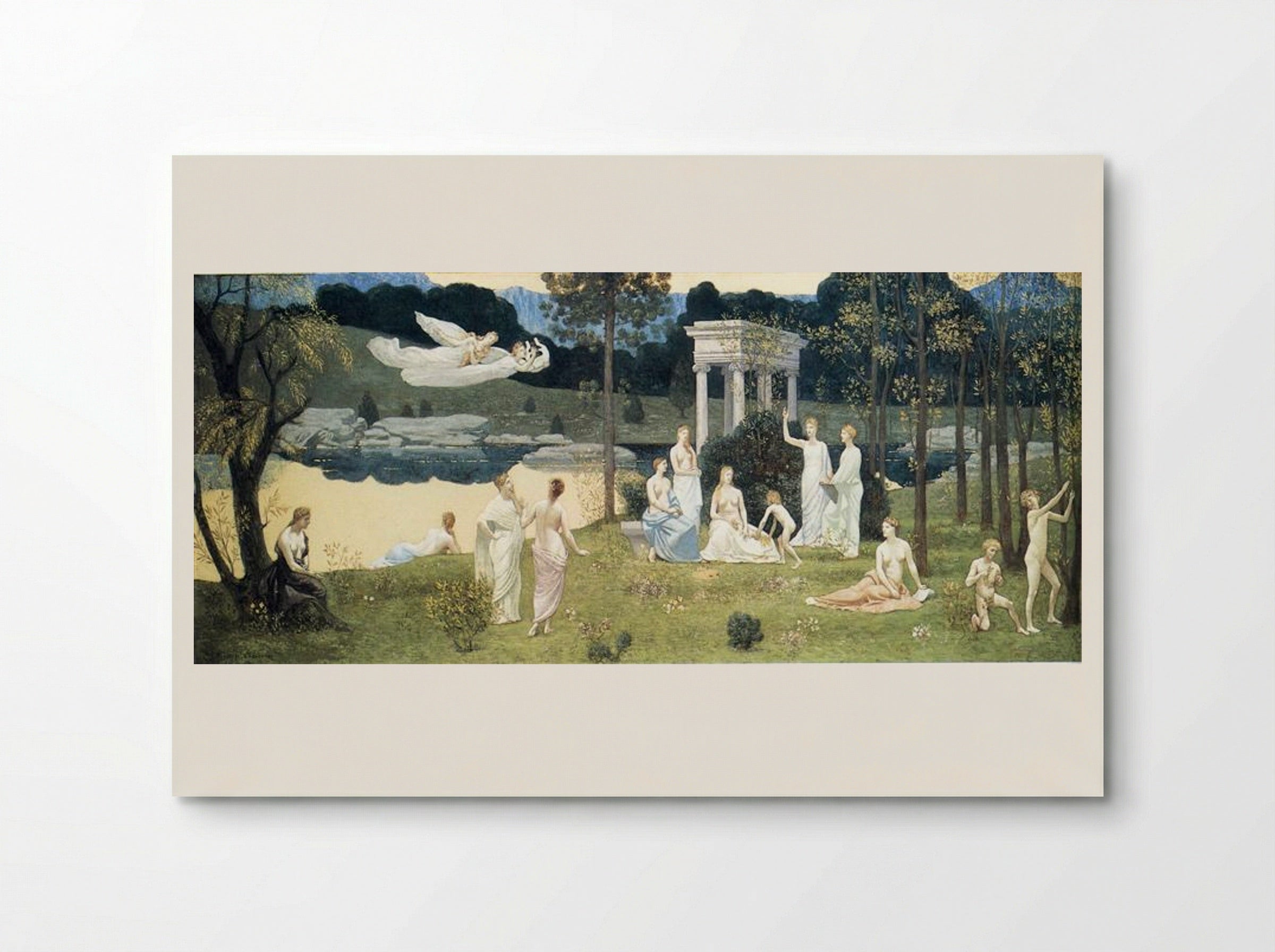
The Sacred Wood Cherished by the Arts and the Muses - Pierre Puvis de Chavannes
Archival giclée
Frames arrive ready to hang
Secure checkout
Made to order
Description
Pierre Puvis de Chavannes's "The Sacred Wood Cherished by the Arts and the Muses" is a Symbolist masterpiece depicting a serene, classical scene with figures in a wooded landscape, painted in muted tones.
Pierre Puvis de Chavannes's "The Sacred Wood Cherished by the Arts and the Muses", painted in 1884, is a quintessential example of Symbolist art. The work is a large-scale mural painting, originally created for the Musée des Beaux-Arts in Lyon. Puvis de Chavannes sought to create a serene and idealised vision of classical antiquity, a space where art and intellect flourish in harmony. His style is characterised by its muted palette and simplified forms, which lend the scene a timeless quality. The painting depicts a group of figures, mostly female, in classical drapery, set within a tranquil, wooded environment. A classical temple stands in the background, further reinforcing the scene's connection to antiquity. The figures are arranged in a frieze-like composition, with gentle gestures and contemplative poses. The overall effect is one of stillness and contemplation, inviting the viewer to enter a world of artistic inspiration and reflection. The colour scheme is dominated by soft greens, blues, and creams, contributing to the painting's ethereal and dreamlike atmosphere. The figures' pale skin tones and flowing garments enhance the sense of grace and harmony.
Return policy
Because every print is made to order, we don't offer change-of-mind returns, refunds or exchanges. If your order arrives faulty, damaged or incorrect, we'll replace it free of charge — just contact us within 48 hours of delivery. See our refunds page for full details.
Shipping
We ship worldwide, printing at the production hub nearest to your delivery address. Delivery times and costs vary by destination — you'll see the options available to you at checkout.
Manufacturing
Each print is produced to order using 12-colour giclée printing on FSC-certified archival paper. Designed in Britain and printed at your nearest production hub to reduce waste and speed up delivery.
Care and materials
Specific Features
Every Solis piece is made to order with archival, gallery-quality materials built to last.
- Museum-grade giclée printing for rich, fade-resistant colour
- Archival matte fine-art paper, FSC-certified
- Multiple sizes and framing options available
- Frames in black, natural wood, dark wood or white
- Framed prints arrive ready to hang
Care & Cleaning
To keep your artwork looking its best:
- Dust gently with a soft, dry cloth
- Avoid prolonged direct sunlight
- Never use liquid cleaners on the print or canvas surface
- Keep in a dry, room-temperature space
- Handle prints with clean, dry hands
Materials & Sizing
Museum-grade giclée on FSC-certified archival matte paper, with framed and canvas options.
- Paper sizes: A4, A3, A2, A1, A0 and B2 (50×70 cm)
- Canvas: XS (20×30 cm) to Large (60×90 cm)
- Frames: black, natural wood, dark wood or white
The Sacred Wood Cherished by the Arts and the Muses - Pierre Puvis de Chavannes

Artist Biography
Pierre Puvis De Chavannes
He was born in Lyon in 1824, the son of a mining engineer from an old Burgundian noble family. He added the ancestral "de Chavannes" to his name himself. A serious illness interrupted his planned engineering career; a trip to Italy redirected him toward painting. Back in Paris he studied briefly under Delacroix, then under Henri Scheffer and Thomas Couture, but developed a style that owed little to any of them: simplified forms, rhythmic outlines, muted colour that imitated the appearance of fresco, applied to large allegorical subjects drawn from antiquity and French history.
His murals at the Pantheon in Paris (begun 1874, depicting the life of Saint Genevieve) and at town halls, churches and civic buildings across France earned him the informal title "the painter for France". The technique was not true fresco but oil on canvas affixed to the wall (marouflage), which allowed him to work in his studio. The pale, flattened surfaces influenced an unlikely range of successors: Seurat studied his compositions, Gauguin absorbed his flat colour planes, Maurice Denis built Nabi theory partly on his example, and Picasso's Blue Period owes something to his chalky palette.
From 1856 he was in a relationship with the Romanian princess Marie Cantacuzene. They were together for forty years, marrying only shortly before both died in 1898.
Why Choose Us ?
Damage-free delivery guarantee
Fast Shipping
Museum-Quality Materials
You May Also Like