

Fine Art Poster
From $39
A giclée print on 200gsm matte fine art paper, using a twelve-colour process for accurate, fade-resistant colour. Supplied unframed, delivered flat or rolled.



Archival giclée
Frames arrive ready to hang
Secure checkout
Made to order
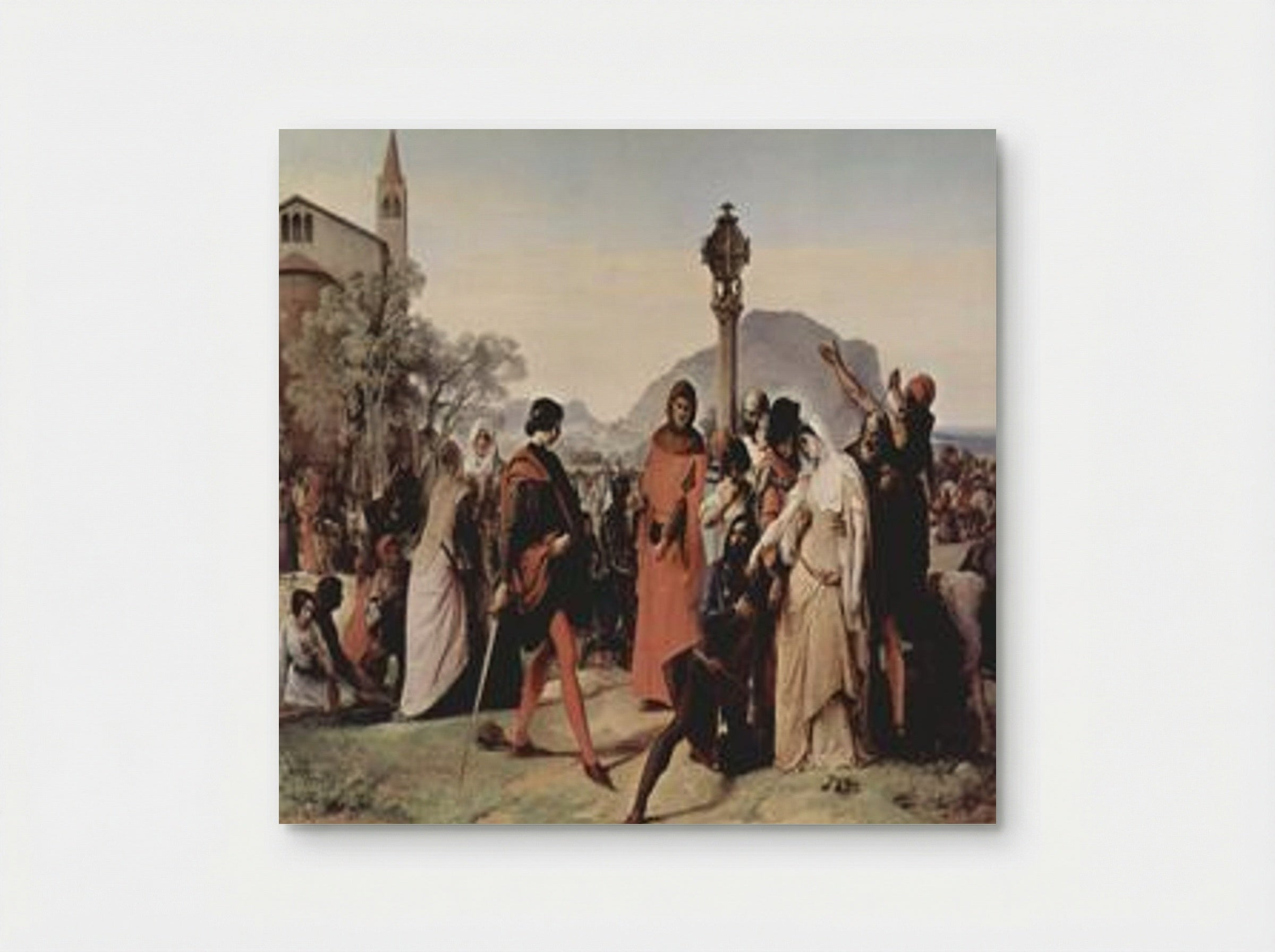
A historical scene by Francesco Hayez depicting the Sicilian Vespers, rendered in the dramatic style of Italian Romanticism.
This work by Francesco Hayez depicts a scene from the Sicilian Vespers, a rebellion against the Angevin rule in Sicily during the late thirteenth century. Hayez, a central figure in Italian Romanticism, utilised this historical subject to communicate contemporary political themes regarding Italian unification. The composition organises a crowd of figures around a central cross, creating a sense of collective tension and impending conflict. The figures are dressed in period-appropriate attire, rendered with the precision characteristic of Hayez's academic training. The narrative focus rests on the emotional responses of the individuals gathered, rather than the physical act of combat. Hayez employs a controlled palette and clear lighting to define the spatial relationships between the foreground figures and the distant architectural elements. The church tower in the background provides a vertical anchor for the scene, while the rugged terrain suggests the specific geography of the island. This painting is one of several versions Hayez produced of this subject, reflecting his interest in historical narratives that resonated with the political climate of the Risorgimento. The artist avoids excessive ornamentation, preferring to direct the viewer's attention to the psychological state of the participants. Through his careful arrangement of the figures, Hayez captures the gravity of the historical moment, balancing the requirements of a large-scale history painting with a focus on individual human experience. The work remains a primary example of how nineteenth-century artists used historical events to address the social and political concerns of their own time.
Because every print is made to order, we don't offer change-of-mind returns, refunds or exchanges. If your order arrives faulty, damaged or incorrect, we'll replace it free of charge — just contact us within 48 hours of delivery. See our refunds page for full details.
We ship worldwide, printing at the production hub nearest to your delivery address. Delivery times and costs vary by destination — you'll see the options available to you at checkout.
Each print is produced to order using 12-colour giclée printing on FSC-certified archival paper. Designed in Britain and printed at your nearest production hub to reduce waste and speed up delivery.

Artist Biography
Our Features
Designed for Lasting Impact
Every Solis piece is made to order with archival, gallery-quality materials built to last.
To keep your artwork looking its best:
Museum-grade giclée on FSC-certified archival matte paper, with framed and canvas options.
Made to order
Every piece is printed to order. These are the five finishes, and what makes each one different.
From $39
A giclée print on 200gsm matte fine art paper, using a twelve-colour process for accurate, fade-resistant colour. Supplied unframed, delivered flat or rolled.

From $119
The same fine art print in a solid wood frame with UV-protective acrylic glaze and rigid backing. Five frame colours. Arrives ready to hang.

From $189
A deeper solid wood frame: 33mm deep with a 20mm face and Perspex glaze. The print sits unmounted for a clean gallery presentation. Black, white or natural.

From $59
Hand-stretched canvas with neat gallery-wrapped edges, giving the artwork surface texture and depth. Arrives ready to hang.

From $175
Stretched canvas set in a floating wood frame, our most substantial finish. Arrives ready to hang.
Why Choose Us ?
Damage-free delivery guarantee
Fast Shipping
Museum-Quality Materials
Artist Biography
Francesco Hayez
You May Also Like
Cookies show us which prints people love, so we hang the right art. Help us fill it?
Essential cookies only if you prefer · Privacy Policy