

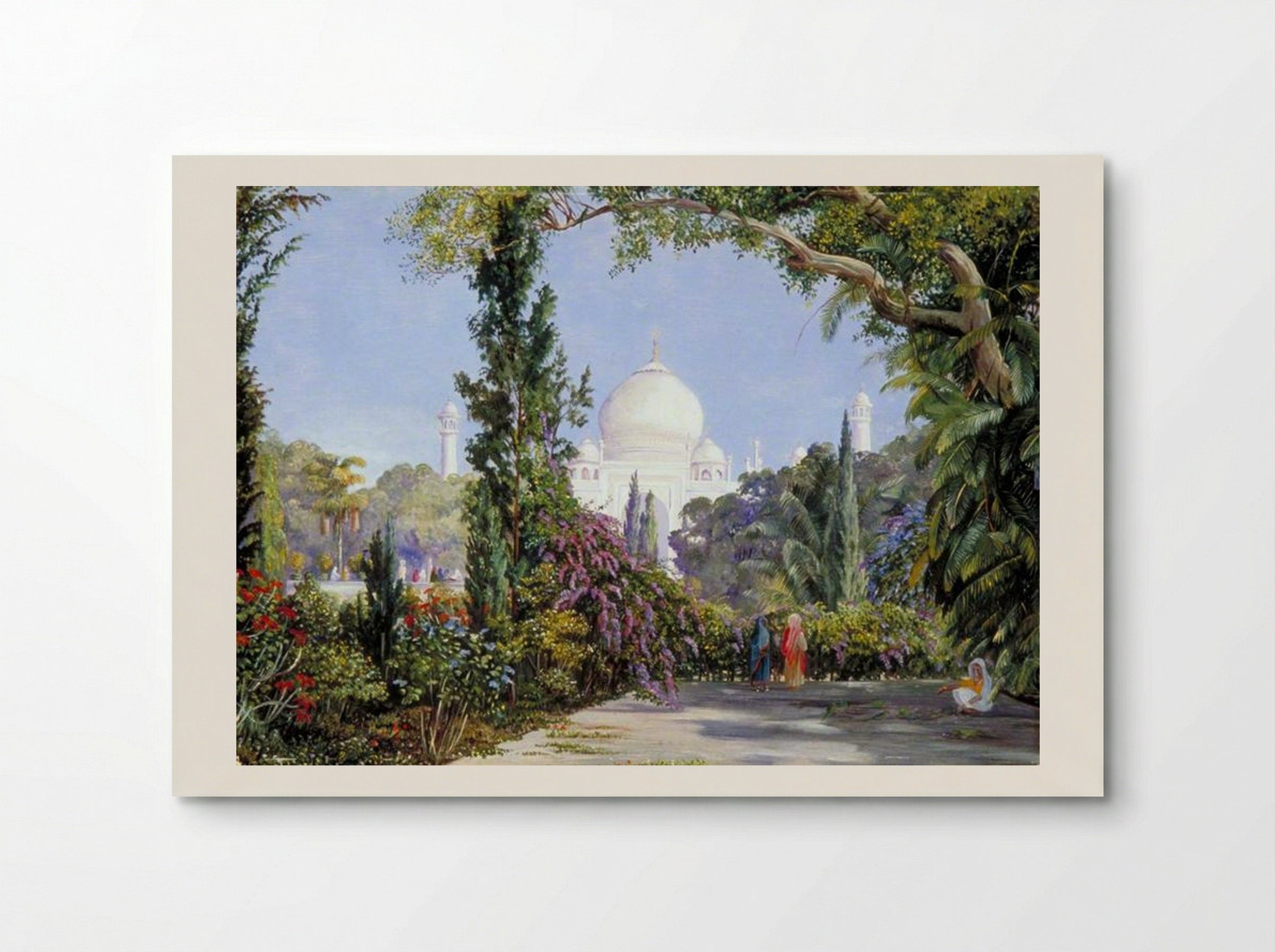
The Taj Mahal at Agra, North-West India - Marianne North
Archival giclée
Frames arrive ready to hang
Secure checkout
Made to order
Description
A detailed oil painting by Marianne North, capturing the Taj Mahal framed by the lush, exotic flora of India during her 1877-1879 travels.
Marianne North was a prolific Victorian traveller and artist who documented the flora of the world with scientific precision. This work depicts the Taj Mahal, viewed through a frame of lush, exotic vegetation. North travelled extensively across India between 1877 and 1879, producing a vast collection of paintings that now reside in the Marianne North Gallery at the Royal Botanic Gardens, Kew. In this composition, the white marble dome of the mausoleum rises above a dense foreground of flowering shrubs and palm trees. North employs a clear, observational style, prioritising the accurate rendering of botanical specimens over atmospheric abstraction. The framing device of overhanging branches creates a sense of depth, drawing the viewer's eye towards the architectural monument in the distance. Two figures in traditional attire stand on a path, providing a sense of scale to the scene. The painting reflects the artist's unique approach to travel art, where the natural environment is given equal weight to the architectural subject. Her work remains a valuable record of the botanical diversity she encountered during her expeditions. The application of paint is controlled and deliberate, characteristic of her training and her objective to create a visual catalogue of plants. The light is even, suggesting a bright day, and the colours are applied with a focus on local tone. This piece offers a glimpse into the nineteenth-century fascination with global travel and the documentation of distant cultures and environments. It is a representative example of North's ability to combine topographical accuracy with a personal, artistic perspective on the places she visited.
Return policy
Because every print is made to order, we don't offer change-of-mind returns, refunds or exchanges. If your order arrives faulty, damaged or incorrect, we'll replace it free of charge — just contact us within 48 hours of delivery. See our refunds page for full details.
Shipping
We ship worldwide, printing at the production hub nearest to your delivery address. Delivery times and costs vary by destination — you'll see the options available to you at checkout.
Manufacturing
Each print is produced to order using 12-colour giclée printing on FSC-certified archival paper. Designed in Britain and printed at your nearest production hub to reduce waste and speed up delivery.
The Taj Mahal at Agra, North-West India - Marianne North

Artist Biography
Marianne North
She was born in 1830 into a wealthy Norfolk family. Her father was an MP. She trained as a singer, but her voice failed and she turned to painting. She was devoted to her father and travelled with him until his death in 1869, which freed her to go further.
She painted plants in oils, not watercolours, and she painted them in situ within their habitats, including animals, people, and temples. In Borneo she painted a pitcher plant unknown to science, which was named Nepenthes northiana in her honour. Charles Darwin personally suggested she visit Australia. She completed 848 paintings in thirteen years, donated 832 to Kew Gardens, and paid for the gallery to house them herself. The Marianne North Gallery at Kew remains the only permanent solo exhibition in a major UK institution. She died in 1890.
Our Features
Designed for Lasting Impact
Specific Features
Every Solis piece is made to order with archival, gallery-quality materials built to last.
- Museum-grade giclée printing for rich, fade-resistant colour
- Archival matte fine-art paper, FSC-certified
- Multiple sizes and framing options available
- Frames in black, natural wood, dark wood or white
- Framed prints arrive ready to hang
Care & Cleaning
To keep your artwork looking its best:
- Dust gently with a soft, dry cloth
- Avoid prolonged direct sunlight
- Never use liquid cleaners on the print or canvas surface
- Keep in a dry, room-temperature space
- Handle prints with clean, dry hands
Materials & Sizing
Museum-grade giclée on FSC-certified archival matte paper, with framed and canvas options.
- Paper sizes: A4, A3, A2, A1, A0 and B2 (50×70 cm)
- Canvas: XS (20×30 cm) to Large (60×90 cm)
- Frames: black, natural wood, dark wood or white
Why Choose Us ?
Damage-free delivery guarantee
Fast Shipping
Museum-Quality Materials
Artist Biography
Marianne North
She was born in 1830 into a wealthy Norfolk family. Her father was an MP. She trained as a singer, but her voice failed and she turned to painting. She was devoted to her father and travelled with him until his death in 1869, which freed her to go further.
She painted plants in oils, not watercolours, and she painted them in situ within their habitats, including animals, people, and temples. In Borneo she painted a pitcher plant unknown to science, which was named Nepenthes northiana in her honour. Charles Darwin personally suggested she visit Australia. She completed 848 paintings in thirteen years, donated 832 to Kew Gardens, and paid for the gallery to house them herself. The Marianne North Gallery at Kew remains the only permanent solo exhibition in a major UK institution. She died in 1890.
You May Also Like