

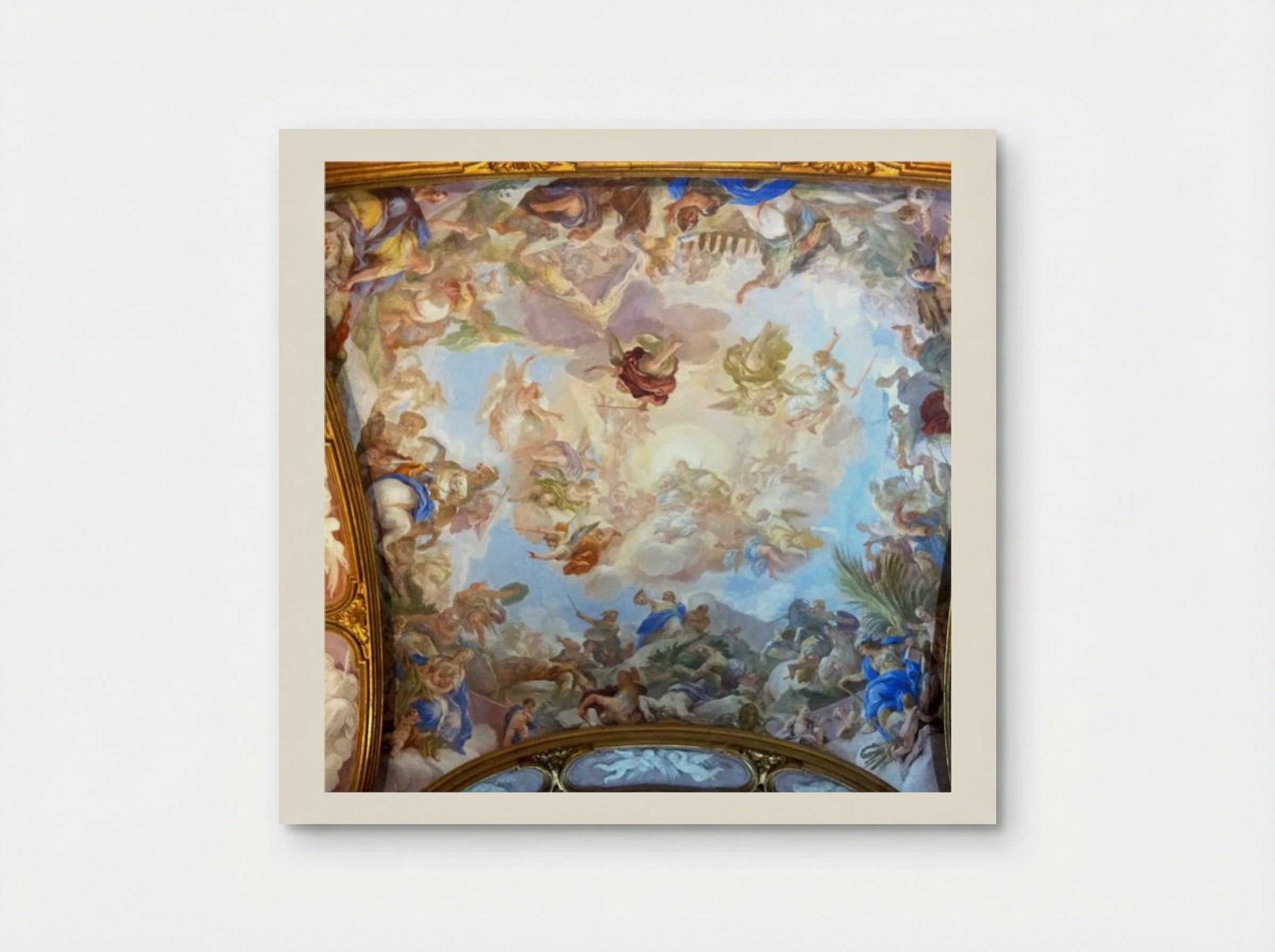
The Triumph of Judith - Luca Giordano
Archival giclée
Frames arrive ready to hang
Secure checkout
Made to order
Description
This fresco by Luca Giordano depicts the biblical story of Judith's triumph over Holofernes. The Baroque artwork features a dynamic composition and a light, pastel colour palette.
Luca Giordano's "The Triumph of Judith" is a fresco depicting the biblical story of Judith, who saved her people by beheading the Assyrian general Holofernes. Giordano, a prominent figure in the late Baroque period, was known for his speed and facility, earning him the nickname "Luca fa presto" (Luca works quickly). His style is characterised by dynamic compositions, a light palette, and a theatrical flair. He blended Venetian colourism with the Roman tradition of grand-scale illusionistic painting. The fresco presents a swirling scene of figures set against a sky. Judith, often depicted holding Holofernes' head, is shown amidst a host of angels and putti. The composition is filled with movement, as figures ascend and descend, creating a sense of drama and divine intervention. The colour palette is dominated by pastel shades of blue, pink, and cream, with touches of stronger colours to draw the eye. The overall effect is one of lightness and exuberance, typical of Baroque ceiling painting.
Return policy
Because every print is made to order, we don't offer change-of-mind returns, refunds or exchanges. If your order arrives faulty, damaged or incorrect, we'll replace it free of charge — just contact us within 48 hours of delivery. See our refunds page for full details.
Shipping
We ship worldwide, printing at the production hub nearest to your delivery address. Delivery times and costs vary by destination — you'll see the options available to you at checkout.
Manufacturing
Each print is produced to order using 12-colour giclée printing on FSC-certified archival paper. Designed in Britain and printed at your nearest production hub to reduce waste and speed up delivery.
Care and materials
Specific Features
Every Solis piece is made to order with archival, gallery-quality materials built to last.
- Museum-grade giclée printing for rich, fade-resistant colour
- Archival matte fine-art paper, FSC-certified
- Multiple sizes and framing options available
- Frames in black, natural wood, dark wood or white
- Framed prints arrive ready to hang
Care & Cleaning
To keep your artwork looking its best:
- Dust gently with a soft, dry cloth
- Avoid prolonged direct sunlight
- Never use liquid cleaners on the print or canvas surface
- Keep in a dry, room-temperature space
- Handle prints with clean, dry hands
Materials & Sizing
Museum-grade giclée on FSC-certified archival matte paper, with framed and canvas options.
- Paper sizes: A4, A3, A2, A1, A0 and B2 (50×70 cm)
- Canvas: XS (20×30 cm) to Large (60×90 cm)
- Frames: black, natural wood, dark wood or white
The Triumph of Judith - Luca Giordano

Artist Biography
Luca Giordano
He was born in Naples in 1634 and trained under Jusepe de Ribera. Around 1652 he travelled to Rome, where he absorbed Pietro da Cortona's Baroque dynamism and studied the High Renaissance masters. His other nickname, Proteus, came from his ability to produce convincing pastiches in the style of almost any painter: Durer, Titian, Veronese. The skill was admired rather than criticised; versatility was a virtue in Baroque Naples.
In 1692, Charles II of Spain invited him to Madrid, where he spent ten years painting frescoes in the Escorial, the Royal Palace and other buildings. His Spanish work is among his best: the scale suited his ambition, and the court demanded the gold brush. He returned to Naples in 1702 after the king's death.
His late paintings, lighter and less rhetorical than his Roman-influenced middle period, anticipated the Rococo. Fragonard admired them a generation later. Giordano was generous with money, particularly to poorer artists, and spent large sums on acts of patronage and charity. His output was enormous, running to thousands of works across oil and fresco. He died in Naples in 1705, at seventy.
Why Choose Us ?
Damage-free delivery guarantee
Fast Shipping
Museum-Quality Materials
You May Also Like