

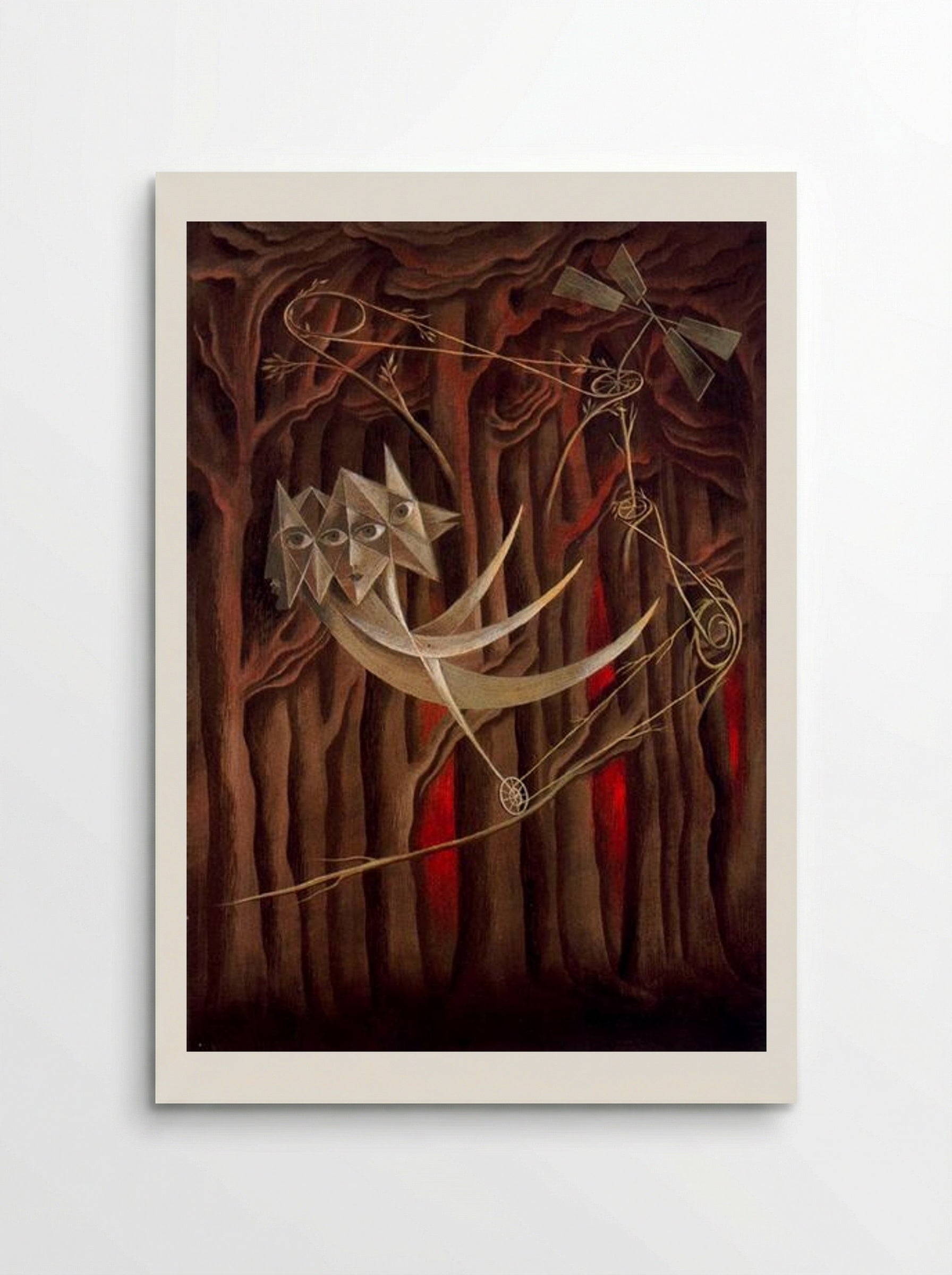
Tightrope Walkers - Remedios Varo
Archival giclée
Frames arrive ready to hang
Secure checkout
Made to order
Description
A surrealist composition by Remedios Varo, depicting a multi-faceted figure navigating a mechanical apparatus within a dark, mysterious forest.
Remedios Varo, a Spanish-born artist who spent her most productive years in Mexico, created this work in 1956. The composition features a central, multi-faceted figure navigating a precarious path through a dense, dark forest. The figure, possessing multiple faces, appears to be suspended by a complex system of pulleys and wires that connect to the surrounding trees. A small windmill sits at the top of this mechanical apparatus, suggesting a sense of perpetual motion or a self-sustaining internal logic. The forest background is rendered in deep, earthy tones, with vertical lines of tree trunks creating a sense of enclosure. Hints of red light emerge from behind the trees, providing a stark contrast to the muted browns and greys of the foreground. Varo often employed such mechanical elements to explore themes of alchemy, transformation, and the search for knowledge. The precision of her brushwork, combined with the dreamlike subject matter, reflects her interest in both scientific inquiry and the subconscious mind. This piece demonstrates the artist's ability to construct entire worlds governed by their own physics. The figure, balanced on a thin branch, moves with a deliberate, almost ritualistic focus. The mechanical contraption, while seemingly fragile, provides the necessary support for the figure's journey. Varo's work frequently features these solitary, questing figures, often depicted in states of transition or discovery. The technical execution, using oil on masonite, allows for the smooth, luminous surfaces that define her mature style. This print captures the atmospheric tension and the meticulous detail of the original composition, offering a glimpse into the singular vision of one of the most distinct voices within the mid-twentieth-century surrealist movement.
Return policy
Because every print is made to order, we don't offer change-of-mind returns, refunds or exchanges. If your order arrives faulty, damaged or incorrect, we'll replace it free of charge — just contact us within 48 hours of delivery. See our refunds page for full details.
Shipping
We ship worldwide, printing at the production hub nearest to your delivery address. Delivery times and costs vary by destination — you'll see the options available to you at checkout.
Manufacturing
Each print is produced to order using 12-colour giclée printing on FSC-certified archival paper. Designed in Britain and printed at your nearest production hub to reduce waste and speed up delivery.
Tightrope Walkers - Remedios Varo

Artist Biography
Remedios Varo
She graduated from the Royal Academy of Fine Arts of San Fernando in 1930, one of the few women in her class. In Barcelona she fell in with the Surrealists and, through them, with the poet Benjamin Peret, who became her partner. When Paris fell, she was jailed on suspicion of espionage. After her release she and Peret boarded one of the last ships allowed to leave France, arriving in Mexico in 1941.
In Mexico City she became inseparable from the English Surrealist Leonora Carrington. Together with the photographer Kati Horna, the three were called the Three Witches. They attended meetings of Gurdjieff and Ouspensky followers, studied alchemy and Jungian dream theory, and put ink in tapioca pearls to serve as caviar at dinner parties for Octavio Paz.
She did not paint prolifically until the last thirteen years of her life, once she was financially stable and free of wartime displacement. The paintings from this period are meticulous: tiny figures in architectural spaces that obey their own physics, conducting experiments with starlight or weaving the fabric of the universe from threads pulled out of the air.
Her posthumous retrospective at the Museum of Modern Art in Mexico City in 1971 drew more visitors than shows by Diego Rivera or David Alfaro Siqueiros. She had died of a heart attack in 1963, at fifty-four, at the peak of her working life.
Our Features
Designed for Lasting Impact
Specific Features
Every Solis piece is made to order with archival, gallery-quality materials built to last.
- Museum-grade giclée printing for rich, fade-resistant colour
- Archival matte fine-art paper, FSC-certified
- Multiple sizes and framing options available
- Frames in black, natural wood, dark wood or white
- Framed prints arrive ready to hang
Care & Cleaning
To keep your artwork looking its best:
- Dust gently with a soft, dry cloth
- Avoid prolonged direct sunlight
- Never use liquid cleaners on the print or canvas surface
- Keep in a dry, room-temperature space
- Handle prints with clean, dry hands
Materials & Sizing
Museum-grade giclée on FSC-certified archival matte paper, with framed and canvas options.
- Paper sizes: A4, A3, A2, A1, A0 and B2 (50×70 cm)
- Canvas: XS (20×30 cm) to Large (60×90 cm)
- Frames: black, natural wood, dark wood or white
Why Choose Us ?
Damage-free delivery guarantee
Fast Shipping
Museum-Quality Materials
Artist Biography
Remedios Varo
She graduated from the Royal Academy of Fine Arts of San Fernando in 1930, one of the few women in her class. In Barcelona she fell in with the Surrealists and, through them, with the poet Benjamin Peret, who became her partner. When Paris fell, she was jailed on suspicion of espionage. After her release she and Peret boarded one of the last ships allowed to leave France, arriving in Mexico in 1941.
In Mexico City she became inseparable from the English Surrealist Leonora Carrington. Together with the photographer Kati Horna, the three were called the Three Witches. They attended meetings of Gurdjieff and Ouspensky followers, studied alchemy and Jungian dream theory, and put ink in tapioca pearls to serve as caviar at dinner parties for Octavio Paz.
She did not paint prolifically until the last thirteen years of her life, once she was financially stable and free of wartime displacement. The paintings from this period are meticulous: tiny figures in architectural spaces that obey their own physics, conducting experiments with starlight or weaving the fabric of the universe from threads pulled out of the air.
Her posthumous retrospective at the Museum of Modern Art in Mexico City in 1971 drew more visitors than shows by Diego Rivera or David Alfaro Siqueiros. She had died of a heart attack in 1963, at fifty-four, at the peak of her working life.
You May Also Like