

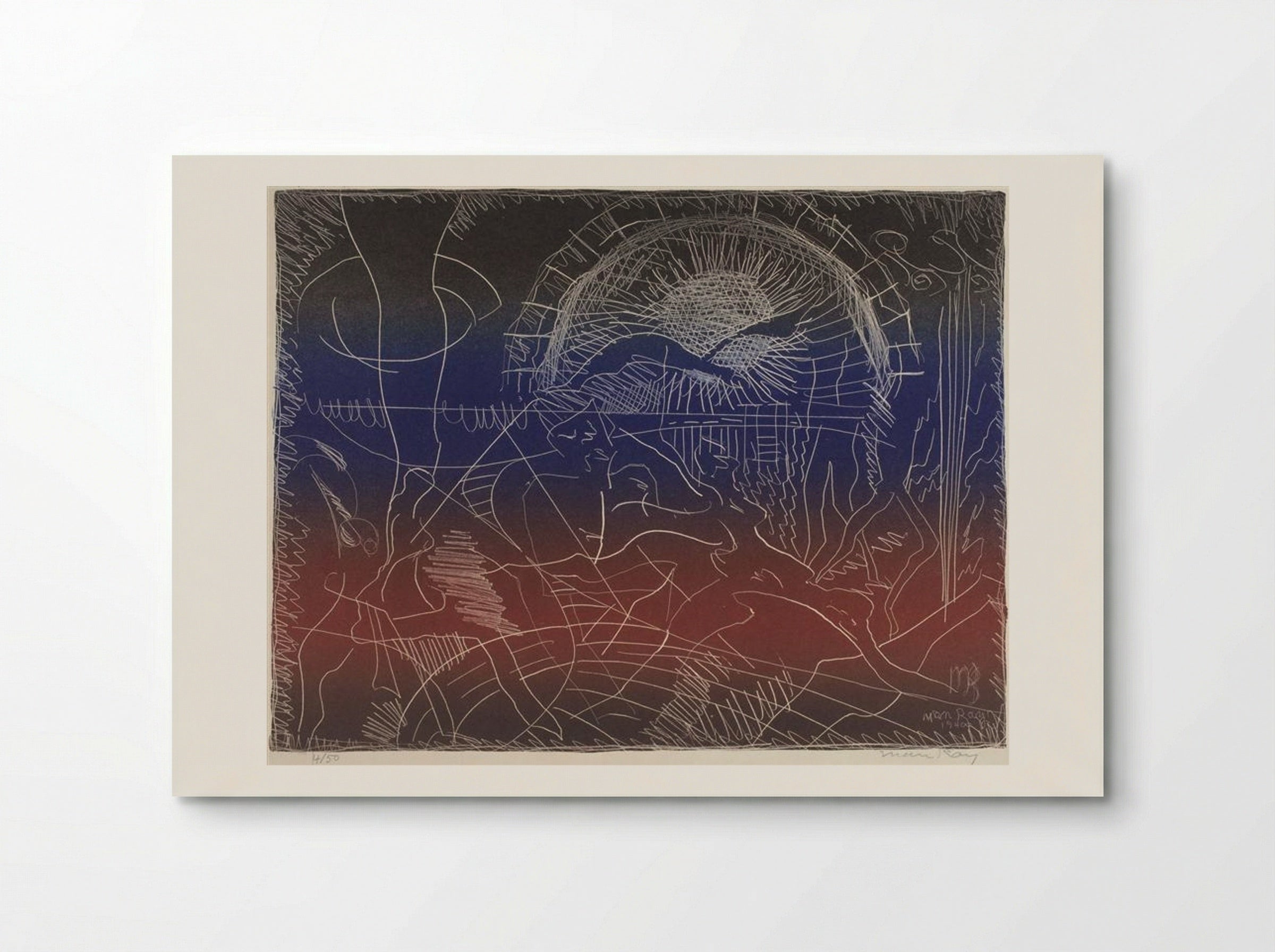
Untitled (Abstract Composition) - Man Ray
Archival giclée
Frames arrive ready to hang
Secure checkout
Made to order
Description
A 1948 etching by Man Ray featuring delicate white-line abstraction against a dark, atmospheric background.
This etching by Man Ray, dated 1948, demonstrates the artist's engagement with linear abstraction during his later career. Known primarily for his contributions to Dada and Surrealism, Man Ray often experimented with the boundaries between representational form and pure graphic mark-making. In this work, the artist employs a delicate, white-line technique against a dark, graduated background. The resulting visual effect mimics the appearance of a negative or a celestial map, where light emerges from the void. The composition is defined by a series of intersecting curves and geometric grids. These lines suggest organic shapes, perhaps hinting at human figures or celestial bodies, yet they remain intentionally ambiguous. The artist avoids a fixed perspective, allowing the viewer to navigate the space through the rhythm of the etched lines. The contrast between the deep, saturated tones of the background and the fine, precise incisions creates a sense of depth that feels both cosmic and microscopic. Man Ray's approach to printmaking here reflects his interest in the technical possibilities of the medium. By using the etching process to scratch into the plate, he achieves a spontaneity that mirrors his earlier photographic experiments. The work avoids rigid structure, favouring instead a fluid arrangement of forms that invite contemplation. It is a clear example of his ability to translate the surrealist impulse into a graphic format, where the subconscious is mapped through line and tone. The print is signed and numbered, indicating its status as a limited edition production from his post-war period in Hollywood and Paris.
Return policy
Because every print is made to order, we don't offer change-of-mind returns, refunds or exchanges. If your order arrives faulty, damaged or incorrect, we'll replace it free of charge — just contact us within 48 hours of delivery. See our refunds page for full details.
Shipping
We ship worldwide, printing at the production hub nearest to your delivery address. Delivery times and costs vary by destination — you'll see the options available to you at checkout.
Manufacturing
Each print is produced to order using 12-colour giclée printing on FSC-certified archival paper. Designed in Britain and printed at your nearest production hub to reduce waste and speed up delivery.
Untitled (Abstract Composition) - Man Ray

Artist Biography
Man Ray
He moved to Paris in 1921 and stayed for twenty years. He arrived knowing Marcel Duchamp, who had been his closest collaborator in New York. The two of them shared an instinct for provocation. Man Ray's contribution to Dada was the 'rayograph', made by placing objects directly on photographic paper and exposing them to light. No camera, no lens. The results look like X-rays of the unconscious: keys, springs, hands, fabrics, rendered as white silhouettes on black.
He became the portrait photographer of the Parisian avant-garde. Picasso, Hemingway, Gertrude Stein, Jean Cocteau, the Surrealists. The portraits are sharp, well-lit, and respectful, which is not what you would expect from a Dadaist. He also worked in fashion photography for Vogue and Harper's Bazaar, which paid the bills and gave him access to models and studios.
The most famous image is Le Violon d'Ingres (1924): a photograph of Kiki de Montparnasse's back with f-holes painted on it, turning a woman into a cello. It is witty, elegant, and uncomfortable in exactly the way Surrealism intended. He claimed to value his paintings more than his photographs. The world disagreed, and he never entirely forgave it.
He returned to Paris after the war and stayed until his death in 1976, at eighty-six.
Our Features
Designed for Lasting Impact
Specific Features
Every Solis piece is made to order with archival, gallery-quality materials built to last.
- Museum-grade giclée printing for rich, fade-resistant colour
- Archival matte fine-art paper, FSC-certified
- Multiple sizes and framing options available
- Frames in black, natural wood, dark wood or white
- Framed prints arrive ready to hang
Care & Cleaning
To keep your artwork looking its best:
- Dust gently with a soft, dry cloth
- Avoid prolonged direct sunlight
- Never use liquid cleaners on the print or canvas surface
- Keep in a dry, room-temperature space
- Handle prints with clean, dry hands
Materials & Sizing
Museum-grade giclée on FSC-certified archival matte paper, with framed and canvas options.
- Paper sizes: A4, A3, A2, A1, A0 and B2 (50×70 cm)
- Canvas: XS (20×30 cm) to Large (60×90 cm)
- Frames: black, natural wood, dark wood or white
Why Choose Us ?
Damage-free delivery guarantee
Fast Shipping
Museum-Quality Materials
Artist Biography
Man Ray
He moved to Paris in 1921 and stayed for twenty years. He arrived knowing Marcel Duchamp, who had been his closest collaborator in New York. The two of them shared an instinct for provocation. Man Ray's contribution to Dada was the 'rayograph', made by placing objects directly on photographic paper and exposing them to light. No camera, no lens. The results look like X-rays of the unconscious: keys, springs, hands, fabrics, rendered as white silhouettes on black.
He became the portrait photographer of the Parisian avant-garde. Picasso, Hemingway, Gertrude Stein, Jean Cocteau, the Surrealists. The portraits are sharp, well-lit, and respectful, which is not what you would expect from a Dadaist. He also worked in fashion photography for Vogue and Harper's Bazaar, which paid the bills and gave him access to models and studios.
The most famous image is Le Violon d'Ingres (1924): a photograph of Kiki de Montparnasse's back with f-holes painted on it, turning a woman into a cello. It is witty, elegant, and uncomfortable in exactly the way Surrealism intended. He claimed to value his paintings more than his photographs. The world disagreed, and he never entirely forgave it.
He returned to Paris after the war and stayed until his death in 1976, at eighty-six.
You May Also Like