

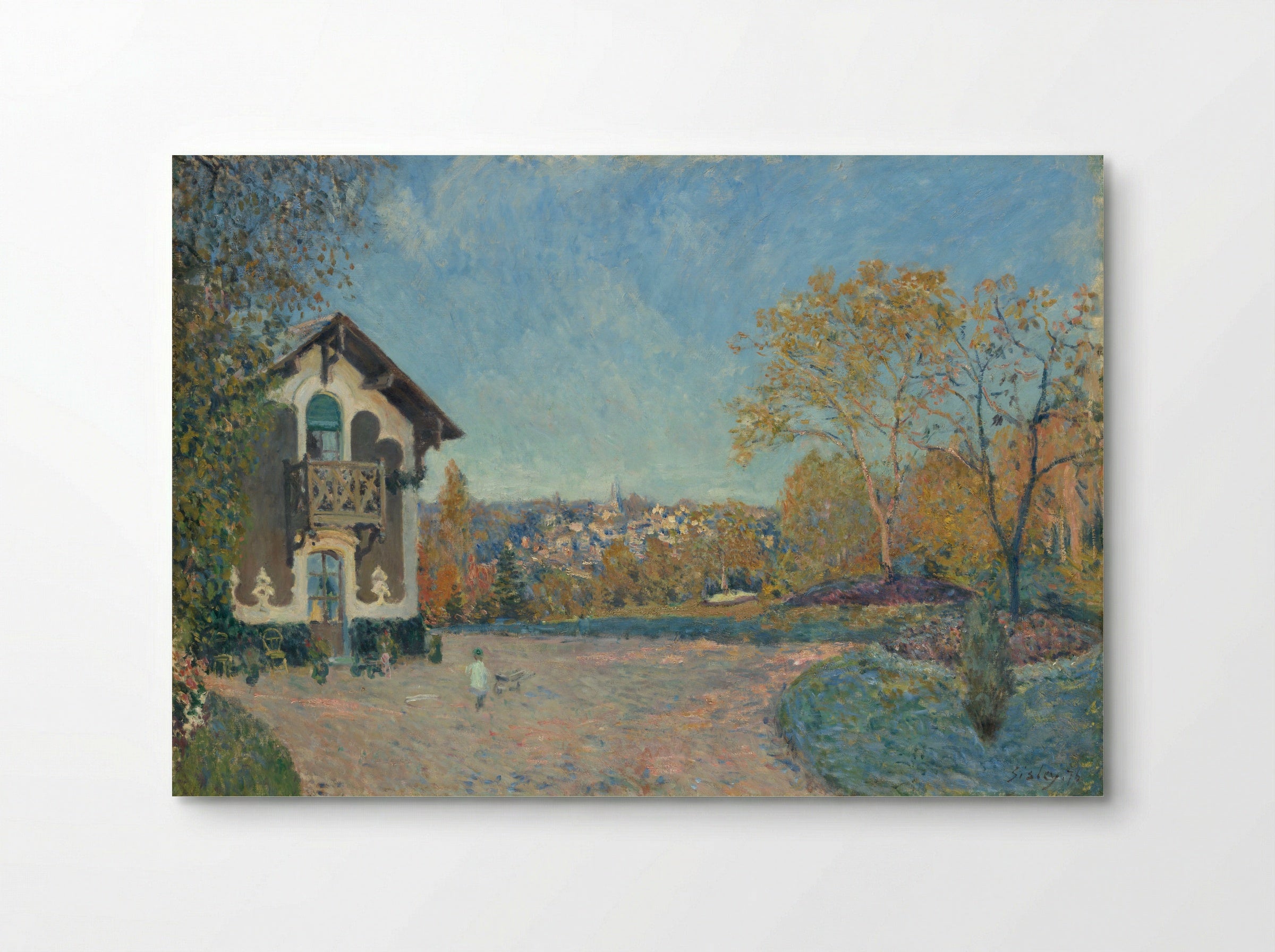
View of Marly-le-Roi from Coeur-Volant - Alfred Sisley
Archival giclée
Frames arrive ready to hang
Secure checkout
Made to order
Description
A serene Impressionist view of Marly-le-Roi, capturing the soft light and atmosphere of the French countryside in 1876.
Alfred Sisley painted this work in 1876, a period when he resided in Marly-le-Roi. The composition captures the view from the Coeur-Volant, a property situated on a hill overlooking the town. Sisley focuses on the atmospheric conditions of the day, using a palette of soft blues, ochres, and greens to render the light as it falls across the house and the distant valley. The house on the left serves as a structural anchor for the scene. Its architectural details, including the balcony and the arched window, are rendered with quick, light brushstrokes. Sisley avoids rigid outlines, preferring to build form through the application of colour. A small figure stands near the house, providing a sense of scale and human presence within the quiet setting. The middle ground transitions into a soft, hazy view of the town, where the buildings are suggested rather than explicitly defined. The sky occupies a significant portion of the canvas, filled with light, wispy clouds that suggest a breezy day. Sisley was known for his dedication to the study of the sky and its effect on the surrounding environment. The trees on the right are painted with a loose, dappled technique, allowing light to filter through the branches. This work demonstrates the artist's ability to capture a specific moment in time, focusing on the interplay between natural light and the built environment. The painting remains a clear example of the Impressionist interest in plein air observation and the transient qualities of the French countryside.
Return policy
Because every print is made to order, we don't offer change-of-mind returns, refunds or exchanges. If your order arrives faulty, damaged or incorrect, we'll replace it free of charge — just contact us within 48 hours of delivery. See our refunds page for full details.
Shipping
We ship worldwide, printing at the production hub nearest to your delivery address. Delivery times and costs vary by destination — you'll see the options available to you at checkout.
Manufacturing
Each print is produced to order using 12-colour giclée printing on FSC-certified archival paper. Designed in Britain and printed at your nearest production hub to reduce waste and speed up delivery.
View of Marly-le-Roi from Coeur-Volant - Alfred Sisley

Artist Biography
Alfred Sisley
He was born in Paris in 1839 to English parents. His father William ran a luxury goods import-export business. At eighteen, Sisley was sent to London to study commerce. He came back wanting to paint. He studied alongside Monet, Renoir, and Bazille at Gleyre's studio in the early 1860s.
He was the most landscape-committed of the Impressionists: he painted almost nothing else. No portraits, no cafe scenes, no modern life. His father's business collapsed during the Franco-Prussian War. Sisley had been financially comfortable until then; after 1870, he lived in poverty for the rest of his life. In 1876 he painted a series of six canvases of the catastrophic Seine flooding at Port-Marly: moody skies, planks laid as walkways, skiffs serving as ferries. They are among his finest works.
He died of throat cancer in 1899 at Moret-sur-Loing, aged fifty-nine. His partner Eugenie Lescouezec had died a few months earlier. Prices for his paintings increased almost immediately after his death.
Our Features
Designed for Lasting Impact
Specific Features
Every Solis piece is made to order with archival, gallery-quality materials built to last.
- Museum-grade giclée printing for rich, fade-resistant colour
- Archival matte fine-art paper, FSC-certified
- Multiple sizes and framing options available
- Frames in black, natural wood, dark wood or white
- Framed prints arrive ready to hang
Care & Cleaning
To keep your artwork looking its best:
- Dust gently with a soft, dry cloth
- Avoid prolonged direct sunlight
- Never use liquid cleaners on the print or canvas surface
- Keep in a dry, room-temperature space
- Handle prints with clean, dry hands
Materials & Sizing
Museum-grade giclée on FSC-certified archival matte paper, with framed and canvas options.
- Paper sizes: A4, A3, A2, A1, A0 and B2 (50×70 cm)
- Canvas: XS (20×30 cm) to Large (60×90 cm)
- Frames: black, natural wood, dark wood or white
Why Choose Us ?
Damage-free delivery guarantee
Fast Shipping
Museum-Quality Materials
Artist Biography
Alfred Sisley
He was born in Paris in 1839 to English parents. His father William ran a luxury goods import-export business. At eighteen, Sisley was sent to London to study commerce. He came back wanting to paint. He studied alongside Monet, Renoir, and Bazille at Gleyre's studio in the early 1860s.
He was the most landscape-committed of the Impressionists: he painted almost nothing else. No portraits, no cafe scenes, no modern life. His father's business collapsed during the Franco-Prussian War. Sisley had been financially comfortable until then; after 1870, he lived in poverty for the rest of his life. In 1876 he painted a series of six canvases of the catastrophic Seine flooding at Port-Marly: moody skies, planks laid as walkways, skiffs serving as ferries. They are among his finest works.
He died of throat cancer in 1899 at Moret-sur-Loing, aged fifty-nine. His partner Eugenie Lescouezec had died a few months earlier. Prices for his paintings increased almost immediately after his death.
You May Also Like