

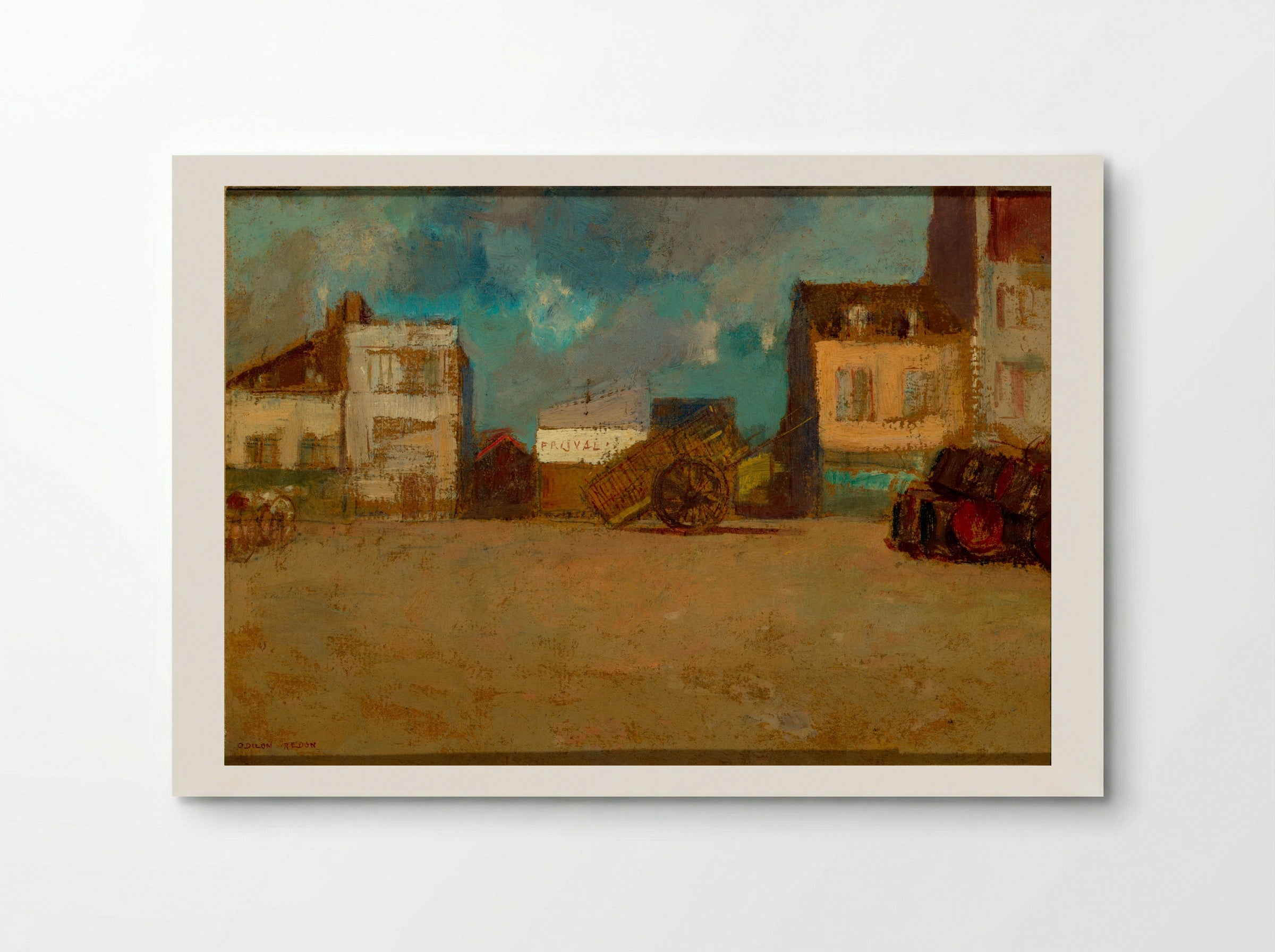
Village Square, Brittany - Odilon Redon
Archival giclée
Frames arrive ready to hang
Secure checkout
Made to order
Description
A rare, observational oil painting by Odilon Redon, capturing the quiet atmosphere of a sun-drenched village square in Brittany.
Odilon Redon is primarily recognised for his dreamlike, monochromatic charcoal drawings and lithographs, yet this oil painting offers a rare glimpse into his engagement with the physical world. Executed during his time in Brittany, the work captures a quiet, sun-drenched square with a directness that contrasts with his more phantasmagorical output. The composition is anchored by the expansive, dusty ground plane, which occupies the lower half of the frame. This empty space creates a sense of stillness, drawing the eye toward the modest architectural forms and the solitary cart positioned in the centre. The palette relies on earthy ochres and browns for the buildings and ground, which are set against a sky of deep, atmospheric blue. Redon applies the paint with a visible, textured hand, allowing the brushwork to define the structural weight of the buildings rather than relying on precise outlines. The light appears heavy and warm, suggesting the heat of a summer afternoon in a rural French town. The presence of the cart and the simple facades provides a grounded, observational quality to the scene. While Redon later moved toward the subjective and the imaginary, this piece demonstrates his technical ability to observe light and form in a traditional manner. The work avoids the narrative complexity of his later Symbolist period, focusing instead on the quietude of a specific location. It serves as a study of light and shadow, where the interaction between the solid, opaque buildings and the open, airy sky creates a balanced visual experience. The painting remains a curious example of how an artist known for internal visions could effectively translate the external world onto canvas with such restraint and clarity.
Return policy
Because every print is made to order, we don't offer change-of-mind returns, refunds or exchanges. If your order arrives faulty, damaged or incorrect, we'll replace it free of charge — just contact us within 48 hours of delivery. See our refunds page for full details.
Shipping
We ship worldwide, printing at the production hub nearest to your delivery address. Delivery times and costs vary by destination — you'll see the options available to you at checkout.
Manufacturing
Each print is produced to order using 12-colour giclée printing on FSC-certified archival paper. Designed in Britain and printed at your nearest production hub to reduce waste and speed up delivery.
Village Square, Brittany - Odilon Redon

Artist Biography
Odilon Redon
For the first two decades of his career he worked exclusively in black: charcoal drawings and lithographs he called his noirs. Floating eyeballs, severed heads with closed lids, spiders with human faces, plants that grow teeth. The images are hallucinatory but precisely rendered, closer to medical illustration than fantasy. He published his first lithograph album, Dans le Reve, in 1879. Nobody noticed.
Recognition came sideways. In 1884, Joris-Karl Huysmans published A rebours, a novel about a reclusive aesthete who decorates his rooms with Redon's prints. The book became a cult text for the Symbolist movement and Redon became famous by association. Stephane Mallarme, the Symbolist poet, became a close friend. Redon also completed a series of lithographs dedicated to Edgar Allan Poe, whose poems Mallarme and Baudelaire had translated into French.
After 1900 he stopped making noirs entirely and shifted to colour: pastels and oils of flowers, mythological figures and butterflies in palettes that anticipate Matisse. The transition was so complete that the Surrealists later claimed the black work while the Fauves claimed the colour, and neither group seemed to notice they were talking about the same person.
He studied under Jean-Leon Gerome at the Ecole des Beaux-Arts, which is an unlikely pairing: Gerome painted Roman gladiators with photographic precision. Redon painted eyeballs attached to balloons. Goya and Delacroix were the influences that actually stuck.
Our Features
Designed for Lasting Impact
Specific Features
Every Solis piece is made to order with archival, gallery-quality materials built to last.
- Museum-grade giclée printing for rich, fade-resistant colour
- Archival matte fine-art paper, FSC-certified
- Multiple sizes and framing options available
- Frames in black, natural wood, dark wood or white
- Framed prints arrive ready to hang
Care & Cleaning
To keep your artwork looking its best:
- Dust gently with a soft, dry cloth
- Avoid prolonged direct sunlight
- Never use liquid cleaners on the print or canvas surface
- Keep in a dry, room-temperature space
- Handle prints with clean, dry hands
Materials & Sizing
Museum-grade giclée on FSC-certified archival matte paper, with framed and canvas options.
- Paper sizes: A4, A3, A2, A1, A0 and B2 (50×70 cm)
- Canvas: XS (20×30 cm) to Large (60×90 cm)
- Frames: black, natural wood, dark wood or white
Why Choose Us ?
Damage-free delivery guarantee
Fast Shipping
Museum-Quality Materials
Artist Biography
Odilon Redon
For the first two decades of his career he worked exclusively in black: charcoal drawings and lithographs he called his noirs. Floating eyeballs, severed heads with closed lids, spiders with human faces, plants that grow teeth. The images are hallucinatory but precisely rendered, closer to medical illustration than fantasy. He published his first lithograph album, Dans le Reve, in 1879. Nobody noticed.
Recognition came sideways. In 1884, Joris-Karl Huysmans published A rebours, a novel about a reclusive aesthete who decorates his rooms with Redon's prints. The book became a cult text for the Symbolist movement and Redon became famous by association. Stephane Mallarme, the Symbolist poet, became a close friend. Redon also completed a series of lithographs dedicated to Edgar Allan Poe, whose poems Mallarme and Baudelaire had translated into French.
After 1900 he stopped making noirs entirely and shifted to colour: pastels and oils of flowers, mythological figures and butterflies in palettes that anticipate Matisse. The transition was so complete that the Surrealists later claimed the black work while the Fauves claimed the colour, and neither group seemed to notice they were talking about the same person.
He studied under Jean-Leon Gerome at the Ecole des Beaux-Arts, which is an unlikely pairing: Gerome painted Roman gladiators with photographic precision. Redon painted eyeballs attached to balloons. Goya and Delacroix were the influences that actually stuck.
You May Also Like