

Wind of Voyage - Yves Klein
Archival giclée
Frames arrive ready to hang
Secure checkout
Made to order
Description
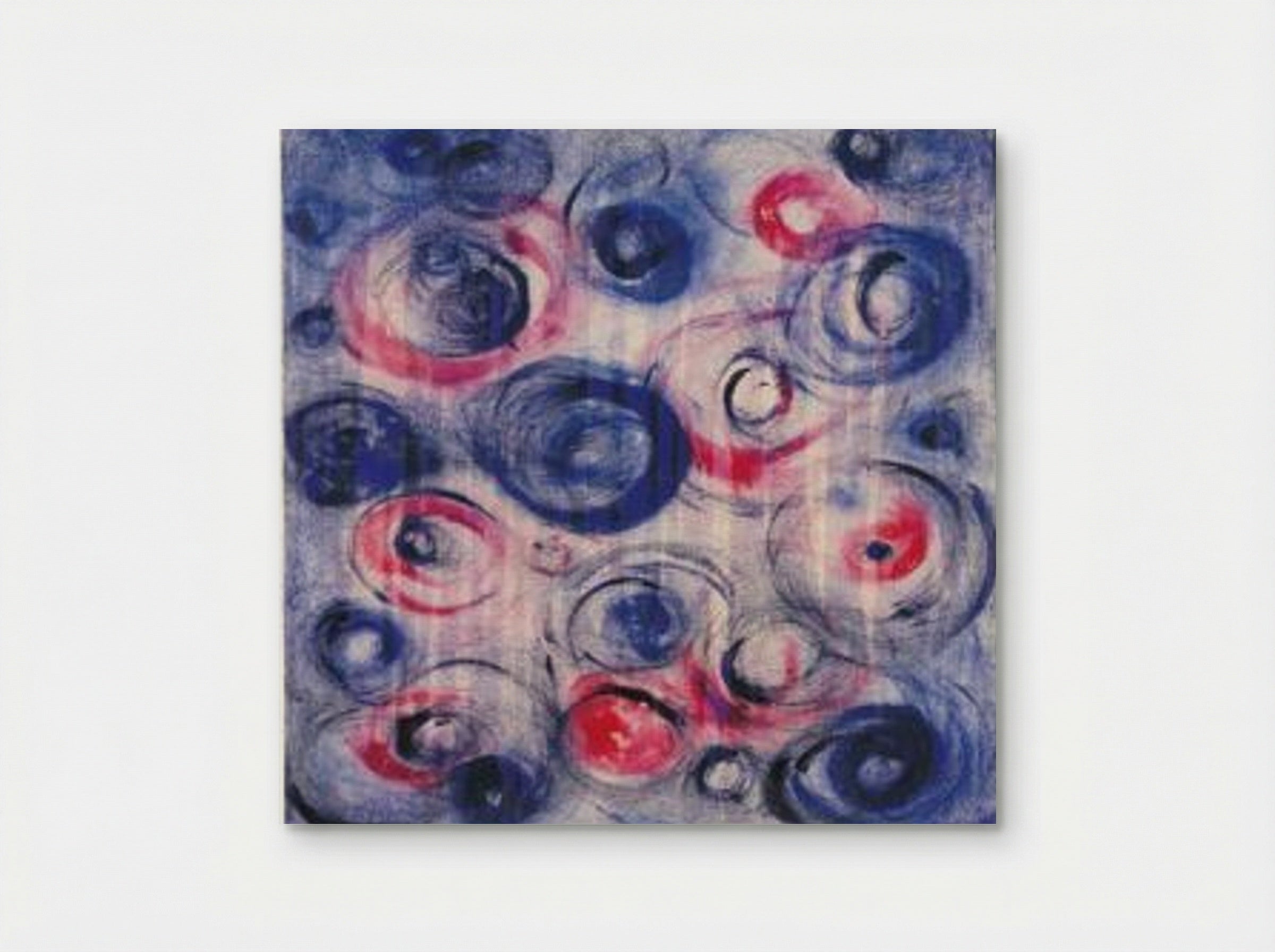
A dynamic abstract composition by Yves Klein featuring swirling concentric forms in blue and red, evoking the movement of air and energy.
Wind of Voyage is a work that captures the experimental spirit of Yves Klein, a figure known for his exploration of pure colour and the physical manifestation of energy. In this piece, Klein moves away from his signature monochrome surfaces to engage with gestural mark-making. The composition is populated by a series of concentric, circular forms that suggest movement, turbulence, or the swirling patterns of air currents. These shapes are rendered in varying densities of blue and red, layered against a textured, lighter ground that allows the underlying canvas to remain visible in places. The application of paint is energetic and direct. The circular motifs appear to float across the surface, creating a sense of rhythm that avoids a fixed centre. Klein often sought to remove the artist's hand from the final product, yet here the physical act of painting is evident in the visible brushwork and the overlapping of translucent pigments. The interaction between the cool, deep blues and the warmer, more urgent reds creates a visual tension that animates the entire field of the work. This painting reflects Klein's broader interest in the immaterial and the invisible forces of nature. By titling the work Wind of Voyage, he invites the viewer to consider the painting not as a static object, but as a record of a transient event or a journey through space. The repetition of the circular forms provides a structural logic to the composition, preventing the work from dissolving into pure chaos while maintaining a sense of fluidity. It is a study in balance and motion, demonstrating how simple geometric repetition can evoke complex atmospheric conditions. The work remains a clear example of Klein's ability to bridge the gap between conceptual art and traditional painterly techniques, offering a direct encounter with colour and form.
Return policy
Because every print is made to order, we don't offer change-of-mind returns, refunds or exchanges. If your order arrives faulty, damaged or incorrect, we'll replace it free of charge — just contact us within 48 hours of delivery. See our refunds page for full details.
Shipping
We ship worldwide, printing at the production hub nearest to your delivery address. Delivery times and costs vary by destination — you'll see the options available to you at checkout.
Manufacturing
Each print is produced to order using 12-colour giclée printing on FSC-certified archival paper. Designed in Britain and printed at your nearest production hub to reduce waste and speed up delivery.
Care and materials
Specific Features
Every Solis piece is made to order with archival, gallery-quality materials built to last.
- Museum-grade giclée printing for rich, fade-resistant colour
- Archival matte fine-art paper, FSC-certified
- Multiple sizes and framing options available
- Frames in black, natural wood, dark wood or white
- Framed prints arrive ready to hang
Care & Cleaning
To keep your artwork looking its best:
- Dust gently with a soft, dry cloth
- Avoid prolonged direct sunlight
- Never use liquid cleaners on the print or canvas surface
- Keep in a dry, room-temperature space
- Handle prints with clean, dry hands
Materials & Sizing
Museum-grade giclée on FSC-certified archival matte paper, with framed and canvas options.
- Paper sizes: A4, A3, A2, A1, A0 and B2 (50×70 cm)
- Canvas: XS (20×30 cm) to Large (60×90 cm)
- Frames: black, natural wood, dark wood or white
Wind of Voyage - Yves Klein

Artist Biography
Yves Klein
He was born in Nice to artist parents and grew up between France, England, and Spain. He studied judo seriously, earning a fourth-degree black belt in Tokyo, and considered martial arts and art as related disciplines: both requiring control, precision, and the projection of force.
He exhibited an empty gallery in 1958 and called it Le Vide (The Void). Over three thousand people attended the opening. The gallery walls were painted white. There was nothing else. He served blue cocktails at the door. He sold invisible paintings (Zones of Immaterial Pictorial Sensibility) for gold, then threw half the gold into the Seine and burned the receipt.
He died of a heart attack in 1962, at thirty-four. His career lasted roughly eight years. In that time he made the monochromes, the Anthropometries, the fire paintings, the sponge sculptures, the void exhibitions, and enough theoretical writing to fill several volumes. He remains one of the most influential artists of the post-war period, which he would have considered insufficient recognition.
Why Choose Us ?
Damage-free delivery guarantee
Fast Shipping
Museum-Quality Materials
You May Also Like