

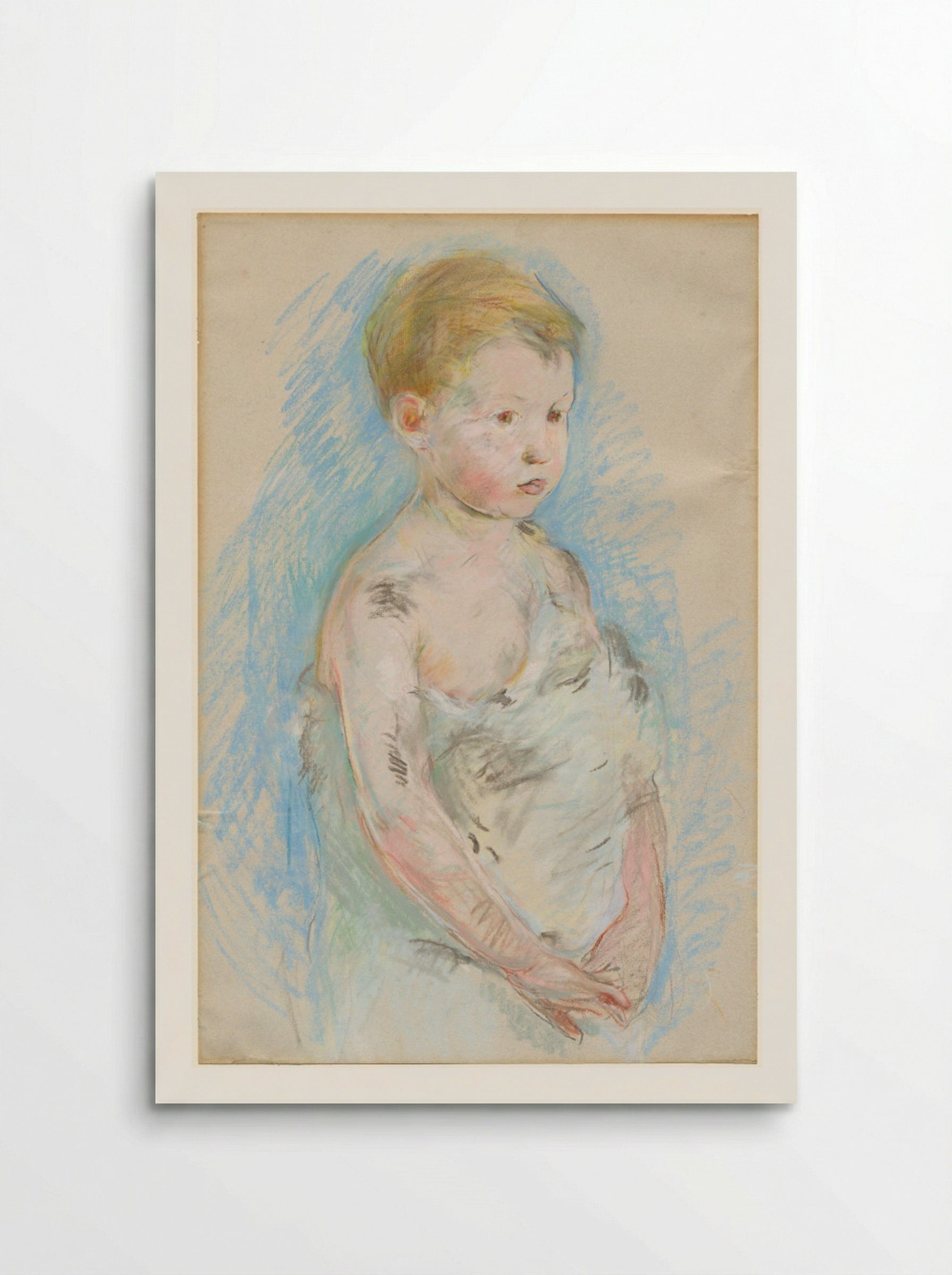
Young Saint John - Berthe Morisot
Archival giclée
Frames arrive ready to hang
Secure checkout
Made to order
Description
A delicate pastel portrait by Impressionist artist Berthe Morisot, capturing a young child in a quiet, contemplative pose.
This delicate study by Berthe Morisot captures a young child posed as Saint John the Baptist. Executed in pastel, the work demonstrates the artist's characteristic approach to light and form. Morisot employs a light, airy touch, allowing the texture of the paper to remain visible beneath the strokes of colour. The figure is rendered with soft, fluid lines, avoiding rigid contours in favour of a more atmospheric quality. The blue background is applied with loose, diagonal hatching, which creates a sense of movement and depth without requiring detailed spatial rendering. Morisot was a central figure in the Impressionist circle, known for her ability to capture fleeting moments with an economy of means. Her work often focused on domestic subjects, family members, and children. In this piece, the subject is draped in a simple cloth, referencing traditional religious iconography while maintaining the informal, intimate character of her portraiture. The palette is restrained, relying on pale flesh tones, soft yellows, and the contrasting blue of the background to define the form. The child's expression is quiet and contemplative, a hallmark of Morisot's sensitive observation of her sitters. As a practitioner of the Impressionist method, Morisot prioritised the immediacy of the sketch. This pastel work reflects her interest in the interplay of light on skin and fabric. The visible marks of the pastel stick provide a rhythmic quality to the surface of the paper. By focusing on the essential features of the child, Morisot creates a portrait that feels both personal and timeless. This print captures the subtle gradations of the original medium, preserving the soft, powdery texture of the pastel and the gentle transitions between light and shadow that define the composition.
Return policy
Because every print is made to order, we don't offer change-of-mind returns, refunds or exchanges. If your order arrives faulty, damaged or incorrect, we'll replace it free of charge — just contact us within 48 hours of delivery. See our refunds page for full details.
Shipping
We ship worldwide, printing at the production hub nearest to your delivery address. Delivery times and costs vary by destination — you'll see the options available to you at checkout.
Manufacturing
Each print is produced to order using 12-colour giclée printing on FSC-certified archival paper. Designed in Britain and printed at your nearest production hub to reduce waste and speed up delivery.
Young Saint John - Berthe Morisot

Artist Biography
Berthe Morisot
She was born in Bourges in 1841. Her parents built a studio in the family garden for Berthe and her sister Edma, who was equally talented. Edma abandoned painting when she married a naval officer in 1869. Berthe, having lost her collaborator, held on harder. She exhibited ten works at the first Impressionist exhibition in 1874, the only woman showing. She participated in every Impressionist show except 1879, the year her daughter Julie was born.
Edouard Manet painted her portrait repeatedly before she married his brother Eugene in 1874. She had sworn to stay single. Eugene gave up his own painting ambitions so she could pursue hers. Whatever the nature of her relationship with Edouard, it produced some of his finest portraits and left a subject that art historians have been circling for over a century.
She painted the domestic world of women with a directness that the male Impressionists could not access: mothers and daughters, women at their toilette, the garden, the drawing room. The brushwork is rapid and unfinished-looking, more so than Monet's. She died of pneumonia in 1895, aged fifty-four, caught while nursing her daughter through the same illness. She wrote to sixteen-year-old Julie the day before.
Our Features
Designed for Lasting Impact
Specific Features
Every Solis piece is made to order with archival, gallery-quality materials built to last.
- Museum-grade giclée printing for rich, fade-resistant colour
- Archival matte fine-art paper, FSC-certified
- Multiple sizes and framing options available
- Frames in black, natural wood, dark wood or white
- Framed prints arrive ready to hang
Care & Cleaning
To keep your artwork looking its best:
- Dust gently with a soft, dry cloth
- Avoid prolonged direct sunlight
- Never use liquid cleaners on the print or canvas surface
- Keep in a dry, room-temperature space
- Handle prints with clean, dry hands
Materials & Sizing
Museum-grade giclée on FSC-certified archival matte paper, with framed and canvas options.
- Paper sizes: A4, A3, A2, A1, A0 and B2 (50×70 cm)
- Canvas: XS (20×30 cm) to Large (60×90 cm)
- Frames: black, natural wood, dark wood or white
Why Choose Us ?
Damage-free delivery guarantee
Fast Shipping
Museum-Quality Materials
Artist Biography
Berthe Morisot
She was born in Bourges in 1841. Her parents built a studio in the family garden for Berthe and her sister Edma, who was equally talented. Edma abandoned painting when she married a naval officer in 1869. Berthe, having lost her collaborator, held on harder. She exhibited ten works at the first Impressionist exhibition in 1874, the only woman showing. She participated in every Impressionist show except 1879, the year her daughter Julie was born.
Edouard Manet painted her portrait repeatedly before she married his brother Eugene in 1874. She had sworn to stay single. Eugene gave up his own painting ambitions so she could pursue hers. Whatever the nature of her relationship with Edouard, it produced some of his finest portraits and left a subject that art historians have been circling for over a century.
She painted the domestic world of women with a directness that the male Impressionists could not access: mothers and daughters, women at their toilette, the garden, the drawing room. The brushwork is rapid and unfinished-looking, more so than Monet's. She died of pneumonia in 1895, aged fifty-four, caught while nursing her daughter through the same illness. She wrote to sixteen-year-old Julie the day before.
You May Also Like