


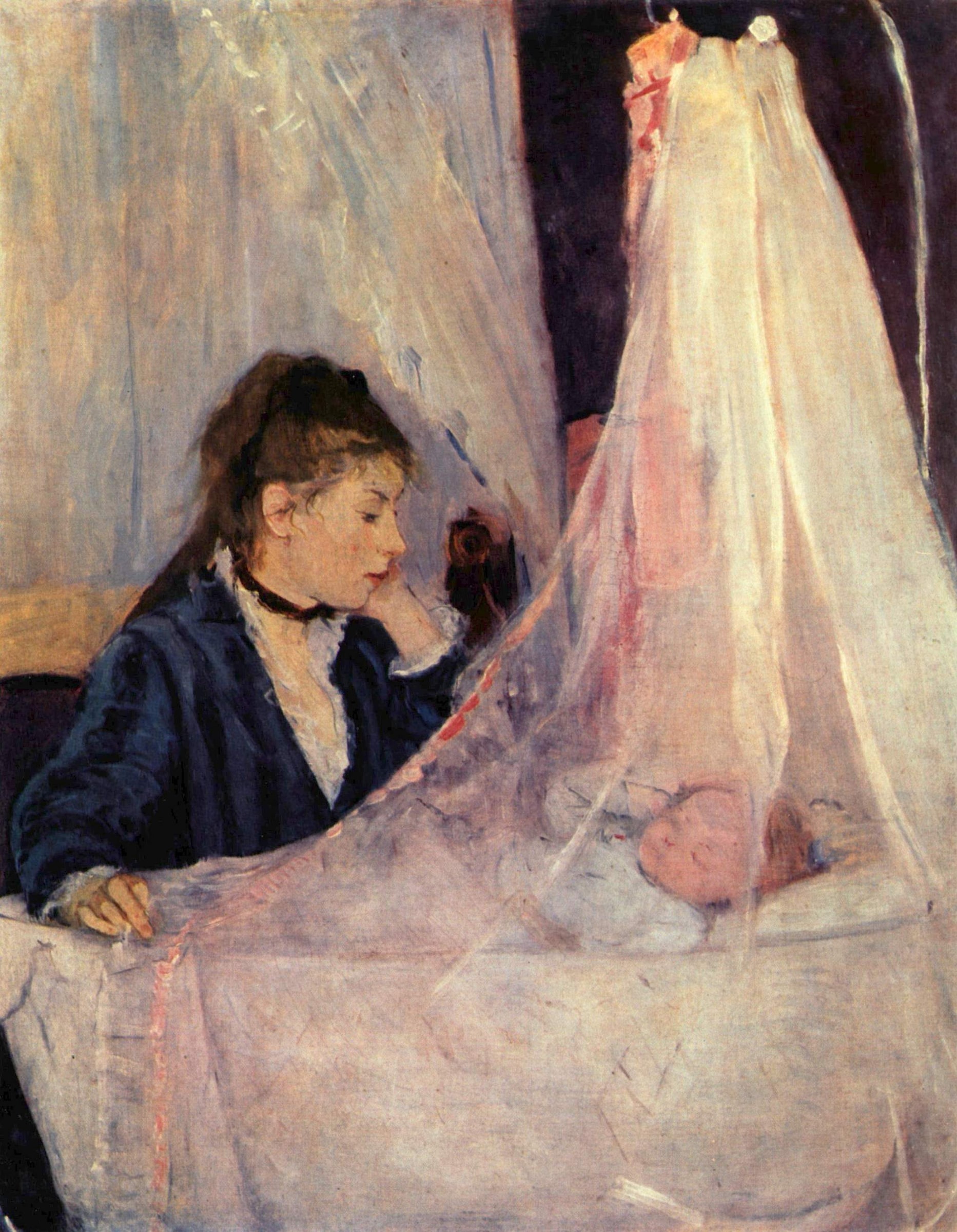
In 1872, Berthe Morisot painted The Cradle, capturing an intimate moment of looking and being watched. Her sister Edma gazes devotedly at her sleeping infant daughter, Blanche. Morisot records this silent observation from her own position as artist, creating a quiet chain of sight within a Parisian domestic interior.
Observation and Intimacy in The Cradle
Berthe Morisot painted The Cradle in 1872 using oil paint on canvas. The work measures 56 centimetres high by 46 centimetres wide and hangs in the Musée d'Orsay in Paris. It presents an intimate domestic scene where a young mother watches over her sleeping baby. The mother is Morisot's sister Edma, who sits bent over the crib where her second daughter, Blanche, rests quietly. Within the room, visual attention moves directly between the figures. Edma looks at the sleeping infant, while Morisot observes her sister from across the canvas. This structure creates a layered study of looking, where the act of watching forms the primary subject of the artwork.
Morisot conveys the quiet affection of the scene through direct positioning and delicate handling of paint. The mother rests her head near her hand as she guards the sleeping child, establishing a sense of calm protection. The artist applied paint freely with a sure touch, using light brushstrokes to construct the domestic setting. Diagonal lines structure the composition, guiding the eye across the figures without disrupting the tranquil atmosphere. Edma's dark hair and dark dress anchor the left side of the canvas, forming a visual balance against the softer tones of the baby's bedding.
Nuances of Light and Colour
In The Cradle, Morisot analyses the nuances of white in a manner characteristic of the Impressionist movement. She frames Edma's dark hair and dress against a white curtain in the window behind her. To prevent the background fabric from overpowering the composition, Morisot mutes its whiteness with soft blue and pale orange tones. These cool and warm shades push the window drape into the background of the painting. In contrast, the white fabric draped over the cradle appears brighter and closer to the front of the picture plane.
The artist used pink and golden tones to convey light shimmering across the delicate material covering the crib. She handled textures with precision, rendering the transparency of the diaphanous veil over the baby and the satin curtain behind her sister. Soft light moves smoothly across the canvas without jarring colour contrasts, preserving the quiet tone of the bedroom. The subtle colour harmonies and delicate brushwork capture the textures of the fabrics while maintaining an even light across the entire scene.
Family Subjects and Parisian Life
Morisot selected her subjects primarily from her immediate domestic world in Paris. Every moment in her family life provided material for her paintings, including her sister, her daughter, her nephews, and her husband. Without her relatives, her artistic output would have lacked its primary subject matter. Her sister Edma was her best friend and served as her most frequent model. Before painting The Cradle, Morisot had depicted Edma in works such as The Artist's Sister at a Window in 1869, showing her holding a fan near a window overlooking the city.
This focus on domestic subjects reflected the practical conditions of Morisot's life. Society imposed strict limitations on women during the nineteenth century, restricting the places they could visit without an escort. Consequently, scenes involving family members inside private homes were among the few subjects Morisot could freely explore. She focused her artistic attention on quiet interiors and private domestic routines. Even when painting outdoors, as in her Normandy pictures near Fécamp or her work View of Paris from the Trocadéro, her palette remained light and focused on direct observation.
Artistic Training and Influence
Berthe Morisot was born in Bourges in 1841 into a wealthy family and was the great-granddaughter of the eighteenth-century painter Jean-Honoré Fragonard. She and her sister trained as painters together in Paris. In 1868, Morisot met Édouard Manet and often modelled for his paintings. Manet offered instruction and advice to Morisot, and the directness and even light of The Cradle show his artistic influence. Later in her career, Morisot was also influenced by Pierre-Auguste Renoir, though her painting retained its delicate approach to domestic themes.
Manet's professional interaction with Morisot extended to her Salon submissions. Before Morisot submitted a canvas depicting Edma and their mother to the Salon of 1870, she asked Manet for advice. Manet repainted the figure of the mother himself, leaving abbreviated brushmarks that contrast with Morisot's own technique elsewhere on the work. Despite such interventions, Morisot developed an independent method characterised by light, feathery strokes. In 1874, she deepened her family connection to the Manet circle by marrying Édouard's brother, Eugène Manet.
Impressionist Exhibitions and Reception
Morisot showed The Cradle publicly at the first Impressionist exhibition in 1874, held at Nadar's studio in Paris. She exhibited the painting alongside Hide and Seek, which depicted Edma in an outdoor setting with a green parasol. Over the course of her career, Morisot participated in seven of the eight Impressionist exhibitions. She and her husband Eugène possessed sufficient financial resources to help fund the eighth exhibition in 1886, where she displayed works including In the Dining Room.
The reception of the Impressionist group was often hostile among contemporary critics. In 1876, a critic described Morisot and her fellow artists as five or six lunatics deranged by ambition, noting that one member of the group was a woman. Despite such criticism, Morisot maintained her active role in the group. Her paintings consistently explored everyday domestic life, using free paint application and subtle colour relationships to depict family members in private interiors.


