


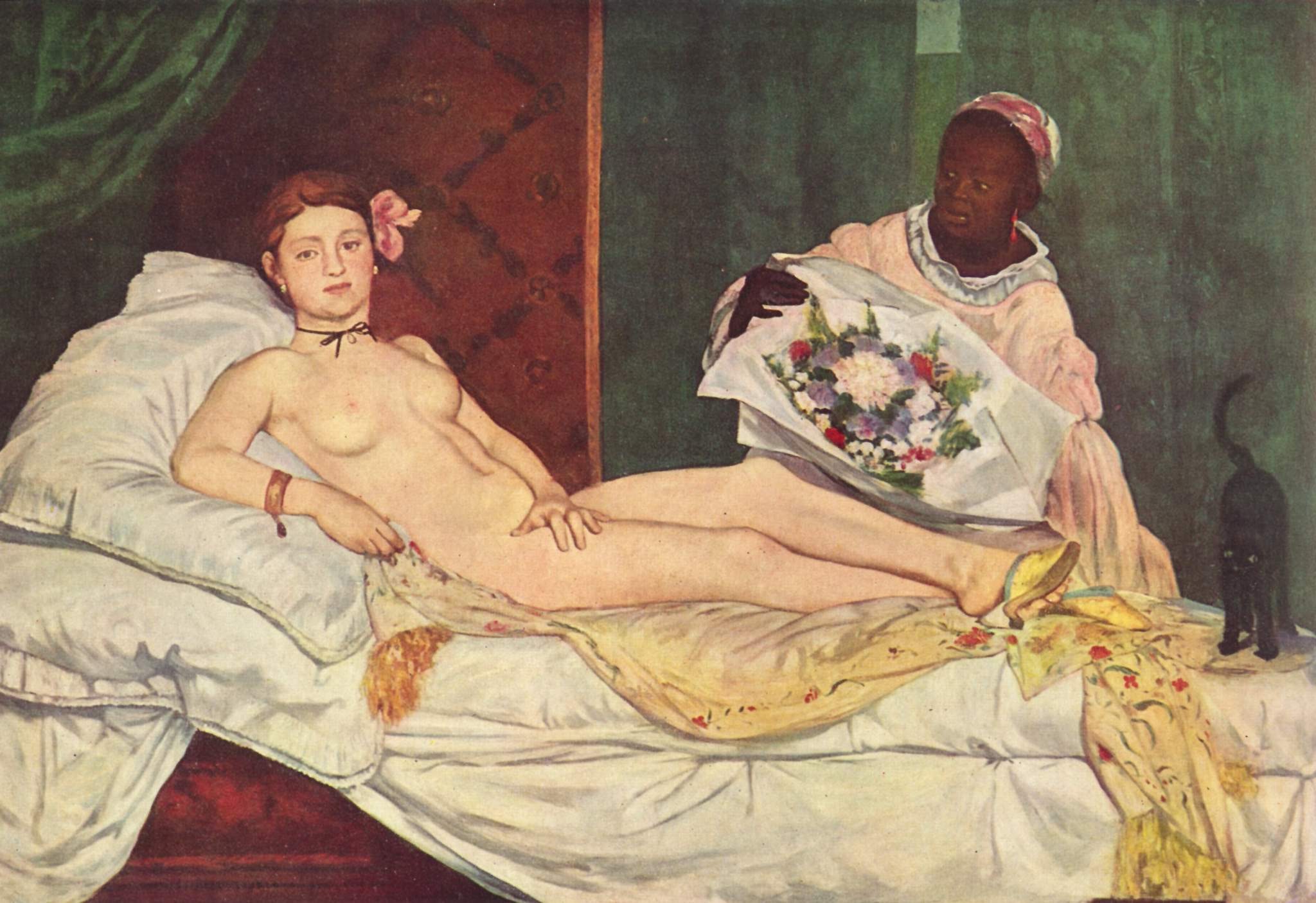
When Édouard Manet exhibited Olympia at the 1865 Paris Salon, the canvas incited an immediate wave of public outrage. Rather than painting an idealised classical deity, Manet depicted a contemporary Parisian prostitute who stares directly at the viewer without modesty, confronting nineteenth-century social reality and dismantling traditional artistic conventions.
Hostility at the Paris Salon
When Olympia was shown to the viewing public at the Paris Salon of 1865, the reaction was fiercely hostile. Immense crowds gathered in Room M, particularly on Sundays when admission was free, creating an atmosphere dominated by hysteria and astonishment. Visitors responded with mockery, catcalls, and fits of crazed laughter, while several spectators turned their heads in fright. Manet was shocked by the extreme hostility, writing to his friend Charles Baudelaire that insults were raining down on him like hailstones and that he had never received such a reception in his career.
The commotion surrounding the painting became so severe that the Marquis de Chennevières had to intervene. Having previously assigned guards to manage admirers around popular works, Chennevières now deployed guards to protect Olympia from indignant visitors. When guards proved insufficient to control the crowds, officials moved the canvas high above the heads of the visitors. This created the exact opposite trajectory of Manet's The Spanish Singer, which had been lowered to eye level four years earlier due to public admiration. Hanging near the ceiling, a critic for Le Figaro remarked that viewers could scarcely tell if they were looking at a bundle of laundry or a parcel of nude flesh.
Modern Identity and the Unflinching Gaze
The primary source of indignation was the figure's direct visual confrontation with the audience. In composition, Manet was inspired by Renaissance precedents, specifically Giorgione's Sleeping Venus and Titian's Venus of Urbino. However, while Renaissance nudes remained psychologically distanced from everyday experience by their identity as classical deities, Manet painted a contemporary figure. The public immediately recognised the model as Victorine Meurent, who had posed for Le Déjeuner sur l'herbe. Her recognisable presence stripped away any mythological pretext, contrasting sharply with popular academic nudes of the era, such as Alexandre Cabanel's The Birth of Venus or Paul Baudry's The Pearl and the Wave.
Contemporaries understood immediately that the subject represented a working prostitute awaiting a client. Her complete nudity was accentuated by a thin velvet ribbon around her neck, a gold bracelet on her wrist, and slippers on her feet, which served as a reference to streetwalking. A black servant presents a floral bouquet carefully prepared by a florist, sent by an admirer. The arrival of these flowers fails to interrupt her bold stare at the viewer. By placing a contemporary courtesan on such a prominent canvas, Manet raised the specter of venereal disease, which was rampant across Paris at the time.
Technique and Spatial Distortion
Manet's formal technique provoked equal outrage among academic traditionalists and fellow painters. Realist painter Gustave Courbet condemned the work, declaring it completely flat and comparing the figure to the queen of spades from a deck of cards coming out of the bath. Manet discarded the soft lighting, gradual transitions, and sensual modelling seen in Titian's Venus of Urbino. Instead, he used harsh illumination that rendered the anatomy pale and starkly defined, setting her white leg against a dark background without traditional dimensional modelling.
This approach was heavily influenced by Japonisme, specifically the technique in Japanese prints of using unmodulated areas of flat colour and simplified forms. While French critics accepted avant-garde experimentation in genre subjects, applying unmodulated paint to a traditional female nude was viewed as unacceptable. Furthermore, Manet flattened the pictorial space by moving the back wall forward so that it sat immediately behind the bed and the black servant. According to art historian Linda Nochlin, this simplified, modern treatment gave a salutary jolt to the traditional concept of the nude as timeless and elevated.
Domestic Details and Contemporary Symbols
Every detail within the bedroom setting subverted classical expectations. Rather than resting on an idealised couch in an idyllic landscape, the figure lies on rumpled white sheets and a pink silk shawl. At the foot of the bed, an alert black cat arches its back. The cat served as an explicit symbol of female sexuality and popular references to brothels, contrasting sharply with the faithful, sleeping dog depicted in Titian's Renaissance composition.
Manet's brushwork in the secondary elements further unsettled contemporary viewers. The bouquet of flowers held by the maid was rendered with rapid, seemingly careless impasto strokes that created an impression of fresh blooms. Observers perceived this vigorous technique, along with the inclusion of the cat and the maid, as a deliberate attempt to mock bourgeois decency, good taste, and the established rules of academic painting.
The Provocation of the Title
The title Olympia, inscribed directly on the frame, further antagonised the public. Although it sounded dubiously mythological, the name held distinct modern connotations in nineteenth-century Paris. Olympia was recognised as the name of an evil character in E.T.A. Hoffmann's popular stories, as well as the subject of a poem by Manet's friend Zacharie Astruc. Astruc's poem described a majestic young girl waking up to a slave delivering gifts for a lover's night.
By attaching the name Olympia to a working courtesan, Manet accentuated the divide between the social reality of Paris and the comfortably removed ideals of classical antiquity. Unlike Titian's Venus, who existed solely within the closed world of her canvas, Olympia looks out unabashedly at the viewer. By refusing to offer traditional signs of modesty, Manet forced the Salon public to confront their own gaze, fundamentally altering the presentation of the female nude in Western art.


