


Diego Velázquez painted Las Meninas in 1656 for the private office of King Philip IV of Spain. The large canvas depicts the royal studio, where figures turn to face an unseen visitor. Art historians continue to debate the central subjects of the composition and the exact nature of its mirrored reflection.
The Composition inside the Studio
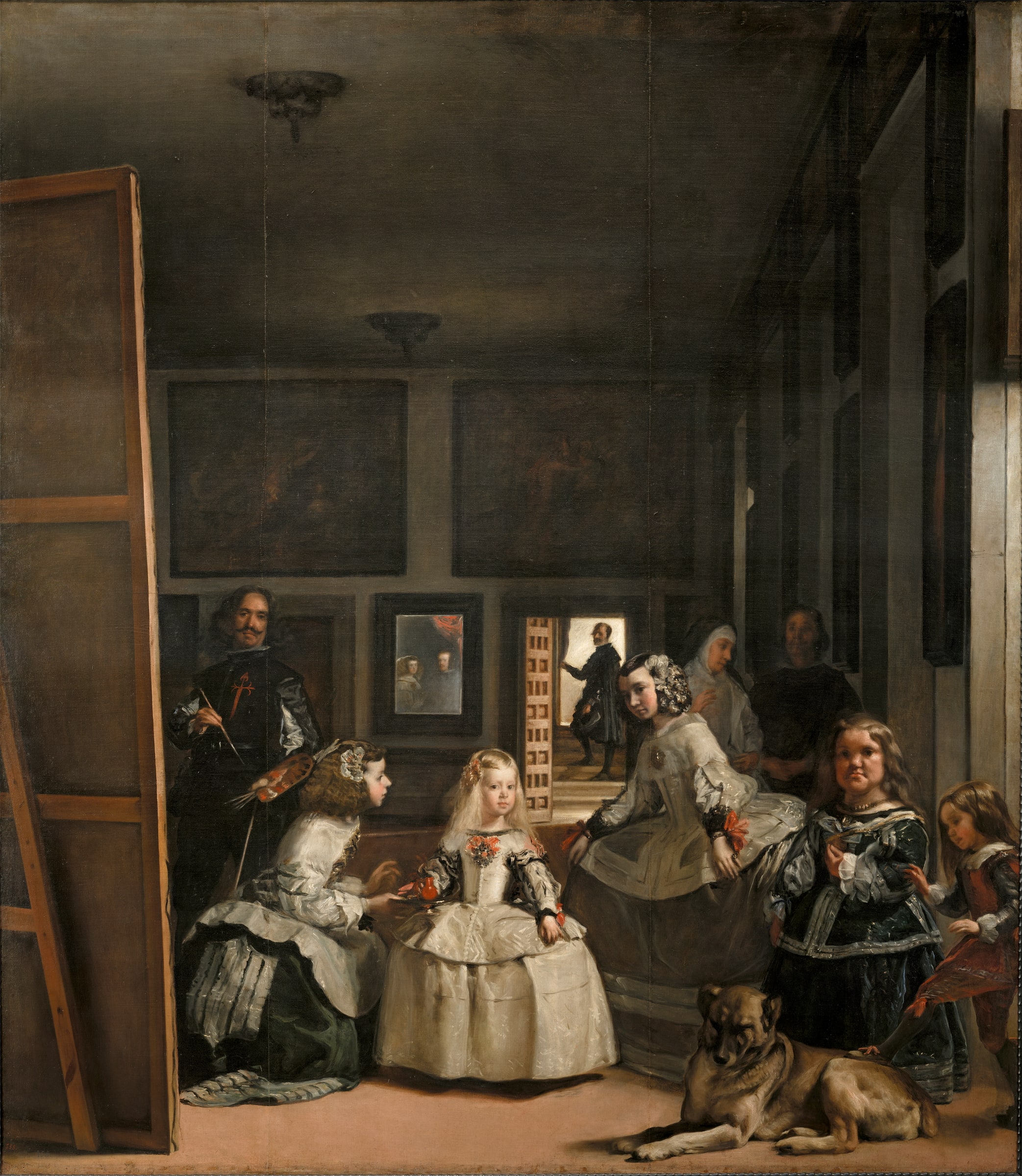
In 1656, Diego Velázquez composed Las Meninas inside the royal palace in Madrid. At the centre of the canvas stands the young Infanta Margarita Teresa, bathed in bright light. She is surrounded by her courtly entourage, including her two maids of honour, or meninas, who bend toward her attentively. Nearby stand her tutors, a page, a dwarf, and a large dog resting on the floor. On the far left of the room, Velázquez depicts himself standing before a huge canvas that looms upward. He holds a palette and brush, pauses in his work, and looks directly toward the viewer.
The surrounding space presents the inner life of the Spanish court in an informal moment. Shadowed walls rise above the figures, decorated with large copies of paintings by Peter Paul Rubens that appear diminished in the dim upper half of the room. Nearly all the individuals shown in the composition correspond to documented historical personages, with the exception of one man standing quietly on the right side of the room. Together, these figures form a complex arrangement that presents court society in reverse order of traditional royal precedence, placing the young princess at the visual centre.
The Ambiguity of the Mirror
On the back wall of the studio, a small mirror draws the eye toward a glowing reflection of King Philip IV and Queen Mariana. A silhouetted courtier standing in an open doorway nearby draws attention to this mirrored image. Art historians have long debated what this mirror actually reflects within the scene. One reading holds that the monarch and his wife are standing in the physical position of the viewer, just outside the plane of the picture. In this view, the king and queen have entered the studio to visit their daughter and observe the artist at work, causing the servants and tutors to look up in acknowledgment.
An alternative proposal suggests that the mirror reflects the image that Velázquez is currently painting onto the large canvas resting on his easel. However, scholars point out that no seventeenth-century double portraits of Philip IV and Mariana exist on such a massive scale. The gigantic proportions of the canvas inside the room are incompatible with any known royal portrait executed during this period. Because of these conflicting visual clues, art historians have never reached a definitive consensus regarding whether the mirror depicts the actual royal couple standing in the room or the canvas within the painting.
The Royal Viewer and Spatial Design
Las Meninas was created specifically to hang in the personal office and private summer quarters of Philip IV. Because access to these private rooms was restricted, the king served as the primary audience for the finished artwork. The spatial construction of the painting directly addresses this royal observer. When Philip IV stood in front of the canvas, he occupied the exact vantage point implied by the outward gazes of his painter, his daughter, and his court attendants. The artwork effectively replayed this studio scene for the monarch whenever he entered his personal chamber.
This deliberate arrangement established a dynamic exchange between the king and the canvas. By stepping into his private office, Philip IV participated in the work both as the implied subject of the gaze and as the sovereign watching his household. The distant mirror transformed the royal couple into small pale shadows, yet their implied presence governed the actions of every person depicted in the studio. Modern museum visitors who stand before the painting in Madrid occupy this same vantage point, stepping into the physical position originally intended for the king.
The Elevation of the Artist
Beyond its narrative ambiguity, Las Meninas reflects Velázquez's effort to assert the dignity of his profession. Serving as first painter to the king and chamberlain of the royal palace, Velázquez possessed high administrative status at court. Throughout his career, he sought admission into the Order of Santiago, an ancient military order that required proof of noble lineage. Because he lacked sufficient nobility, he obtained membership only near the end of his life after securing a special dispensation from the pope.
In the painting, Velázquez wears the red cross of the Order of Santiago prominently displayed on his doublet. Although court legend suggested that Philip IV added the red cross to the canvas himself after the artist died, evidence indicates that Velázquez painted the symbol onto his own chest two or three years after completing the picture. By depicting himself in the immediate presence of the royal family, Velázquez presented the painter as a figure of high social standing, echoing classical accounts of King Alexander the Great visiting the studio of the ancient painter Apelles.
Brushwork and Visual Impression
When examined at close range, the painted surface demonstrates Velázquez's economical technique. The fabric of the Infanta Margarita Teresa's silver and white sleeve breaks down into a series of loose, rapid brushstrokes and squiggles of paint. Because the painter stood close to the massive canvas while applying these rapid marks, he could not see the complete unified pattern from his position at the easel. The apparent chaos of strokes on the surface resolves into a convincing depiction of shimmering cloth only when observed from a distance.
This contrast between close inspection and distant viewing demonstrates Velázquez's mastery over his medium. The artist captured a fleeting moment of daily studio life, holding still an ordinary passage of time rather than a dramatic historical event. Through his subtle handling of light, shadow, and perspective, Velázquez created a lasting representation of the Spanish court that continues to engage scholars and observers.


