


Pierre-Auguste Renoir painted Luncheon of the Boating Party in 1881 on the balcony of the Restaurant Fournaise in Chatou. The composition brings together fourteen named friends, acquaintances, and models from contemporary Parisian society around a lunch table along the River Seine.
Identifications at the Restaurant Fournaise
In the left foreground of the 1881 canvas, Renoir’s fiancée and future wife, Aline Charigot, sits at the table playing with a small dog. She wears a Prussian blue dress paired with a hat decorated with orange-red flowers. Directly across the table in the right foreground sits the painter Gustave Caillebotte. A keen rower, Caillebotte is depicted wearing a straw hat and a white sleeveless shirt while straddling a chair. Seated beside him, model Angèle Legault drinks from a glass while wearing a blue-and-white hat. Antonio Maggiolo, an Italian journalist, leans over the table to speak with her.
The remaining figures surrounding the table represent a cross-section of Parisian social circles. Leaning back against the balustrade is Alphonse Fournaise, the son of the restaurant proprietor. His sister, Louise-Alphonsine Fournaise, rests her chin on her hand as she leans against the wooden railing. Further back, actress Jeanne Samary covers her ears with her fingers. Standing beside her are painter Paul Lhôte, dressed in red and white clothing, and Eugène-Pierre Lestringuez, a civil servant from the Ministry of the Interior. Art historian and banker Charles Ephrussi stands in a black top hat, conversing with poet Jules Laforgue, who is smoking a pipe. Actress Ellen Andrée wears pearl earrings while conversing with Maggiolo.
Social Hierarchy and Placement
The gathering on the terrace at Chatou presents a casual assembly of contemporaries from various social strata. Academic painting conventions of the nineteenth century typically rendered individuals of higher social standing at a larger physical scale to denote rank. Renoir discarded this traditional hierarchy, relying entirely on visual perspective to establish the relative size of each figure. Wealthy art patrons, working actresses, rowers, and civil servants occupy the same scene without spatial artificiality.
Charles Ephrussi, an affluent banker and art historian, stands near the back of the group in formal attire, sharing space with informal rowers and studio models. Behind the assembled party, the River Seine remains visible through the balcony structure, complete with passing sailing boats on the water. The setting at the Restaurant Fournaise allowed Renoir to depict his acquaintances relaxing together in an informal outdoor environment.
Composition and Use of Light
The structural composition relies on the diagonal line of the wooden balcony railing to divide the canvas into two distinct regions. One half of the space contains a dense, overlapping group of figures engaged in conversation. The opposite side remains largely open, featuring only Louise-Alphonsine Fournaise and her brother Alphonse. This division places structural emphasis on the proprietor's children through the contrast between the crowded and vacant areas of the terrace.
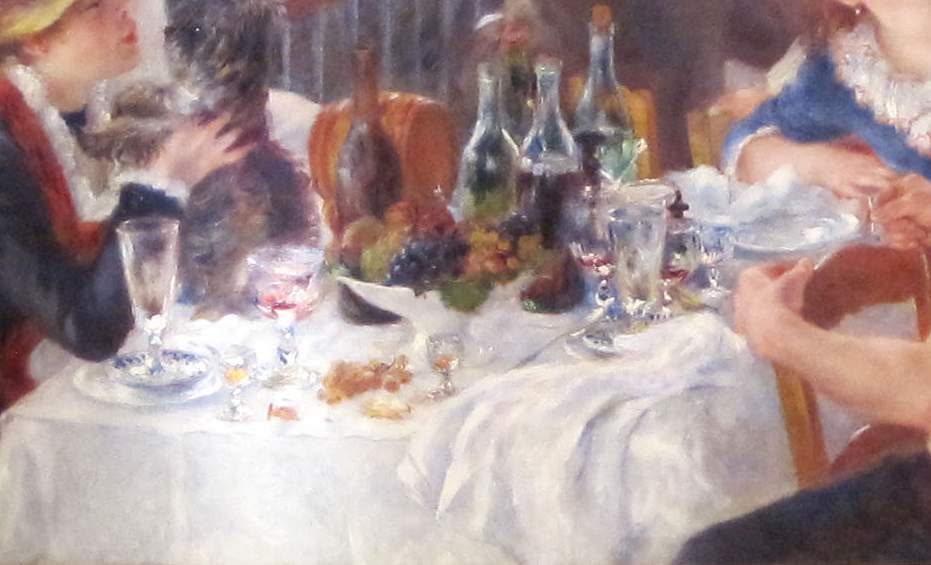
Illumination enters the balcony through a large opening adjacent to the standing man in the hat and the woman leaning on the railing. Renoir unified the composition by allowing light to reflect off specific surface areas, including the white tablecloth and the sleeveless tops worn by the men in the foreground. He selected complementary colours, placing the orange-red of the flowers on Aline Charigot’s hat against the Prussian blue of her dress, while repeating these tones in muted shades across the clothing of background figures.
Revisions and Studio Practice
Renoir commenced the work without preparing formal preliminary sketches, relying only on minimal underdrawing directly on the canvas surface. Modern technical examinations using X-radiographic and infrared analysis demonstrate that the artist altered the arrangement repeatedly during execution. The scans reveal that a figure initially positioned to look directly towards the viewer was later painted over and replaced by a male figure facing Alphonsine.
The process of completing the canvas proved logistically complex because the models posed in small groups or as individuals rather than all at once. Models frequently arrived late or failed to keep their appointments, disrupting the artist's schedule. In a letter to his patron Paul Berard, Renoir expressed his frustration with the painting, stating that he no longer knew where he was with the work and that it was annoying him increasingly.
Reception and Exhibition History
The completed canvas was displayed at the Seventh Impressionist Exhibition in 1882, held in rented rooms at 251 Rue Saint-Honoré in Paris. The business operations of the exhibition were managed by the art dealer Paul Durand-Ruel, allowing the participating artists to focus on their entries. Three contemporary critics declared Renoir's canvas to be the finest painting in the exhibition. Writing in Le Pays on 10 March 1882, critic Paul de Charry described the work as fresh and free without being bawdy.
In La Vie Moderne on 11 March 1882, Armand Silvestre praised the draftsmanship, noting that the remarkable drawing resulted from the juxtaposition of hues rather than outlined edges, calling it one of the most beautiful pieces produced by independent artists. In contrast, Albert Wolff published a harsh review in Le Figaro on 2 March 1882, writing that Renoir would have produced a pretty picture had he learned to draw. The painting was eventually acquired for the Phillips Collection in the United States, where actor Edward G. Robinson later described spending hours standing before the canvas during visits to the museum in Washington.


.jpg)