


The 1905 Salon d'Automne opened in Paris on 18 October at the Grand Palais. Henri Matisse, then thirty-five, was hanging four paintings in Room VII, including Open Window, Collioure and Woman with a Hat. André Derain, ten years younger and Matisse's recent collaborator, had several canvases on the same wall. In the centre of the room stood a small Donatello-style Renaissance bronze.
The critic Louis Vauxcelles wrote about Room VII for the Gil Blas newspaper. He pointed at the contrast between the conventional bronze and the surrounding paintings and produced the phrase that named a movement: "Donatello au milieu des fauves" — Donatello in a den of wild beasts. The word fauves stuck. Matisse, Derain, Maurice de Vlaminck, Albert Marquet, Henri Manguin, Charles Camoin, and Othon Friesz became Les Fauves.
What Was On the Wall
The Fauve paintings of 1905 used colour the way no European painting had used it since the medieval illuminators. Pure, unblended pigment straight from the tube. Cadmium red next to viridian. Cobalt blue against zinc yellow. No earth tones, no subtle modelling, no atmospheric grey. The colour was applied in broad flat areas, often outlined in another colour, often departing entirely from the colour of the actual subject.
Open Window, Collioure shows the view from Matisse's hotel room window in the southern French fishing village of Collioure, where he had spent the summer of 1905 with Derain. A small balcony, three flower pots, and a window-frame in the foreground. A small harbour beyond, with three boats. The sky and the sea are painted in pink, peach, blue-green, and salmon. The walls of the balcony are red and pink. The shutters are green and red.
The painting was not naturalistic and was not trying to be. Matisse had begun, in summer 1904, working on a series of pictures that pushed colour past Impressionist observation toward what he called "expression through colour." Open Window was the fullest statement of this practice he had yet made. The colour did the work.
The Critics
Vauxcelles's wild-beast review was relatively mild. Other critics were not. The reviewer for L'Illustration wrote that Woman with a Hat was "the most unpleasant thing in the entire Salon." Charles Morice, an established Symbolist critic, wrote about Matisse's paintings as "the products of an apparent disorder of the cerebral functions."
The pictures were also defended. Gertrude and Leo Stein, the American collectors who had just begun acquiring contemporary French painting, bought Woman with a Hat for 500 francs after watching the painting be mocked in front of them by other Salon visitors. The Russian textile-magnate collector Sergei Shchukin began buying Matisse the following year and would acquire 37 Matisse paintings over the next decade.
The Joy of Life
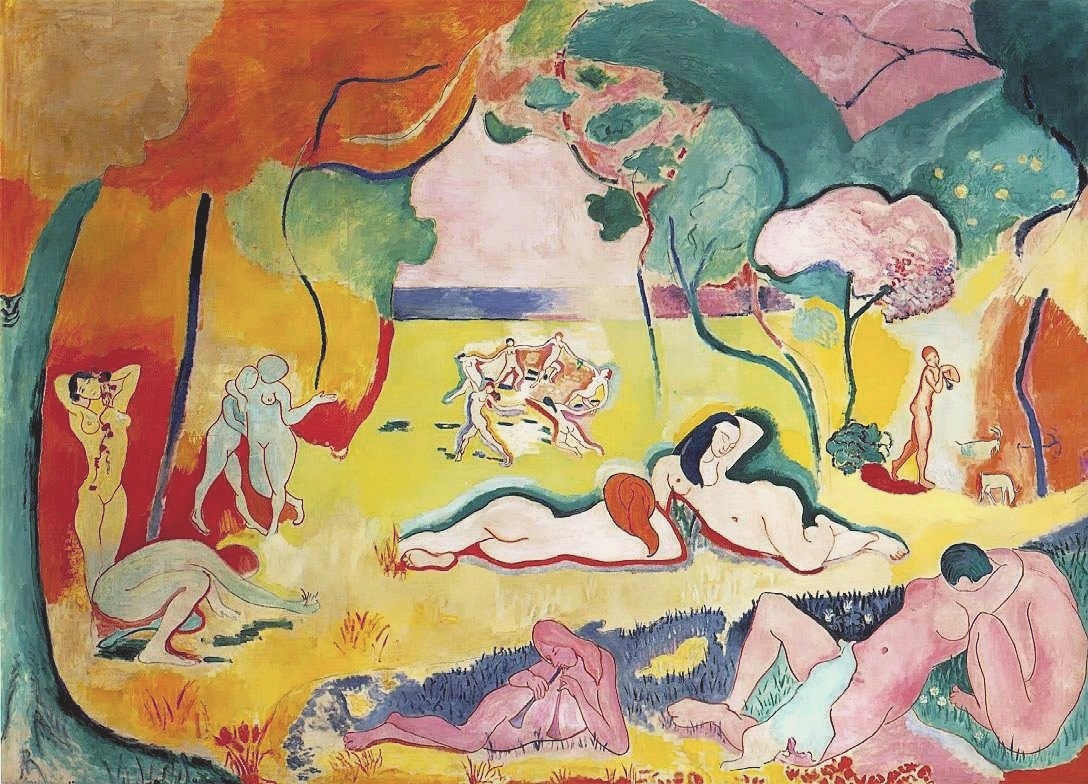
In autumn 1905, immediately after the Salon, Matisse began the largest painting of his career to date: Le Bonheur de vivre (The Joy of Life), 175 by 241 centimetres, oil on canvas. The picture shows a sunlit meadow with figures relaxing in various states of nudity: dancing, lying down, embracing. The colours are even more saturated than the Fauve room of 1905. The drawing is simplified to long flowing contour lines.
Bonheur was finished by spring 1906 and shown at the 1906 Salon des Indépendants. It was the public statement of what Matisse thought Fauvism could do at full scale. The painting was attacked again, but this time Matisse had a defender at hand: Leo and Gertrude Stein bought Bonheur for 1,000 francs and hung it in their Rue de Fleurus salon, where it became the most-discussed contemporary painting in Paris for the next several years.
The Steins' salon was where the Fauve picture met the next generation. Picasso saw Bonheur there in spring 1906 and began working on Les Demoiselles d'Avignon (1907) partly in response. The competition between Matisse and Picasso that would define European painting for the next twenty years began at the Steins' apartment in 1906.
Why Fauvism Lasted So Briefly
Fauvism as a coherent movement existed from roughly 1905 to 1908. By the end of 1907, the group had begun to fragment. Derain shifted toward a darker, more structured manner influenced by Cézanne. Vlaminck moved similarly. Braque, who had begun working in a Fauve idiom in 1906, switched in 1908 to early Cubism alongside Picasso.
Matisse himself kept developing what he had begun, but increasingly along his own lines. By 1909 he was producing paintings (Dance, The Conversation, The Music) that were Matissean rather than Fauvist. The collective movement had served its purpose. It had broken the hold of post-Impressionist atmospheric colour and opened up the possibility of using pigment for its own properties rather than as a vehicle for description.
What the Window Argued
The Open Window of 1905 was a small painting (55 by 46 centimetres) that did a large amount of historical work. It argued that European painting could continue without being bound to the colour conventions that Impressionism had developed and post-Impressionism had partly modified.
The argument was made through the painting's structure. The view through the window is composed of horizontal bands of colour. Sea and sky take up most of the upper half of the picture; the balcony and pots occupy the lower half. Each band is a different colour, and the bands are separated by hard edges rather than the soft transitions Impressionist painters used. The colour does not describe what is being seen; the colour decides what the painting is.
This shift, from colour as observation to colour as construction, is the foundation of all twentieth-century colour painting. Mondrian, Rothko, Newman, Kelly, Diebenkorn: each of them descends from the 1905 Salon room. The lineage runs through Matisse's late cut-outs of the 1940s and 1950s, which carried the original Fauve logic to its conclusion.
What Happened to the Wild Beasts
Vauxcelles's joke became a movement name within weeks. The painters he had called fauves accepted the label and used it. The Salon d'Automne of 1905 became, in retrospect, the foundational exhibition of twentieth-century French painting.
Open Window, Collioure is now in the National Gallery of Art in Washington. Woman with a Hat is in the San Francisco Museum of Modern Art. Le Bonheur de vivre is at the Barnes Foundation in Philadelphia. The four paintings Matisse hung in Room VII in October 1905 are now in major American museum collections, on display every day, drawing larger audiences than they ever drew in Paris.
The painters of 1905 had been told they were monstrous. They turned out to be the first painters of the century.


