



Ad Reinhardt
For the last seven years of his life, Ad Reinhardt painted nothing but black. More precisely: nothing but near-black. Each of his late canvases measured exactly 60 x 60 inches, and contained, if you looked long enough and the light was right, a cruciform grid in dark reds, blues, or greens barely distinguishable from the surrounding field. The effect was religious in its austerity and deeply annoying to critics who expected more from an artist trained at Columbia and the American[1] Artists School.
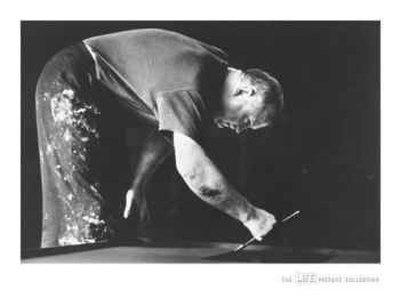
Biography
Born in Buffalo, New York, on 24 December 1913[1], Reinhardt studied art history under Meyer Schapiro at Columbia and became editor of the student humour magazine Jester (the preceding editor had been the novelist Herman Wouk). During the 1940s he contributed cartoons to PM, a left-wing New York newspaper, including a widely reproduced series called "How to Look at Art." This playful satirical output, which he maintained throughout his career, sits oddly beside the severity of the black paintings; Reinhardt appeared to see no contradiction. He also wrote extensively for Art News, covering Asian and Islamic art with genuine scholarship.
Within the Abstract Expressionist generation, Reinhardt was an insider dissident. He rejected the movement's core values: gestural improvisation, autobiographical content, emotional expression, and the cult of artistic personality. By the late 1950s he had formulated his aphoristic list of prohibitions: no texture, no drawing, no colour, no light, no space, no time, no size, no shape, no movement, no object. These were not decorative paradoxes but working constraints, enforced in canvases that demanded prolonged attention before their barely-there geometry resolved. Critic Jed Perl described his writings as "a celebration of negativity, so irredeemably dark that they generate their own kind of revelatory black light."
Barbara Rose, writing in the mid-1960s, noted that his rules had become "nearly canonical for the young artists" then developing Minimalism. Reinhardt refused to acknowledge the connection; he was equally hostile to any co-option of his ideas. He died of a heart attack in New York in August 1967[1], aged fifty-three, having completed the last of his black paintings the year before. The Minimalists moved his ideas into three dimensions. He would almost certainly have disapproved.
Timeline
- 1913Born in Buffalo, New York on December 24th
- 1940Contributed cartoons to PM newspaper, including 'How to Look at Art'
- 1950Formulated his list of prohibitions for art
- 1966Completed the last of his black paintings
- 1967Died of a heart attack in New York in August
Notable Works
Tap to view larger.
Next stop
Abstract Expressionism →
Explore the artists and ideas of Abstract Expressionism.
Related Artists




Frequently Asked Questions
What is Ad Reinhardt known for?
Ad Reinhardt is best known for his series of near-black paintings, which he created during the last seven years of his life. These canvases, measuring 60 x 60 inches, featured a cruciform grid in dark reds, blues, or greens that were barely distinguishable from the surrounding field.Who was Ad Reinhardt?
Ad Reinhardt was an American[1] abstract expressionist painter, born in Buffalo, New York. He is known for his satirical cartoons, his writings on Asian and Islamic art, and especially for his late paintings that were near-black canvases with subtle cruciform grids.What was Ad Reinhardt's art style?
Ad Reinhardt's art style evolved into what might be described as near-black abstraction. He rejected many core values of Abstract Expressionism[1], such as gestural improvisation, autobiographical content, and emotional expression, instead enforcing constraints like 'no texture, no drawing, no colour, no light, no space, no time, no size, no shape, no movement, no object.'How did Ad Reinhardt die?
Ad Reinhardt died in 1967[1] at the age of 54.
Sources
Editorial draws on the following primary and tertiary references for Ad Reinhardt.
- [1] wikipedia Wikipedia: Ad Reinhardt Used for: biography, birth dates, death dates, identifiers, movement attribution, nationality.
- [2] book Richard Klin, Abstract Expressionism For Beginners Used for: biography.
- [3] book Beard, Lee, 1973- author, Butler, Adam, author; Van Cleave, Claire, author; Fortenberry, Diane, author; Stirling, Susan, author, Beard, Lee, 1973- author, Butler, Adam, author; Van Cleave, Claire, author; Fortenberry, Diane, author; Stirling, Susan, author - The Art Book_ New Edition, Mini Format Used for: biography.
- [4] book Masterpieces of western art : a history of art in 900 individual studies from the Gothic to the present day Used for: biography.
Editorial overseen by Solis Prints. Sources verified 2026-08-29. Click a source for details, or hover over [N] in the page above to preview.
Editorial standardsMethodologyCorrectionsAI disclosureAbout the editorial team