



Aleksey Antropov
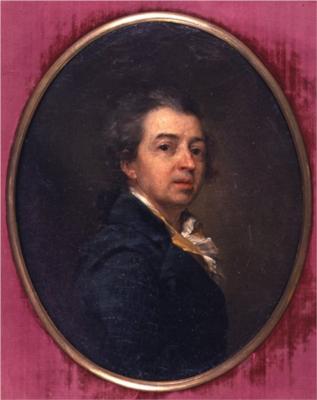
- portrait
Aleksey Antropov was born in St Petersburg in 1716[1] and spent his entire working life in service to the Russian[1] court and church. He entered the Chancellery of Buildings at sixteen, training first under Andrey Matveyev before spending nearly twenty years under Ivan Vishnyakov, a thorough apprenticeship in the formal conventions of official portraiture: full-length compositions, drapery and columns, flags and decorative accessories, the whole apparatus of aristocratic self-presentation. He also studied under the French court painter Louis Caravaque and, later, under Pietro Rotari, giving his formation an unusually broad European base.
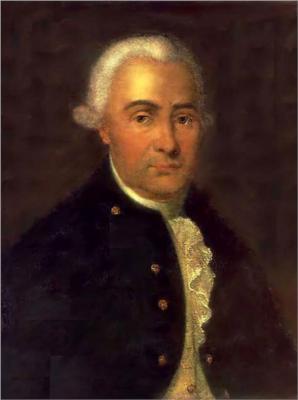
Biography
Antropov's best work dates from the 1750s and 1760s, when the reign of Elizabeth Petrovna brought expanded patronage and an appetite for more psychologically direct portraiture alongside the ceremonial commissions. Peter Leek, whose survey of Russian[1] painting remains authoritative, describes Antropov as having achieved "a remarkable degree of veracity" despite the constraints of the genre. His style, with its sharp colour contrasts against dark backgrounds and a certain frontal stillness, retained something of the earlier parsuna tradition, the pre-Petrine Russian portrait[1] idiom, which made him seem less fashionable than his contemporary Ivan Argunov but gave his work a quality of concentrated attention that Argunov's more fluid manner sometimes lacks.
In 1762[1] alone Antropov painted four portraits of the short-reigning Peter III. He later supervised icon painting for the Synod of the Russian[1] Orthodox Church and taught portrait[1] painting, his most consequential student being Dmitri Levitsky, who went on to become the dominant Russian portraitist of the later eighteenth century. In 1789 Antropov donated his only house to establish a free art school. He died in St Petersburg in 1795[1].
Timeline
- 1716Born in St Petersburg, Russia
- 1730Studied under Louis Caravaque.
- 1732Entered the Chancellery of Buildings at sixteen.
- 1732Trained under Andrey Matveyev.
- 1732Apprenticed under Ivan Vishnyakov for nearly twenty years.
- 1750Began producing his best work.
- 1760Studied under Pietro Rotari.
- 1762Painted four portraits of Peter III.
- 1789Donated his house to establish a free art school.
- 1795Died in St Petersburg, Russia.
Notable Works
Tap to view larger.
Next stop
Browse the movements →
Every movement in the collection, from the Renaissance to Pop art.
Related Artists

Frequently Asked Questions
What is Aleksey Antropov known for?
Aleksey Antropov is known for his portraiture, particularly during the reign of Elizabeth Petrovna, when there was an appetite for more psychologically direct portraits. Peter Leek described Antropov as having achieved "a remarkable degree of veracity" in his portraits, despite the constraints of the genre. In 1762[1] alone, Antropov painted four portraits of Peter III.Who was Aleksey Antropov?
Aleksey Antropov was born in St Petersburg in 1716[1] and spent his entire working life in service to the Russian[1] court and church. He trained under Andrey Matveyev, Ivan Vishnyakov, Louis Caravaque, and Pietro Rotari. He later supervised icon painting and taught portrait[1] painting, with Dmitri Levitsky as his most consequential student.What was Aleksey Antropov's art style?
Aleksey Antropov's style retained something of the earlier parsuna tradition, with sharp colour contrasts against dark backgrounds and a certain frontal stillness. This made him seem less fashionable than his contemporary Ivan Argunov, but gave his work a quality of concentrated attention. His style achieved "a remarkable degree of veracity" despite the constraints of official portraiture.How did Aleksey Antropov die?
Aleksey Antropov died in 1795[1] at the age of 79.
Sources
Editorial draws on the following primary and tertiary references for Aleksey Antropov.
- [1] wikipedia Wikipedia: Aleksey Antropov Used for: biography, birth dates, death dates, identifiers, movement attribution, nationality.
- [2] book Allison Lee Palmer, Historical Dictionary of Neoclassical Art and Architecture Used for: biography.
- [3] book Palmer, Allison Lee, Historical Dictionary of Neoclassical Art and Architecture Used for: biography.
- [4] book Peter. Leek, Russian Painting Used for: biography.
Editorial overseen by Solis Prints. Sources verified 2026-09-16. Click a source for details, or hover over [N] in the page above to preview.
Editorial standardsMethodologyCorrectionsAI disclosureAbout the editorial team