



Carl-Ludwig Johann Christineck
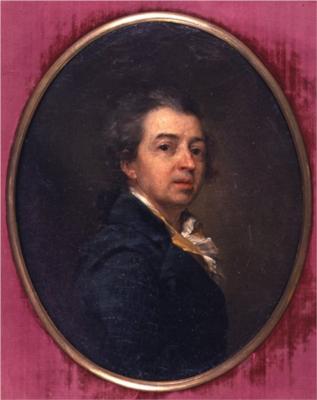
- portrait
A German-born painter who spent his entire career at the Russian[1] imperial court, Carl-Ludwig Christineck became one of the more productive portraitists working in St Petersburg during Catherine the Great's reign. Despite never holding a formal court appointment, he built a steady clientele among the Russian nobility at a moment when portraiture was the primary medium of social self-definition.
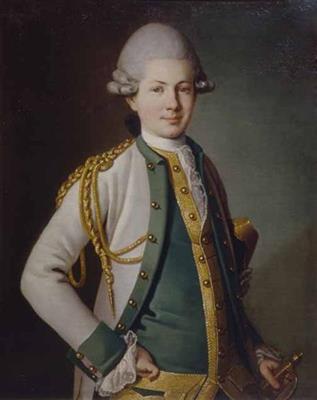
Biography
His subjects read like a register of the Petrine elite: the future Tsar Paul I, the favourite Grigory Orlov, the imperial secretary Adam Olsufiev, and Alexei Bobrinsky, the illegitimate son of Catherine herself. That Christineck secured sittings from figures this close to the throne suggests a reputation built on discretion as much as technical competence.
Outside portraiture, he contributed a mosaic depicting the Battle of Poltava to the Imperial Porcelain Factory in St Petersburg, a commission that placed him alongside craftsmen at the heart of Russian[1] imperial self-mythology. His 1785[1] portrait[1] of the architect Yury Felten, who designed the granite embankments along the Neva and the iron railing of the Summer Garden, shows the breadth of his connections across Petersburg's professional class.
Trained initially in Germany, Christineck adapted quickly to Russian[1] tastes without abandoning the northern European tradition of sober, well-observed likeness. He died in St Petersburg around 1794, having spent essentially his whole adult life in a city built by foreigners for a Russian empire that was, by then, very much its own.
Timeline
- 1732Born in Germany.
- 1785Painted a portrait of the architect Yury Felten.
- 1792Died in St Petersburg, Russia, aged approximately 60.
Notable Works
Tap to view larger.
Next stop
Browse the movements →
Every movement in the collection, from the Renaissance to Pop art.
Related Artists

Frequently Asked Questions
What is Carl-Ludwig Johann Christineck known for?
Carl-Ludwig Johann Christineck is known for his portraiture of the Russian[1] nobility. His subjects included the future Tsar Paul I, Grigory Orlov, Adam Olsufiev, and Alexei Bobrinsky.What is Carl-Ludwig Johann Christineck's most famous work?
Carl-Ludwig Johann Christineck (1732[1]-1792[1]) was a German engraver. He is best known for his work as a professor at the Electoral Academy of Art in Dresden. He taught engraving there, and he also served as the director from 1764[1]. Christineck's most recognised achievement is his publication, *Anfangsgründe der Ätzkunst*, issued in Leipzig in 1774. This manual on etching techniques became a standard reference work for artists. It covered various methods, tools, and materials used in etching. The book provided practical guidance for both beginners and experienced printmakers. It included detailed explanations and illustrations. Christineck's *Anfangsgründe der Ätzkunst* contributed significantly to the dissemination of knowledge about etching during the late 18th century. It helped to standardise practices and promote the art of etching across Europe. The book remains a valuable historical resource for understanding printmaking techniques of the period.What should I know about Carl-Ludwig Johann Christineck's prints?
Carl-Ludwig Johann Christineck was a German artist who worked in several graphic media, including woodcuts, lithographs, etchings, and engravings. Printmaking experienced a revival during the German Expressionist movement, to which Christineck is connected. Expressionist artists often looked to medieval woodcuts for inspiration. The graphic style of Die Brücke, an early Expressionist group, had a considerable effect on German art. The years immediately following the First World War saw a surge in printmaking activity in Germany, with new prints and portfolios appearing. During the hyperinflation period of the early 1920s, art became a more secure investment. Prints, being more affordable than paintings or sculpture, became accessible to a wider population. Publishers produced editions in a more polished, commercial way, with edition sizes typically between forty and one hundred impressions. Some artists, however, preferred to print their own works, maintaining smaller, less uniform editions.What style or movement did Carl-Ludwig Johann Christineck belong to?
It is difficult to assign Carl-Ludwig Johann Christineck to one particular movement. However, comparison to the work of Lucas Cranach the Elder (1472-1553[1]) is useful. Cranach developed a reproducible painting style under his supervision. His shop produced over sixty copies of elector portraits when John Frederick the Magnanimous came to the electorship of Saxony. Cranach's portraits show a tendency toward diminished plasticity, emphasised by silhouette, but with subtle modelling. His naturalistic style appears in portraits of figures such as Dr Johannes Scheiiring (1529). Cranach rejected overwhelming drama and linearism, achieving effect through silhouette and surface ornamentation. The unmodulated background is treated as a blank area, silhouetting the subject's hair. Cranach's sophisticated use of pattern, flattened light, and tonal gradations appears across his subject matter. His figures are sensuous and mannered. He was unconcerned with the ideal human proportion that governed Albrecht Dürer. Cranach and his patrons preferred the pleasurable side of the classical heritage.What techniques or materials did Carl-Ludwig Johann Christineck use?
Carl-Ludwig Johann Christineck worked primarily with stained glass. The techniques of glass painting in the 15th and 16th centuries involved specific materials and processes. "Hüttenglas" (hut glass), a flat glass smelted in a pot furnace and coloured with metal oxides, was standard. Artists used colour through transparent coloured-glass pieces, and modelling via semi-translucent matts (washes smoothed with a badger brush). Opaque contours defined the drawing. Silver stain, introduced around 1300, allowed for colours from lemon yellow to golden yellow. The artist applied matts or glazes using a soft badger blender brush. From about 1510, wet stippling became more common, refining the surface with a brush, sponge, or cloth. Scratch stippling, an innovation of the late 15th century, involved scratching out points of light with a metal brush. Glass paints consisted of pulverised glass with metal oxides, diluted with a binder. Watery binders (water, gum, vinegar, wine) alternated with oily substances.What was Carl-Ludwig Johann Christineck known for?
Carl-Ludwig Johann Christineck is recorded as a sculptor active in the early nineteenth century. He is best known for portrait[1] busts of noted figures, particularly those displayed at Valhalla, near Regensburg. Commissioned by Ludwig I, King of Bavaria, these portrait busts immortalised emperors, statesmen, military leaders, poets, and philosophers. Christineck worked alongside other sculptors, including Johann Gottfried Schadow and Christian Daniel Rauch, on the Valhalla project. Ludwig I, a knowledgeable connoisseur, offered both praise and criticism of the artists' work. He urged Schadow to add 'a little more finish' to his busts. Ultimately, Ludwig I favoured Rauch's attention to physical accuracy over Schadow's style. Christineck's contribution to Valhalla reflects the Neoclassical interest in commemorating important historical figures through portraiture.When did Carl-Ludwig Johann Christineck live and work?
Carl-Ludwig Johann Christineck was born on 4 October 1720 in Mojano di Mestre, near Venice. He was baptised on 8 November in the church of San Moisé, Venice. His parents were Laura Lucchesi and Angelo Piranesi, a prosperous stone mason and master builder. He died in Rome on 9 November 1778[1]. In 1735, Christineck apprenticed to his maternal uncle, Matteo Lucchesi, an architect and hydraulics engineer. He studied perspective under Carlo Zucchi. After disagreements with Lucchesi, Christineck moved to the studio of the neo-Palladian architect Giovanni Antonio Scalfurotto (circa 1700-1764[1]). There, he may have been involved in the final stages of the church of SS. Simeone e Guida (built 1718-38), Venice. In 1740, Christineck moved to Rome as a draftsman in the retinue of the Venetian ambassador, Marco Foscarini (1696-1763).Where can I see Carl-Ludwig Johann Christineck's work?
Works by Carl-Ludwig Johann Christineck can be viewed in a number of museums in Europe and North America. These include: the Augustinermuseum, Freiburg im Breisgau; the Bayerisches Nationalmuseum, Munich; the Dom- und Didzesanmuseum, Hildesheim; and the Griines GewGlbe, Staatliche Kunstsammlungen, Dresden. Other museums include: the Domkapitel Aachen, Domschatzkammer, Aachen; the Domschatz, Halberstadt; and the Domschatz des Katholischen Saint Petri-Domes zu Fritzlar, Fritzlar, Hessen. In Germany, Christineck's art can be seen at the Briicke Museum and the Nationalgalerie, both in Berlin. Other German locations include the Kunsthalle and Sammlung Bottcherstrasse in Bremen, the Ludwig Museum and Wallraf-Richartz Museum in Cologne, and the Folkwang Museum in Essen. Further German institutions that hold his works are the Gesellschaft Kruppsche Gemaldesammlung, the Kunsthalle in Hamburg, the Niedersachsisches Landesmuseum in Hanover, the Stadtische Kunsthalle in Mannheim, the Bayerische Staatsgemaldesammlungen in Munich, the Stiftung Ada und Emil Nolde in Seebull, and the Von der Heydt Museum in Wuppertal.Where was Carl-Ludwig Johann Christineck from?
Carl-Ludwig Johann Christineck's precise origins are not detailed in the provided texts. However, one passage mentions Christian Daniel Rauch, a sculptor born in Arolsen, the Residenz town of the principality of Waldeck, near Kassel. Rauch received early training from the court sculptor Friedrich Valentin from nearby Helsen. He later moved to the art academy in the neighbouring margravate of Hessen-Kassel. This suggests a network of artistic activity in that area of Germany. Without more specific information, it is impossible to state Christineck's exact place of birth or family background. It is possible he was connected to the artistic circles around Kassel, given the geographical proximity and the movement of artists within that region.Who did Carl-Ludwig Johann Christineck influence?
The provided texts do not offer information about who Carl-Ludwig Johann Christineck may have influenced. However, the passages do mention a number of artists who influenced, or were influenced by, other artists. For example, Théodore Chassériau, a pupil of Ingres, combined Ingres's classical style with the coloration of Delacroix. Degas considered Chassériau's painting "The Sisters of the Artist" to be the best painting of the century. William Merrit Chase, after training in Munich, adopted open-air painting and Impressionistic techniques, becoming an influential teacher in New York. Carl Blechen is presented as continuing the work of Friedrich, while rejecting his mysticism. Blechen's naturalism is compared to that of Camille Corot. Johann Wilhelm Schirmer, of the Düsseldorf Academy, was called the "new Ruisdael". Arnold Böcklin, Caspar Scheuren, and Alexandre Calame were all drawn to Ruisdael's style.Who influenced Carl-Ludwig Johann Christineck?
Carl-Ludwig Johann Christineck (1732[1]-1792[1]) was a German engraver and art writer. He managed his family's paper mill and print shop in Neustadt an der Orla, and he assembled a large collection of prints. Christineck's 1766[1] book *Anleitung zur Handzeichnung für Anfänger* (Instructions on Drawing by Hand for Beginners) shows the influence of French art theory. He translated Charles-Antoine Jombert's *Méthode pour apprendre à dessiner* (Method for Learning to Draw) into German in 1767. Jombert's book promoted the academic drawing style taught at the French Royal Academy of Painting and Sculpture. This style emphasised clear outlines and idealised forms. Christineck's own drawings and engravings reflect this academic influence. His prints often feature precise lines and carefully modelled figures. He produced portraits, allegorical subjects, and illustrations for books. His work demonstrates a knowledge of French artistic principles and a desire to disseminate them to a German audience. He aimed to provide practical instruction for aspiring artists.Who was Carl-Ludwig Johann Christineck?
Carl-Ludwig Johann Christineck was a German-born painter who spent his career at the Russian[1] imperial court. He was one of the more productive portraitists working in St Petersburg during Catherine the Great's reign.
Sources
Editorial draws on the following primary and tertiary references for Carl-Ludwig Johann Christineck.
- [1] wikipedia Wikipedia: Carl-Ludwig Johann Christineck Used for: biography, birth dates, death dates, identifiers, movement attribution, nationality.
- [2] book Getty, Getty - Oudrys Painted Menagerie Used for: biography, stylistic analysis.
- [3] book Milam, Jennifer Dawn, Historical Dictionary of Rococo Art Used for: biography.
- [4] book Neoclassicism and romanticism : architecture, sculpture, painting, drawings, 1750-1848 Used for: biography.
- [5] book Neville, Kristoffer,Skogh, Lisa, Queen Hedwig Eleonora and the Arts Used for: biography.
- [6] book Dror Wahrman;, The Throne of the Great Mogul in Dresden Used for: stylistic analysis.
Editorial overseen by Solis Prints. Sources verified 2026-09-16. Click a source for details, or hover over [N] in the page above to preview.
Editorial standardsMethodologyCorrectionsAI disclosureAbout the editorial team