



Alessandro Vittoria
The sculptor who introduced the portrait bust to Venice arrived there as an eighteen-year-old from Trento, son of a tailor, on 25 July 1543[1]. Alessandro Vittoria had come to train under Jacopo Sansovino, the dominant architect-sculptor of the city, and their working relationship, though frequently fractious, produced some of the most accomplished decorative sculpture of the Venetian Renaissance.
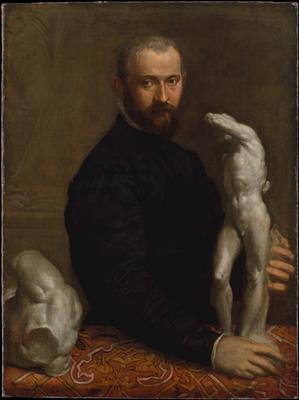
Biography
Contemporary accounts described the relationship with Sansovino as stormy: disagreements over attribution and payment were common. Yet Vittoria contributed figures to Sansovino's Biblioteca Marciana and, when Sansovino died, assumed his studio. His collaboration with Paolo Veronese on the Villa Barbaro at Maser (1560[1]-62) is among the most felicitous pairings in 16th-century art: Vittoria's stucco figures and Veronese's illusionist frescoes occupy the same rooms in a rare unity of sculptural and painted space.
Working in terracotta (often gilded), marble, and bronze, Vittoria drew on the dynamism of Michelangelo and the painterly colour sense he absorbed from Titian and Tintoretto. His portrait busts were the most technically refined of their generation; the sitters include Doge Niccolò da Ponte and Marino Grimani. He joined the Scuola Grande di San Marco in January 1563[1] and was admitted to the Accademia del Disegno in Florence around 1567, recognition from both the civic and academic establishments of the day.
He died in Venice on 27 May 1608[1]. His self-portrait bust survives in the church of San Zaccaria, where he is also buried: a fitting arrangement for an artist who produced some of the most psychologically acute portraiture in Venetian sculpture.
Timeline
- 1525Born in Trento (present-day Italy)
- 1543Arrived in Venice to train under Jacopo Sansovino
- 1560Collaborated with Paolo Veronese on Villa Barbaro until 1562
- 1563Joined the Scuola Grande di San Marco
- 1567Admitted to the Accademia del Disegno in Florence
- 1570Contributed figures to Sansovino's Biblioteca Marciana
- 1570Assumed Sansovino's studio after his death
- 1608Died in Venice on May 27
Notable Works
Tap to view larger.
Next stop
Browse the movements →
Every movement in the collection, from the Renaissance to Pop art.
Related Artists




Frequently Asked Questions
What is Alessandro Vittoria known for?
Alessandro Vittoria is known for his technically refined portrait busts. His sitters included Doge Niccolò da Ponte and Marino Grimani; he worked in terracotta, marble, and bronze.What is Alessandro Vittoria's most famous work?
It is difficult to identify a single 'most famous' work by Alessandro Vittoria, as his reputation rests on a varied output of sculpture, portraits, and stucco work. He was a prolific artist, and different works may be more or less well known depending on the viewer's interests. He is well known for his portrait busts of Venetian notables. These include works such as his Melchiorre Michiel (circa 1565[1]), now in the Ca' d'Oro, Venice. He also produced religious sculpture, such as his St Sebastian (1566) in the Church of San Francesco della Vigna, Venice. Vittoria also created stucco decorations for buildings, including the Palazzo Ducale and the Biblioteca Marciana in Venice. Any assessment of Vittoria's 'most famous work' depends on the criteria used: Is it the most technically accomplished, the most historically significant, or simply the most frequently reproduced?What should I know about Alessandro Vittoria's prints?
Alessandro Vittoria (1525[1]-1608[1]) was an Italian[1] Mannerist sculptor. While he is not primarily known for printmaking, his work is documented in relation to prints and drawings. Scholarship indexes his name in connection to various collections and artworks. Vittoria's name appears in catalogues and indices alongside artists such as Alessandro Algardi, Raphael, Gian Lorenzo Bernini, Pietro da Cortona, and others. These references suggest Vittoria's artistic milieu and the range of artists with whom his work may have been associated or collected. Mentions of collections, such as those in the National Gallery of Art in Washington and the Print Room at Windsor Castle, indicate locations where examples of works related to Vittoria or his contemporaries can be found. These references offer a starting point for researching any prints potentially associated with Vittoria.What style or movement did Alessandro Vittoria belong to?
Alessandro Vittoria's career spanned the High Renaissance and the emergence of Mannerism. He was born in Trent in 1525[1] and died in 1608[1]. Vittoria is seen as aligned with the Venetian High Renaissance, although his later works display Mannerist traits. In Venice, Vittoria studied with Jacopo Sansovino, alongside painters such as Titian and Tintoretto. His sculptures show the influence of Michelangelo, particularly in their anatomical detail and expressive energy. Vittoria's style is characterised by a blend of classical form with a dynamic, emotional intensity. This combination places him at a point of transition, reflecting both the High Renaissance and the developing Mannerist style. Some scholars see his work as anticipating aspects of the Baroque.What techniques or materials did Alessandro Vittoria use?
Alessandro Vittoria sculpted primarily in terracotta, marble, and bronze. He favoured modelling, building up figures in soft, pliable materials like wax and clay. These media were relatively cheap, and he used them for exploratory sketches and models. For bronze sculpture, Vittoria employed the lost-wax method. This involved creating a wax surface over a clay core, attaching wax rods (sprues), and encasing the structure in a clay mould. Heating the mould would melt the wax, leaving a void into which molten bronze was poured. After cooling, the mould was broken away, and the surface refined through filing, polishing, and gilding. Vittoria also carved marble, a tradition with deep roots in Italy, which had abundant sources of marble. The process involved drawing an outline on a rectangular block, removing surplus stone with axes, and defining the form with chisels and drills. Fine details were achieved with flat chisels, followed by smoothing and polishing with metal rasps, emery, and pumice.What was Alessandro Vittoria known for?
Alessandro Vittoria (1525[1]-1608[1]) was an Italian[1] Mannerist sculptor. He is best known for portrait busts and allegorical figures. Born in Trent, he trained with Jacopo Sansovino in Venice. Vittoria's early works show Sansovino's influence; however, he developed his own style. This style combined classical ideals with Venetian elegance. Vittoria was a contemporary of artists such as Titian and Veronese. He collaborated with them on various projects. For example, he created stucco decorations for the Palazzo Ducale's library. He also produced bronze sculptures for Venetian churches. His terracotta and bronze portrait busts are particularly admired. They capture the likenesses of prominent Venetians. These busts display a remarkable attention to detail and a sense of animation. His mythological figures, often in stucco or bronze, are full of movement. They show his mastery of the human form. Vittoria's work can be seen in museums and churches, mainly in Venice and the surrounding area.When did Alessandro Vittoria live and work?
Alessandro Vittoria (1525[1]-1608[1]) was an Italian[1] Mannerist sculptor. He was born in Trente, now Trento, and he died in Venice. Vittoria is known for his stucco work and bronze sculptures. He is less known as a medallist and architect. He trained with Jacopo Sansovino in Venice. He received further instruction from the painter and sculptor, Danese Cattaneo. Vittoria's career was centred in Venice. He worked alongside artists such as Titian, Tintoretto, and Veronese. These collaborations allowed him to create sculptures that complemented their paintings. His work can be seen in various Venetian churches and public spaces. These include San Giorgio Maggiore, the Doge's Palace, and the Scuola Grande di San Rocco. Vittoria's sculptures are characterised by their expressive poses and detailed anatomy. They mark a transition from the High Renaissance style to the more dramatic Mannerist style. He was a leading figure in the Venetian art scene during the late 16th century. He had a significant influence on subsequent generations of sculptors in the region.Where can I see Alessandro Vittoria's work?
Alessandro Vittoria's work can be found in collections across Europe and North America. In the United Kingdom, his work is held in a few locations. Some pieces are in private collections, such as that of Sir Anthony Blunt in London. Others are in public institutions, such as the Dulwich College Picture Gallery (London) and the Wallace Collection (London). Elsewhere in Europe, Vittoria's art can be seen at the Hermitage Museum in Saint Petersburg, the Prado in Madrid, and the Pushkin Museum of Fine Arts in Moscow. Further works are in the Nationalmuseum in Stockholm, the Galleria Sabauda in Turin, and the Kunsthistorisches Museum in Vienna. In the United States, you can find his pieces at the Minneapolis Institute of Arts, the John and Mable Ringling Museum of Art in Sarasota, the M. H. de Young Memorial Museum, and the National Gallery of Art in Washington, D.C.Who did Alessandro Vittoria influence?
Alessandro Vittoria, a Mannerist sculptor, active mainly in Venice, influenced several artists in his circle and beyond. Vittoria's emphasis on expressive emotion and dynamic poses had a notable impact on later sculptors. His pupils included both his son, Alessandro, and his nephew, Giovanni Maria Mosca. Both continued in his style, producing works that echoed his Mannerist tendencies. Other artists who absorbed elements of his style include Nicolò Roccatagliata, a Genoese sculptor who worked extensively in Venice; Roccatagliata's bronzes, in particular, show Vittoria's impact. Vittoria's influence extended beyond sculpture. Painters such as Tintoretto were inspired by his work, particularly his skill in capturing movement and drama. Vittoria and Tintoretto collaborated on several projects; this cross-pollination of ideas further disseminated Vittoria's artistic principles. His impact can also be seen in the work of some architects and designers who adopted his decorative motifs and his emphasis on elaborate ornamentation.Who influenced Alessandro Vittoria?
Alessandro Vittoria appears to have been influenced by a range of artists, if we consider the evidence of works collected at Windsor Castle and the National Gallery of Art, Washington. These collections include drawings and sculptures by artists such as Gian Lorenzo Bernini, Pietro da Cortona, Ciro Ferri, Carlo Fontana, Alessandro Algardi, Raphael, and others. Furthermore, a poem mentions Michelangelo, Titian, Correggio, Raphael, Tibaldi, Primaticcio, Parmigianino, and Niccolino as potential sources of influence. These artists represent a variety of styles and periods, suggesting that Vittoria's artistic development may have been shaped by a diverse set of examples. The poem recommends studying these masters, but suggests focusing on the works of Niccolino.Who was Alessandro Vittoria?
Alessandro Vittoria (1525[1]-1608[1]) was a Mannerist sculptor, born in Trent, northern Italy. He is best known for portrait busts and allegorical figures. Vittoria trained with Jacopo Sansovino in Venice. He was a contemporary of artists such as Titian, Paolo Veronese, and Tintoretto. Vittoria's work is often associated with the Venetian High Renaissance style, characterised by its classical influences and emphasis on humanism. Vittoria collaborated with Sansovino on projects including the decoration of the Biblioteca Marciana in Venice. He later developed his own independent practice. His sculptures can be found in Venetian churches, palaces, and museums. These include the figures on the façade of San Giorgio Maggiore and the stucco work in the Palazzo Ducale. Vittoria's terracotta and bronze portrait busts are particularly admired. They demonstrate his skill in capturing individual likenesses and conveying a sense of character. He also produced a number of allegorical bronzes, often small in scale, that reflect the fashion for collecting antiquities during the Renaissance.Why are Alessandro Vittoria's works important today?
Alessandro Vittoria was a Mannerist sculptor active in Venice during the later 16th century. He is best known for his work in stucco and bronze, and for his portrait busts. Vittoria's sculptures can be found in several Venetian churches and palaces, including the Doge's Palace. Vittoria's importance lies in his ability to capture the likeness and character of his subjects. His portrait busts are particularly notable for their realism and attention to detail. He worked at the Villa Barbaro, Maser; there, he provided actual statues for many rooms, and Veronese included niches with statues resembling them in the fictive architecture of his frescoes. His work represents a link between the High Renaissance and the Baroque periods. Vittoria's influence can be seen in the work of later sculptors, such as Gian Lorenzo Bernini. Although overshadowed by contemporaries such as Titian, Tintoretto, and Veronese, Vittoria's artistic output contributes to an understanding of Venetian art.
Sources
Editorial draws on the following primary and tertiary references for Alessandro Vittoria.
- [1] wikipedia Wikipedia: Alessandro Vittoria Used for: biography, birth dates, death dates, identifiers, movement attribution, nationality.
- [2] book Masterpieces of western art : a history of art in 900 individual studies from the Gothic to the present day Used for: biography.
- [3] book Beckett, Wendy, The story of painting Used for: biography.
- [4] book Titian, Susanna Biadene, Mary Yakush, Italy) Palazzo Ducale (Venice, National Gallery of Art (U. S.), Terisio Pignatti, Titian, Prince of Painters _ [Palazzo Ducale, Venice, 2 June - 7 October 1990 ; National Gallery of Art, Washington, 28 Octo Used for: biography.
Editorial overseen by Solis Prints. Sources verified 2026-09-16. Click a source for details, or hover over [N] in the page above to preview.
Editorial standardsMethodologyCorrectionsAI disclosureAbout the editorial team