



Paul Gauguin
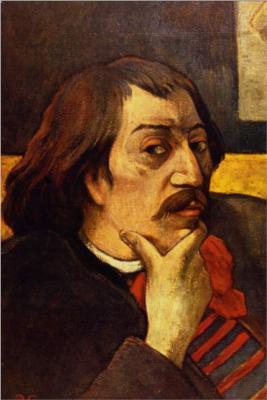
Gauguin was a stockbroker for eleven years. A successful one. He married a Danish woman named Mette, had five children, collected Impressionist paintings, and took art lessons on the side. Then the French[7] stock market crashed in January 1882[7], and his career evaporated. He tried to continue in finance for another year before giving it up entirely to paint. His family moved to Copenhagen. He failed as a tarpaulin salesman. In 1885, Mette's family asked him to leave. He went back to Paris, taking one son. He sent money sporadically and saw the rest of his family only a handful of times over the next eighteen years.
Biography
He was born in 1848[7] in Paris, the year of the revolution. His maternal grandmother was Flora Tristan, a proto-socialist feminist of Peruvian-French[7] descent. When he was two, the family sailed for Peru. His father died of a ruptured aneurysm during the voyage. Gauguin spent his first six years in Lima with wealthy relatives. The colours and light of that early childhood never quite left him.
In late October 1888[7], he arrived in Arles at Vincent van Gogh's insistent invitation. The cohabitation lasted sixty-three days. They argued constantly about art. On 23 December, after a particularly bad quarrel, Van Gogh severed part of his own ear. (An alternative theory, based on contemporary police records, suggests Gauguin may have done it with a fencing sword and both men agreed on the self-mutilation story. This remains disputed.) Gauguin left immediately. They never met again, though they continued to write to each other.
He sailed for Tahiti in 1891[7], expecting an untouched paradise. He found a French[7] colonial territory. The world he sought had been largely destroyed by colonisation. He painted it anyway, building a vision of Polynesian life that was part observation, part invention. In 1897, destitute and ill, he painted Where Do We Come From? What Are We? Where Are We Going?, his largest canvas, and then attempted suicide with arsenic. He survived. He moved to the Marquesas Islands in 1901, took the side of indigenous people against French administrators, was charged with libelling the governor, and died in 1903[7] at fifty-four.
Timeline
- 1848Born on 7 June in Paris during revolutionary upheaval. His mother was the daughter of socialist activist Flora Tristan.
- 1874At 26, began painting while working as a stockbroker in Paris, meeting Pissarro and exhibiting with the Impressionists.
- 1886At 38, moved to Pont-Aven in Brittany, becoming the central figure of an experimental colony rejecting Impressionist naturalism.
- 1888At 40, spent nine turbulent weeks with Van Gogh at the Yellow House in Arles.
- 1891At 43, left France for Tahiti, seeking a life free from European convention.
- 1903Died on 8 May aged 54 on Hiva Oa in the Marquesas Islands, impoverished and in poor health.
Notable Works
Tap to view larger.
Where to See Paul Gauguin
18 museums worldwide.
-
 336 works
National Gallery of Art
Washington D.C., United States
Mon–Sat 10:00–17:00, Sun 11:00–18:00 · Free
-
-
 19 works
Hermitage Museum
Saint Petersburg, Russia
Tue, Thu, Sat–Sun 10:30–18:00; Wed, Fri 10:30–21:00; closed Mon · 500 RUB adults (Russian residents), 1000 RUB international
-
10 works
Cleveland Museum of Art
Cleveland, United States
Tue–Sun 10:00–17:00, closed Mondays · Free
-
10 works
Metropolitan Museum of Art
New York City, United States
Sun–Tue, Thu 10:00–17:00; Fri–Sat 10:00–21:00; closed Wed · Adults $30, students $17 (pay-what-you-wish for NY residents)
-
 10 works
Thyssen-Bornemisza Museum
Madrid, Spain
Mon 12:00–16:00, Tue–Fri 10:00–19:00 (summer 10:00–21:00), Sat 10:00–23:00, Sun 10:00–19:00 · 14€ adults


Next stop
Post-Impressionism →
Explore the artists and ideas of Post-Impressionism.
Paul Gauguin prints
Hand-finished archival prints from Paul Gauguin's body of work.
 Blue Barge - Paul Gauguin
From £28.00
Blue Barge - Paul Gauguin
From £28.00
 Still Life with Lemon and Glass - Paul Gauguin
From £37.00
Still Life with Lemon and Glass - Paul Gauguin
From £37.00
 Young Breton Woman - Paul Gauguin
From £28.00
Young Breton Woman - Paul Gauguin
From £28.00
 At the Pond - Paul Gauguin
From £28.00
At the Pond - Paul Gauguin
From £28.00
 Orchard under the Church of Bihorel (Children in the Pasture) - Paul Gauguin
From £28.00
Orchard under the Church of Bihorel (Children in the Pasture) - Paul Gauguin
From £28.00
 Calvaire breton - Paul Gauguin
From £28.00
Calvaire breton - Paul Gauguin
From £28.00
Related Artists


Take Paul Gauguin home.
See all Paul Gauguin prints →Frequently Asked Questions
Did paul gauguin have children?
Paul Gauguin abandoned his wife and children to pursue his artistic dreams.How did paul gauguin die?
Paul Gauguin died in 1903[7] at the age of 55.Paul gauguin most famous?
Paul Gauguin died in poverty in the Marquesas in 1903[7]. Three years later, a large retrospective exhibition of 227 of his paintings and engravings was held in Paris.Was paul gauguin married?
Paul Gauguin married a Danish woman named Mette.What is Paul Gauguin's most famous work?
Paul Gauguin's most famous painting is generally considered to be *Where Do We Come From? What Are We? Where Are We Going?* (1897[7]-98). This large oil-on-canvas work is part of the collection of the Museum of Fine Arts, Boston. Gauguin created the painting in Tahiti, and he thought of it as the summation of his artistic and philosophical ideas. He even intended to commit suicide after its completion. The painting is structured as a frieze, reading from right to left. Gauguin described it as a visual poem, with figures representing the questions posed in the title. A sleeping infant represents the beginning of life; standing figures in the centre represent daily existence; and an old woman nearing death represents the end. The blue idol in the background, according to Gauguin, represents the realm of the afterlife. Gauguin was disappointed by the initial reception of the painting. However, it has since become one of his most recognised and studied works, achieving iconic status.What should I know about Paul Gauguin's prints?
Paul Gauguin produced prints throughout his career, although they are fewer in number than his paintings or sculptures. His printmaking experiments include woodcuts, lithographs, and monotypes. These graphic works often echo themes and imagery found in his paintings, such as Tahitian figures and Pacific island settings. Gauguin's prints are characterised by bold lines and simplified forms. He often employed a technique of leaving areas of the paper untouched, creating a stark contrast between light and dark. This is particularly evident in his woodcuts, where the grain of the wood itself becomes an important element of the composition. One notable set of prints is the Noa Noa series (circa 1893[7]-94). These works were created to accompany his book of the same name, a semi-fictional account of his time in Tahiti. The Noa Noa prints combine woodcut and monotype techniques, resulting in unique impressions with varied colour and texture. These prints helped to disseminate Gauguin's vision of Polynesia to a wider audience. Other important prints include his Bretonneries series, depicting scenes from Brittany.What style or movement did Paul Gauguin belong to?
Paul Gauguin is associated with several styles, including Post-Impressionism[7], Synthetism, and Cloisonnism. He moved away from Impressionism's emphasis on optical realism. Instead, he sought to express subjective feelings and ideas through simplified forms, bold colours, and symbolic imagery. Synthetism, which Gauguin developed with Émile Bernard and others in the late 1880s, stressed the synthesis of observation, memory, and emotion. Artists working in this style aimed to create works that captured the essence of a subject rather than its surface appearance. Cloisonnism, named after the medieval enamelling technique, is characterised by flat planes of colour separated by dark outlines. Gauguin's use of this technique can be seen in works such as "The Yellow Christ" (1889[7]). In this painting, the simplified forms and strong outlines contribute to its spiritual and emotional impact. Gauguin's interest in non-Western art, particularly the art of Brittany and later French[7] Polynesia, also influenced his style. He incorporated elements of these cultures into his work, further distinguishing it from Impressionism and other contemporary movements. His style influenced the development of Expressionism and other 20th-century art movements.What techniques or materials did Paul Gauguin use?
Paul Gauguin's techniques and materials evolved throughout his career. Initially, he used minimally hand-ground colours, which gave a granular texture, unlike the smooth, machine-made pigments available at the time. His palette included cadmium and chrome yellows, yellow ochre, viridian and emerald greens, ultramarine and cobalt blues, cobalt violet, red lakes, vermilion, and white. Gauguin often employed unprimed, coarse fabrics like sackcloth, exploiting their texture to create matt surfaces. He applied thin, opaque paint layers, allowing the fabric to show through. When using primed canvas, he preferred thin, pale layers. He believed absorbent grounds were important, as they gave a sunken appearance to the paint, similar to unprimed cloth. He sometimes added wax to his paint to stiffen it and create a matt finish, a common practice at the time to stabilise the paint and reduce the pigment needed. In warmer climates like Tahiti, wax-filled colours remained malleable. Gauguin applied paint with brushes, sometimes stiff, and occasionally used a palette knife. He outlined contours directly onto the canvas in vermilion and dark ultramarine or Prussian blue paint, building up modelling in flat areas of colour.What was Paul Gauguin known for?
Paul Gauguin (1848[7]-1903[7]) was a French[7] Post-Impressionist artist. He is known for his experimental use of colour and Synthetist style, which departed from Impressionism. Early in his career, Gauguin collected works by Impressionists like Camille Pissarro, and he studied with Pissarro. He exhibited with the Impressionists in the 1880s. By the late 1880s, Gauguin grew dissatisfied with Impressionism's focus on optical realism. He sought to express emotional and symbolic ideas through simplified forms, flattened space, and non-naturalistic colour. Gauguin's search for an alternative to European art led him to Brittany, and later to French Polynesia. In 1891[7], he moved to Tahiti, seeking a simpler way of life and new artistic inspiration. There, he created paintings of Tahitian people and culture, such as "Ia Orana Maria" (1891) and "Where Do We Come From? What Are We? Where Are We Going?" (1897-1898[7]). These works often combined elements of Tahitian mythology and Christian symbolism. His work influenced many artists, including Pablo Picasso and Henri Matisse. Although not commercially successful during his lifetime, Gauguin's art gained recognition after his death.When did Paul Gauguin live and work?
Paul Gauguin was born in Paris on 7 June 1848[7]. His family briefly relocated to Peru, but by 1855[7], they had returned to France. He entered the merchant marine as a cabin-boy in 1865, then served in the navy from 1868 to 1871. From 1871 to 1873, he worked as a stockbroker, developing an interest in art, and began painting. Gauguin exhibited at the official Salon in 1876. By 1880, he was exhibiting paintings and sculpture in Impressionist exhibitions. He devoted himself to painting full-time from 1883. In 1887, he travelled to Panama and Martinique. He lived in Pont-Aven (Brittany), and in 1888, he stayed with Vincent van Gogh in Arles. In 1891, Gauguin moved to Tahiti, where he lived from 1891 to 1893, and again from 1895 to 1901. In 1901, he moved to Atuona, on Hiva Oa in the Marquesas Islands, where he died on 8 May 1903[7].Where can I see Paul Gauguin's work?
Paul Gauguin's paintings and prints are held in museum collections around the world. The Musée d’Orsay in Paris has a substantial collection of his paintings, including works from his time in Brittany and Tahiti. The Art Institute of Chicago also holds a number of important paintings, such as "Why Are You Angry?" (1896[7]). Other significant collections are at the National Gallery of Art in Washington, D.C., the Courtauld Gallery in London, and the Ny Carlsberg Glyptotek in Copenhagen. These museums offer a range of Gauguin's output, from early Impressionist-influenced works to his later Synthetist style. Prints and drawings by Gauguin are less frequently on display than his paintings, due to their sensitivity to light. However, major print rooms such as the British Museum and the Bibliothèque Nationale de France hold significant collections. These can often be viewed by appointment, or during special exhibitions. Catalogues raisonnés are available; these document the locations of known works.Where did paul gauguin live?
Paul Gauguin lived in Lima, Peru as a baby, before returning to Paris when he was seven years old. Later in life, he lived in Copenhagen, Brittany, and Tahiti, among other places.
Sources
Editorial draws on the following primary and tertiary references for Paul Gauguin.
- [1] museum Brooklyn Museum Used for: museum holdings.
- [2] museum Toledo Museum of Art Used for: museum holdings.
- [3] museum Buffalo AKG Art Museum Used for: museum holdings.
- [4] museum Hungarian National Gallery Used for: museum holdings.
- [5] museum Musée des Beaux-Arts d'Orléans Used for: museum holdings.
- [6] museum Galleria d'arte moderna di Milano Used for: museum holdings.
- [7] wikipedia Wikipedia: Paul Gauguin Used for: biography, birth dates, death dates, identifiers, movement attribution, nationality.
- [8] book Susie Hodge, Art Used for: biography.
- [9] book Susie Hodge, Art: Everything You Need to Know About the Greatest Artists and Their Work Used for: biography.
- [10] book Susie Hodge, Artistic Circles Used for: biography.
- [11] book Vincent van Gogh, Delphi Complete Works of Vincent Van Gogh (Illustrated) Used for: biography.
- [12] book Susie Hodge, I Know an Artist Used for: biography, museum holdings.
- [13] book Susie Hodge, I Know an Artist: The Inspiring Connections Between the World's Greatest Artists Used for: biography, museum holdings.
- [14] book Masterpieces of western art : a history of art in 900 individual studies from the Gothic to the present day Used for: biography.
- [15] book Vincent van Gogh, Masters of Art - Vincent van Gogh Used for: biography.
- [16] book Nathalia Brodskaya, Post-Impressionism Used for: biography.
- [17] book Post-impressionism : cross-currents in European painting Used for: biography.
- [18] book Post-impressionism : cross-currents in European painting Used for: biography.
- [19] book Perry, Gill, Frascina, Francis, Harrison, Dr. Charles, Primitivism, Cubism, Abstraction_ The Early Twentieth Century_ Book 2 (Open University_ Modern Art - Practices & Debates) Used for: biography.
- [20] book VINCENT VAN GOGH, Works of Vincent van Gogh (Masters of Art) Used for: biography.
Editorial overseen by Solis Prints. Sources verified 2026-10-12. Click a source for details, or hover over [N] in the page above to preview.
Editorial standardsMethodologyCorrectionsAI disclosureAbout the editorial team