



Alexandre-Jacques Chantron
- portrait
To train under William-Adolphe Bouguereau in 1870s Paris was to learn one of the most technically exacting approaches to the figure then practised in Europe. Alexandre-Jacques Chantron absorbed that education thoroughly, building a Salon career on carefully rendered portraits and nude studies that followed the academic tradition with professional competence.
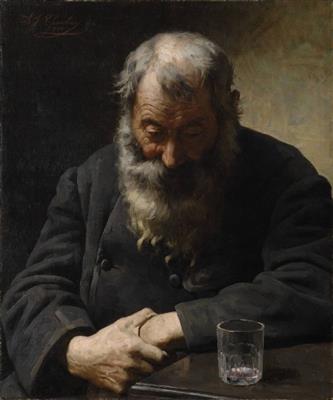
Biography
Born in Nantes in 1842[1], Chantron studied under three painters of considerable standing: François-Édouard Picot, Tony Robert-Fleury, and Bouguereau himself. He entered the Paris Salon in 1877[1] with a religious composition and continued to exhibit with steady regularity across the following decades. Alongside his painting practice, he worked with early photographic techniques, an interest common among academic painters of his generation who saw the medium as a compositional resource rather than a rival art form.
His Salon trajectory followed the measured arc of a reliable academic: an honourable mention in 1893[1], a third-class medal in 1899, and a second-class medal in 1902 for Feuilles Mortes. His 1895 entry Fleurs de printemps and the society portrait[1] known as Preparing for the Ball, or The Pink Dress, show his range across subject matter, though it was his figural work in the Bouguereau manner that remained most characteristic. He returned to Nantes, where he died in 1918[1].
Timeline
- 1842Born in Nantes, France
- 1870Studied under William-Adolphe Bouguereau in Paris
- 1877Entered the Paris Salon with a religious composition
- 1893Received an honourable mention at the Salon
- 1895Exhibited 'Fleurs de printemps' at the Salon
- 1899Awarded a third-class medal at the Salon
- 1902Awarded a second-class medal for 'Feuilles Mortes'
- 1918Died in Nantes, France
Notable Works
Tap to view larger.
Where to See Alexandre-Jacques Chantron
1 museum worldwide.
-
1 works
Nottingham Museums
Nottingham, United Kingdom
Next stop
Browse the movements →
Every movement in the collection, from the Renaissance to Pop art.
Related Artists



Frequently Asked Questions
What should I know about Alexandre-Jacques Chantron's prints?
Alexandre-Jacques Chantron was an 18th-century French[1] draughtsman and engraver. He is best known for printmaking. Prints experienced an efflorescence during Chantron's lifetime. They were a popular medium; the processes of production and publication were well established. Printmaking had become a recognised artistic category, but it was often seen as lower in status than painting. Chantron's prints include ornament and design, such as his series of three prints of a rococo candlestick. These asymmetrical designs were part of a larger set of 50 prints after Meissonnier, published around 1734. A similar candlestick design was used for the Meissen 'Swan Service' around 1739. Chantron's work also includes title pages for collected volumes.What techniques or materials did Alexandre-Jacques Chantron use?
Information regarding Alexandre-Jacques Chantron's specific artistic techniques is scarce. However, we can infer some practices from the context of French[1] painting during his era. Seventeenth- and eighteenth-century French painters employed techniques such as *dhrempe* (water-based media like glue or tempera), fresco, miniature work, and oil painting. Oil painting was considered relatively new at the time, and preparing the medium was a challenge. Recipes suggested nut oil mixed with lead white, thickened by sunlight. To dry a lead white or *grisaille* layer, painters mixed the white pigment with oil of turpentine. Canvas preparation involved stretching the material, smoothing it with pumice, sizing it with glue, and applying a double ground. The first ground was coloured with raw umber and red brown, spread with a knife. The second used lead white with a touch of carbon black to create a grey. By the early nineteenth century, the painting process involved outlining the composition on prepared canvas and indicating the modelling, often with a reddish-brown "sauce". Local colour, light, and shade were then applied.What was Alexandre-Jacques Chantron known for?
Alexandre-Jacques Chantron was a French[1] artist working during a period when the Academy influenced French art. During the early 1800s, the Neoclassic style was reaching its peak in France, driven by artists who followed Jacques-Louis David. Jean-Auguste-Dominique Ingres, a student of David, became the most well-known of these artists. Jean-Baptiste-Siméon Chardin, born in Paris, is best known for his small-scale paintings. These works often depicted domestic interiors and aimed to instruct viewers in emerging bourgeois values. He was admitted to the academy in 1728, where he initially hoped to become a history painter. However, he gained recognition as a genre painter, a category considered less prestigious within the academic hierarchy. Chardin's style differed from other artists of his time, as he did not travel to Rome and cannot be easily classified as either Rococo or Neoclassical. Instead, his works drew inspiration from Dutch Baroque painting.When did Alexandre-Jacques Chantron live and work?
Alexandre-Jacques Chantron was active as an artist in France during the latter half of the 19th century. The 1870s saw much activity in the French[1] art world. The early part of the decade was marked by the Franco-Prussian War (1870[1]-1871[1]) and the revolt in Paris, which led to the establishment of the Third Republic. The first successful colour photographs also appeared at this time. The first Impressionist group show took place in Paris in 1874. Impressionist dinners were instituted in 1885. The eighth and last Impressionist group show was in 1886. These years also saw the deaths of a number of significant figures: Jean-François Millet in 1875, Gustave Courbet in 1877, and Edouard Manet in 1883.Where can I see Alexandre-Jacques Chantron's work?
Alexandre-Jacques Chantron's work can be viewed in a number of galleries and museums. Several are located in Paris, including the Musée du Louvre, Musée d’Orsay, Musée du Petit Palais, Musée des Arts Decoratifs, and Musée Gustave Moreau. Other French[1] museums include the Musée des Beaux-Arts in Nantes, Musée des Beaux-Arts in Rouen, Musée des Beaux-Arts in Lille, Musée des Beaux-Arts in Nancy, Musée des Beaux-Arts Jules Cheret in Nice, Musée Matisse in Nice, and Musée des Beaux-Arts in Dijon. You can also find his work at the Musée des Beaux-Arts in Reims, Musée des Beaux-Arts in Rennes, Musée Crozatier in Le Puy, Musée des Augustins in Toulouse, Musée d’Art et d’lndustrie in Saint Etienne, and Musée de l’Annonciade in Saint Tropez. Outside France, Chantron's art can be seen at the Musées Royaux des Beaux-Arts de Belgique in Brussels.Where was Alexandre-Jacques Chantron from?
Alexandre-Jacques Chantron was French[1]. Jean-Baptiste-Siméon Chardin, born in Paris to a royal cabinetmaker, also spent his career there, rarely leaving the city. Similarly, Jean Courtonne was the architect of a number of townhouses in Paris during the second and third decades of the 18th century. Nicolas and Guillaume Coustou, sculptors, were from Lyon. They moved to Paris to train with their uncle, Antoine Coysevox, a sculptor at the court of Louis XIV. Charles Le Brun, a French painter, architect, and theorist, was a pupil of Simon Vouet and François Perrier in Paris. He later went to Rome to study with Nicolas Poussin. Antoine Coypel was raised in Rome, where his father was the director of the Académie de France. He returned to France by 1676.Who influenced Alexandre-Jacques Chantron?
Alexandre-Jacques Chantron was influenced by a number of artists and movements. Jean-Baptiste-Siméon Chardin, known for his paintings of domestic interiors, was an important influence. Unlike many of his contemporaries, Chardin did not travel to Rome, and he cannot be categorised as either Rococo or Neoclassical. Instead, Chardin drew inspiration from Dutch Baroque painting, using a more informal style, building his pictures with blocks of solid, grainy paint and a restricted palette. Antoine Coypel, who was brought up in Rome, also had an impact. He was part of a generation of artists working in a transitional style, adhering to aspects of 17th-century French[1] Classicism, while exploring colour. His decorative schemes demonstrate the extent to which Coypel was influenced by the illusionism of the Italian Baroque. Coypel experimented with the trois crayons technique, which is often associated with Rococo artists.What was Alexandre-Jacques Chantron's art style?
Alexandre-Jacques Chantron's art style followed the academic tradition. His figural work was in the manner of Bouguereau.How did Alexandre-Jacques Chantron die?
Alexandre-Jacques Chantron died in 1918[1] at the age of 76.
Sources
Editorial draws on the following primary and tertiary references for Alexandre-Jacques Chantron.
- [1] wikipedia Wikipedia: Alexandre-Jacques Chantron Used for: biography, birth dates, death dates, identifiers, movement attribution, nationality.
- [2] book Masterpieces of western art : a history of art in 900 individual studies from the Gothic to the present day Used for: biography.
- [3] book Post-impressionism : cross-currents in European painting Used for: biography.
- [4] book Post-impressionism : cross-currents in European painting Used for: biography.
Editorial overseen by Solis Prints. Sources verified 2026-09-30. Click a source for details, or hover over [N] in the page above to preview.
Editorial standardsMethodologyCorrectionsAI disclosureAbout the editorial team